






Hsinchu, Taiwan |July 20, 2026
Taiwan Semiconductor Manufacturing Co. has just reported its fifth straight record quarter. Net income rose 77.4% compared to last year. Revenue reached $40.2 billion, hitting the high end of its guidance. Still, the stock dropped.
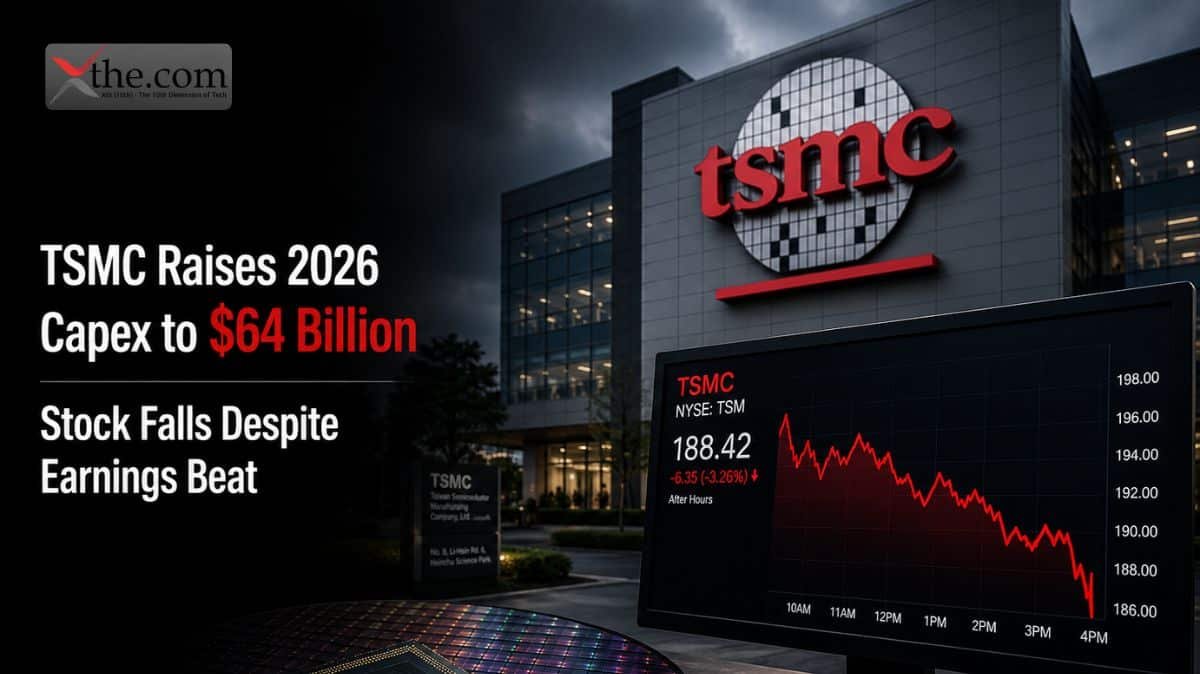
This contradiction is at the heart of the TSMC capex increase 2026 story, and it is worth understanding its own terms rather than as a footnote to another blockbuster print. On July 16, TSMC’s leaders told investors they would spend far more than expected to keep up with demand for artificial intelligence, which CEO C.C. Wei called “stronger and stronger.” Instead of cheering, the market responded by selling the stock.
TSMC Q2 2026 Results: A Beat by Almost Every Measure
Let’s look at the numbers first, since they are clear. TSMC’s Q2 2026 revenue was $40.2 billion, up 36% from a year ago, and its gross margin grew to 67.7%. Net profit was NT$706.56 billion, or about $22 billion, a 77.4% increase from the same quarter last year. Earnings per share were much higher than analysts expected.
High-performance computing, which includes TSMC’s AI accelerator and GPU business, grew 20% from the previous quarter and now makes up two-thirds of total wafer revenue. Smartphone chip sales fell 4% as demand for consumer electronics remains weak, but automotive orders rose 15%, showing that the industrial side is bouncing back even as phone sales lag. For the third quarter, TSMC expects revenue between $44.6 billion and $45.8 billion, a 12% rise from the previous quarter. The company also increased its full-year revenue growth forecast to just over 40% in U.S. dollars, up from about 30% last quarter.
These results do not suggest a company in trouble. Instead, they show a business struggling to build capacity quickly enough.
The Capex Number That Shocked Wall Street
This capacity challenge is why TSMC’s 2026 capex increase is more significant than the earnings beat. TSMC increased its full-year capital spending forecast to between $60 billion and $64 billion, a big jump from the $52 billion to $56 billion it had set just one quarter prior. This is the third upward revision to TSMC 2026 capex guidance this year. CFO Wendell Huang said 70% to 80% of the budget will go to advanced process nodes, with another 10% to 20% set aside for advanced packaging, testing, and mask making.
Put plainly, this is a chipmaker spending guidance raised to a level that now exceeds what TSMC spent across the previous three years combined. Wei was direct about the trajectory during the earnings call in Taipei: the company had previously told investors that capex over the next three years would be significantly higher than over the prior three years. Now, he said, spending over that same window will run even more significantly above it. That is not incremental guidance. It is a structural reset of how much capital the world’s dominant chipmaker believes it needs to deploy.
Why the Number Matters More Than the Beat
Here is why TSMC stock fell on earnings beat headlines despite the strong quarter: investors do not just price current profitability. They price the return on every dollar a company commits going forward, and a capex figure this large forces a recalculation of near-term free cash flow. TSMC’s own Q2 free cash flow came in at NT$287.36 billion, healthy on its own, but now measured against a spending bill that dwarfs anything in the company’s history. When a business this large tells the market it is accelerating an already aggressive build-out, some investors read conviction. Others see risk that AI infrastructure spending is outpacing proven, durable returns. TSMC shares slipped roughly 2% on the print, even as the underlying quarter beat expectations across nearly every line item.
This is the essential tension behind TSMC earnings beat stock falls coverage this week: strong current results and an aggressive forward spending plan are, in the eyes of many investors, two different signals pulling in opposite directions. One says the business is performing. The other says the business is betting an enormous sum that demand will hold up for years.
The Arizona Announcement
The TSMC Arizona investment is the clearest expression of that bet. Alongside its capex guidance, TSMC disclosed an additional TSMC $100 billion Arizona expansion, bringing its total U.S. investment to $265 billion. This new funding will pay for at least four more factories making chips at the 2-nanometer node and below, plus more advanced packaging capacity. This confirms a plan that had been rumored in the market since February.
Wei said the expansion intends to meet “very strong multi-year demand” from top U.S. customers and that TSMC is moving “as fast as possible.” However, the company did not give a firm construction timeline, saying the pace will depend on real market demand instead of a set schedule. At the same time, TSMC is building 13 new advanced packaging facilities in Taiwan, showing that the main bottleneck for AI chip supply is now packaging, not wafer production.
TSMC’s next-generation process node, A14, is set for risk production in 2027 and full production in 2028. The company says it will be 15% faster than its current 2-nanometer process at the same power, or use 30% less power at the same speed, with over 20% more logic density. This roadmap is exactly the kind of technical advantage TSMC wants to protect with its investments.
Reading the Disconnect
Executives and supply chain planners following this story should keep two questions separate. First, is TSMC’s business healthy? By all standard measures like margin, revenue growth, order backlog, and next-quarter guidance, the answer is clearly yes. Second, does the market reward companies for making big, early investments in AI demand that has not yet been tested through a downturn? That answer is much less clear, and Thursday’s stock drop shows investors are still figuring it out.
Suppliers are giving a similar message. ASML raised its 2026 outlook the day before TSMC’s announcement, and Applied Materials’ CEO told reporters that the industry will need to keep expanding capacity for years. Wei also shared his confidence, predicting strong demand through “probably 2029, 2030,” though he admitted there could be some dips along the way.
What Comes Next
The real test in the near future will not be TSMC’s next earnings report. It will be whether large customers actually turn their AI infrastructure plans into real, working data centers as quickly as TSMC expects. If the gap between announced demand and installed capacity closes as planned, this week’s stock drop will probably look like a short-lived moment of investor prudence during a bigger expansion. But if the gap grows, the $265 billion committed to Arizona could come under much closer scrutiny.
Source: TSMC raises capex and revenue forecast, highlighting growing AI chip demand








