





Houston, Texas | July 16, 2026
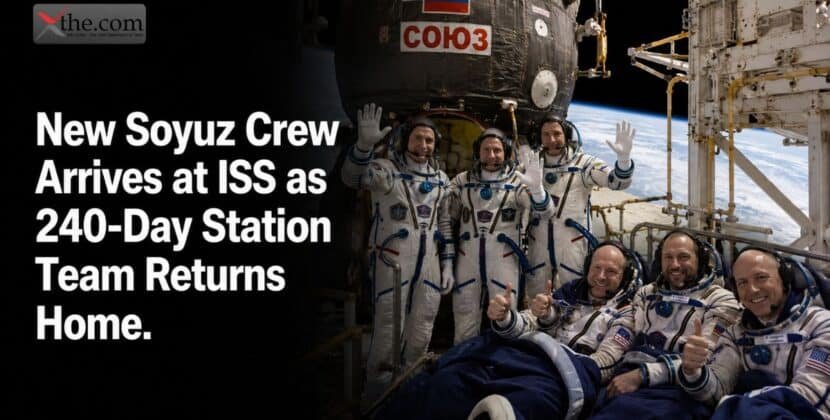
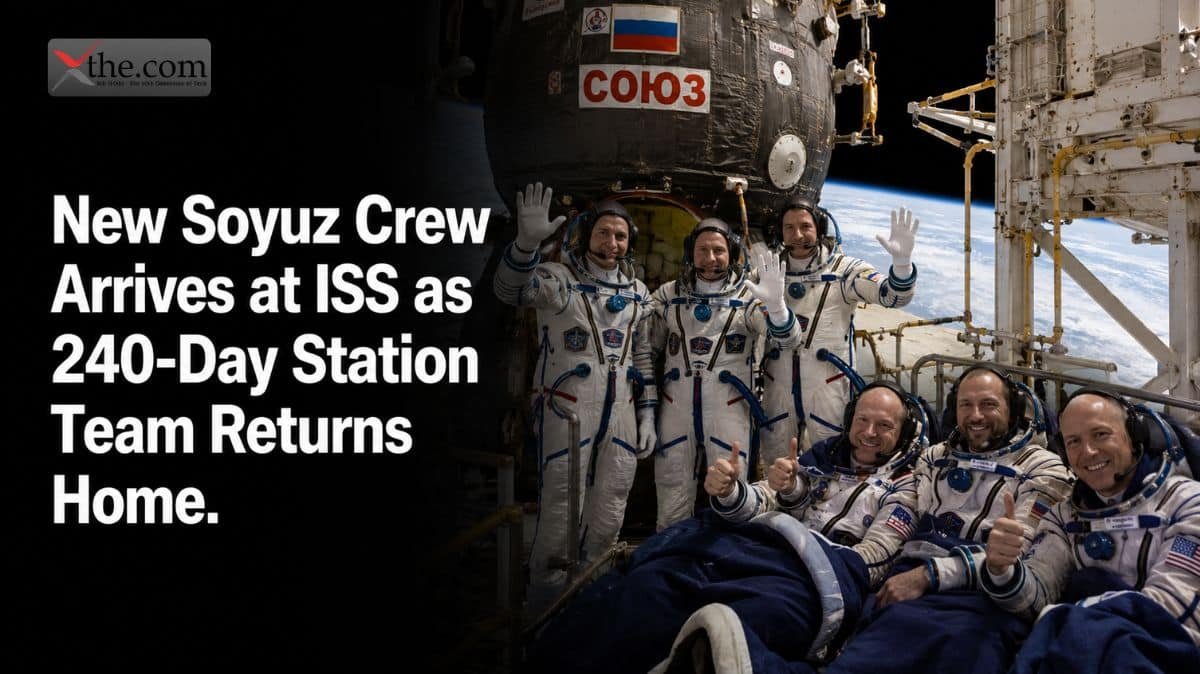
Three seats became available at the International Space Station this week, and three new crew members arrived within hours to fill them. This quick exchange is the essence of a Soyuz handover, and it happened again on Tuesday. The Soyuz crew’s ISS 2026 rotation brought a new team to the station just as their predecessors prepared to return home after eight months in space.
The new ISS crew arrives in July 2026 with NASA astronaut Anil Menon and Roscosmos cosmonauts Pyotr Dubrov and Anna Kikina. They launched aboard Soyuz MS-29 from the Baikonur Cosmodrome in Kazakhstan at 10:47 a.m. EDT. The spacecraft docked with the station’s Prichal module about three hours later, at 1:52 p.m. EDT, after a two-orbit journey. Dubrov is the mission commander, making his second spaceflight, as is Kikina, while Menon is on his first trip to space. The three will spend about eight months on the station, with plans to return to Earth in April 2027.
A Crew Handover Built on Overlap, Not Urgency
Spaceflight almost never allows for gaps, and NASA and Roscosmos have spent decades perfecting the process to avoid them. Menon, Dubrov, and Kikina will work alongside the outgoing Soyuz MS-28 crew for about twelve days. This coincidence gives them time to share important knowledge that manuals can’t fully explain, like which valve is tricky, which experiment needs extra care, or which module sounds different than before.
The outgoing crew is the other half of this story, and the reason the 240-day space station crew returns narrative matters as much as the arrival itself. Roscosmos cosmonauts Sergey Kud-Sverchkov and Sergey Mikayev, along with NASA astronaut Chris Williams, launched on November 27, 2025, and are set to undock from the station’s Rassvet module on July 26. Their stay will be about 241 days, close enough to the round figure to earn the label. This is the new Soyuz crew replaces 240-day ISS station dynamic in practice: one crew’s arrival is timed almost precisely to another’s departure, a rhythm the two space organizations have maintained with few interruptions since the station’s early days.
What Eight Months in Orbit Does to a Body
The physical effects of long-term spaceflight are tough, even if they don’t make headlines. Bones lose about 1% to 1.5% of their density each month in microgravity unless astronauts work hard to prevent it. Muscles weaken, and the sense of balance, adjusted to months without gravity, has to adapt again. After landing in Kazakhstan, Kud-Sverchkov, Mikayev, and Williams will begin a rehabilitation program lasting several weeks. This includes working with physical therapists, retraining their balance, and slowly getting used to standing up again. It may not be as dramatic as a launch but helping the body adjust back to life on Earth is a key part of spaceflight.
The Station Itself Is on Borrowed Time
This International Space Station crew rotation in July 2026 arrives against a background that gives every mission now a quiet undertone of conclusiveness. NASA has committed to operating the ISS through 2030, after which a special U.S. Deorbit Vehicle will guide the 450-ton station into a controlled descent over a remote part of the Pacific Ocean. According to NASA’s schedule, that leaves about four more years of crewed missions. This timeline affects everything, from which research gets priority to the push for commercial replacement programs by companies like Axiom Space, Blue Origin, and Vast.
Even with these changes ahead, Menon, Dubrov, and Kikina have a busy mission. They will conduct many scientific experiments, perform spacewalks, and handle routine maintenance on systems that have run nonstop for 25 years. Menon will focus on research into making semiconductor crystals in space, which could lead to better computer and medical device parts. It’s a unique connection between science in orbit and the technology industry back on Earth.
The crew’s research also shows a bigger change happening on the station: there is more use of automated and AI tools to spot problems in medical and system checks before people need to step in. NASA has tested this kind of decision-support software over several missions, believing that with only a few years left, it’s better to catch faults early than to add more crew to fix them later. This is just one part of a larger shift, the same one pushing companies like Axiom Space, Blue Origin, and Vast to develop their own crewed stations. These small changes frequently become more important in hindsight than they seem at first.
The Commercial Crew Backdrop
The Soyuz system is still one of the two vehicles that keep the ISS staffed. SpaceX’s Dragon capsule takes turns with Soyuz for crew transport under a barter agreement between NASA and Roscosmos, which has been extended through at least 2027. This deal makes sure astronauts from both countries fly on each other’s spacecraft, providing a backup in case one vehicle is grounded. This ISS NASA Russian crew return July 2026 cycle is a sign that, geopolitical tension aside, the operational partnership between the two agencies has proven durable in ways few other U.S.-Russia collaborations possess.
The Soyuz crew’s return to Earth on July 26 will follow a familiar routine: undocking from Rassvet, a brief free flight, and a parachute landing on the Kazakh steppe about three and a half hours later. This process is so well-practiced that it rarely makes the news—except when, as usual, everything goes smoothly.
What Comes Next
The New Soyuz crew arrives at the ISS; replaces three cosmonauts; 240-day stay; July 2026 milestone is one entry in a rotation calendar that will repeat roughly twice a year until the station’s final crew closes the hatch for good. The International Space Station crew rotation for the July 2026 240-day mission ends the cycle now underway and is unremarkable in the way that well-run infrastructure is unremarkable — which is, in its own way, the achievement worth noting. Twenty-five years of continuous human presence in orbit did not happen by accident. It happened because crews like this one keep showing up, keep handing off the work, and keep coming home in one piece. The station may now have a retirement date. The handoffs that have kept it alive for this long do not appear to be slowing down before it arrives.
Source: NASA astronaut and 2 cosmonauts blast off for an 8-month stay in space