






New York, New York | July 16, 2026
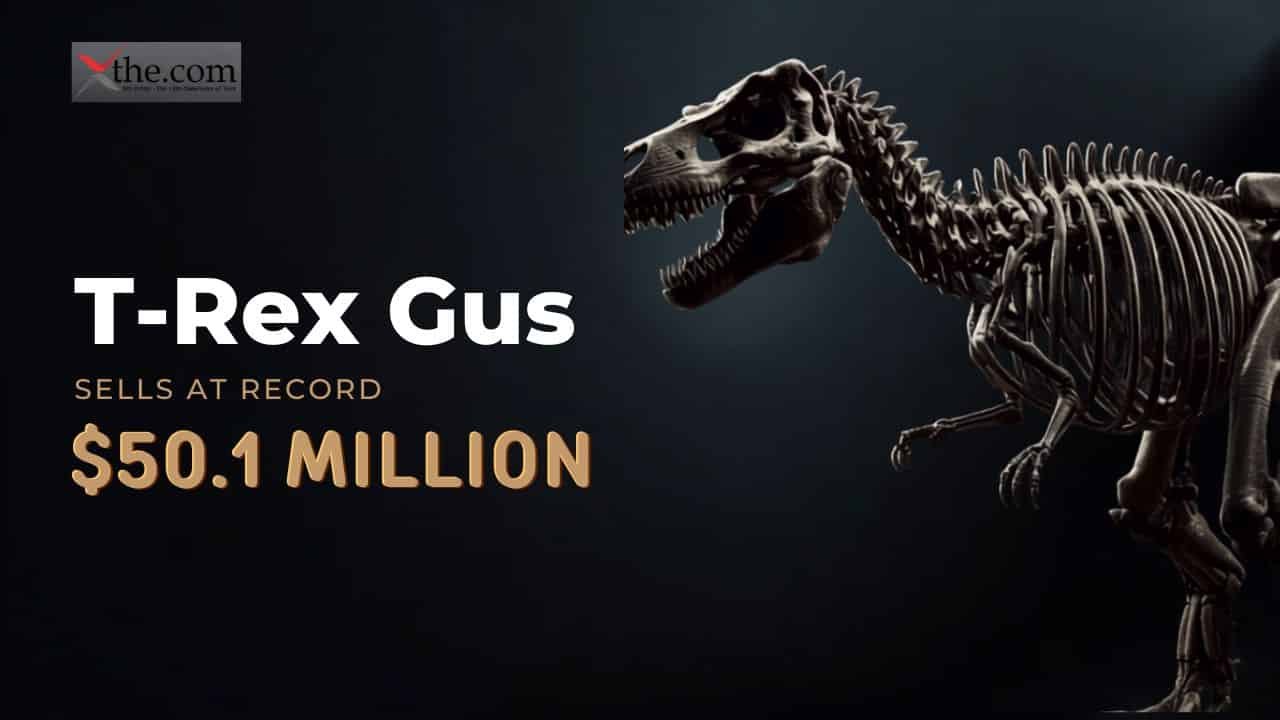
Seven bidders competed for just ten minutes, ending with a single phone call that saw a 67-million-year-old predator sell for more than most Manhattan penthouses. On Tuesday, T-Rex Gus sold for $50.1 million, becoming the new milestone in a market that barely existed one generation ago: dinosaur bones as investment-grade collectibles.
The sale at Sotheby’s Breuer Building in New York set a Sotheby’s dinosaur record for the auction house and confirmed Gus as the largest T-Rex sold in 2026, capping a bidding war that started at $19 million and quickly surpassed the pre-sale estimate of $20 million to $30 million. At one point, auctioneer Phyllis Kao encouraged the room to “try a bigger bite.” The bidders responded.
A Skeleton Built for Superlatives
Gus is not the most complete Tyrannosaurus rex ever found; that title still goes to Sue, the 90%complete specimen at Chicago’s Field Museum since 1997. But Gus T-Rex, 38 feet long and 12.5 feet tall, puts the animal firmly among the largest individuals of its species ever mounted for display, with a 54-inch skull that Sotheby’s specialists consider exceptionally well preserved. The skeleton includes 183 cataloged bones, about 61% complete by count and closer to 75%-80% complete by mass when the largest bones are included.
The fossil was discovered in 2021 on a cattle ranch in Harding County, South Dakota’s Hell Creek Formation. It took five years to excavate, prepare, and mount the skeleton on its steel frame. The T. rex was named after Gary “Gus” Licking, the rancher who owned the land and passed away during the excavation. His widow, Dana Licking, kept ownership until the sale. The discovery was made by Theropoda Expeditions, a Texas-based commercial paleontology company that specializes in these high-risk digs.
What makes Gus stand out from most fossil finds is its condition, not just its size. The skeleton includes a wishbone, which is rarely preserved, and both feet are intact—a combination Sotheby’s says is found in only one other known T. rex. Healed fractures on several ribs and bite marks on the skull suggest a life shaped by violence and survival. Collectors are more and more attracted to these kinds of stories as much as the fossils themselves.
How the Record Was Set
The Sotheby’s mystery bidder $50.1M outcome unfolded fast. Bidding started at $19 million and shot past the high estimate in just minutes, with seven parties competing before it came down to an anonymous phone bidder. The hammer dropped at $43 million, but with buyer’s premium and fees, the final price reached $50.1 million, formalizing the T-Rex record auction 2026 will be remembered for.
That figure eclipses the Stan T-Rex previous record $31.8M, set when the skeleton nicknamed Stan sold at Christie’s in 2020. Stan now anchors a T-Rex combat display at the Natural History Museum of Abu Dhabi. Gus’s price also surpasses the roughly $44.6 million paid in 2024 for Apex, a nearly complete Stegosaurus that hedge fund billionaire Ken Griffin bought and later loaned to New York’s American Museum of Natural History. Put plainly, this is the T-Rex Gus $50.1 million record-setting Sotheby’s mystery-bidder July 2026 headline that dinosaur auctions have been building toward for years, and it is now the highest price ever paid for a fossil at auction, dinosaur or otherwise.
Cassandra Hatton, Sotheby’s vice chairman and worldwide head of science and natural history, described the sale as proof of careful stewardship, not just novelty. “Gus is not only an exceptional find, but a specimen that’s been excavated, documented, prepared, and cared for with real excellence,” she said after the auction. “The market responds when great specimens are taken care of in the right way.”
The Scientific Objection
Not everyone at the auction, or watching from afar, was celebrating. The Society of Vertebrate Paleontology, which represents scientists, scholars, and students, has often warned that important fossils sold to private buyers may be lost to research. A skeleton kept in a corporate lobby or private home cannot be CT-scanned by students, sampled for isotope analysis, or compared with new discoveries like a museum specimen can.
The counterargument, which Sotheby’s often cites, is based on past examples. Sue sold $8.3 million in 1997 and ended up at the Field Museum. Apex was bought by a private buyer in 2024 and is now on loan to a major New York institution for four years. Stan, though, was sold to an undisclosed buyer and is now on public display in Abu Dhabi. History shows that trophy fossils frequently return to public view, even if they first go into private hands.
Whether Gus will adhere to that pattern remains to be seen. Auction houses and paleontologists are watching to see whether the new owner will loan the skeleton to a museum, keep it in a private collection, or, as some collectors have done with Stan casts, sell replicas to institutions that cannot afford the original.
Who Might Own a $50 Million Dinosaur?
Sotheby’s has only revealed that the buyer participated by phone and requested anonymity. This lack of information has stimulated speculation. Recent sales indicate a few likely types of buyers: tech billionaires with new wealth, private museums seeking notable pieces, and collectors backed by sovereign wealth funds who treat rare fossils like blue-chip art. Ken Griffin’s purchase of Apex shows that hedge fund money is also in the mix.
Dinosaur fossils have quickly become one of the fastest-growing areas in the collectibles market. Wealthy buyers are looking for past traditional art and investing in rare, impressive fossils that carry prestige. Auction houses have taken note. Sotheby’s natural history department has added more sales, and competitors are searching for similar specimens for future auctions.
For now, Gus sits at the top of a young but rapidly maturing market, representing the largest, most complete T. rex ever sold, surpasses Stan $31.8 million record story that will likely define fossil auctions for the next several years. The next comparable specimen to reach the block will be measured against this sale, and the one after that will be measured against whatever record Gus’s eventual successor sets. If the pattern holds, this will not be the last time a mystery bidder rewrites what a 67-million-year-old predator is worth.
Source: Mystery bidder buys T. rex nicknamed ‘Gus’ for a record $50 million