





Apple’s MacBook Pro Touchscreen Breaks a 10-Year Company Rule
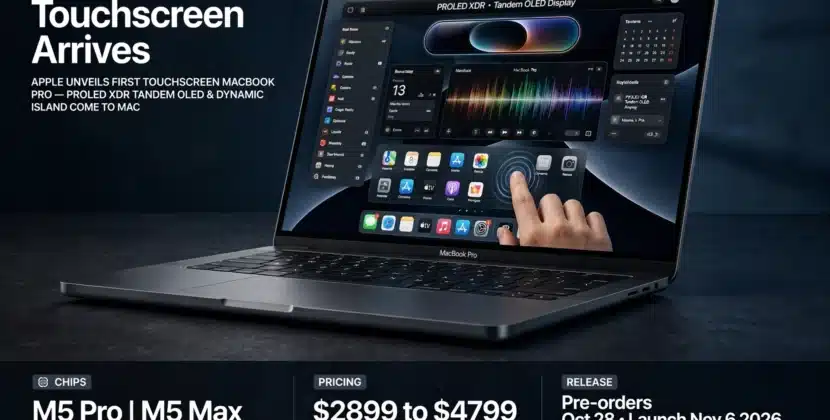
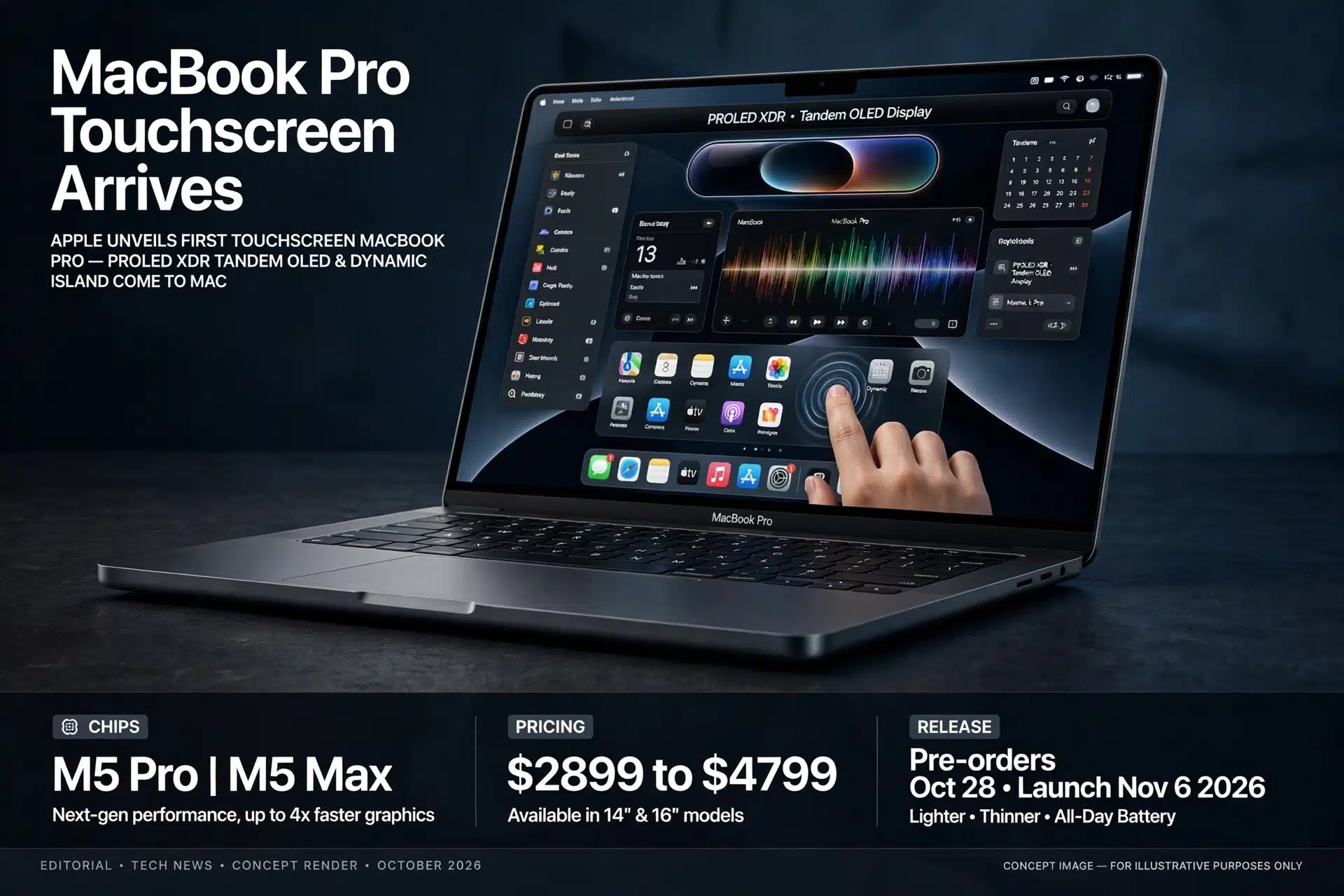
Apple announced the first touchscreen MacBook Pro on October 28, 2026, ending a decade-long stance that touch does not belong on a laptop. The new MacBook Pro touchscreen pairs a tandem-OLED PROLED XDR panel with M5 Pro and M5 Max chips, preorders opened the same day, and the 14-inch model starts at $2,899 with US availability from November 6. Here is what changed, what it costs, and whether US buyers should upgrade before the holidays.
Key Takeaways:
- – Apple unveiled the MacBook Pro with PROLED XDR Display, its first Mac laptop with touch input, at the October 28 Pro and tell event.
- – US pricing starts at $2,899 for the 14-inch and $3,399 for the 16-inch, both with M5 Pro; M5 Max models start at $4,499.
- – A maxed-out 16-inch with 128GB memory, 16TB storage and nano-texture glass reaches $14,549.
- – Preorders opened October 28 and the first units ship Friday, November 6, 2026.
- – The entry 14-inch is $400 above the prior generation, an OLED and touch premium over the M6 models sold alongside it.
What the MacBook Pro touchscreen actually adds
The headline change is a tandem-OLED panel Apple brands PROLED XDR. It delivers up to 2,000 nits of peak brightness in both HDR and standard content, a 10,000,000:1 contrast ratio, and adaptive refresh from 10Hz to 120Hz. Apple removed the notch in favor of a Dynamic Island that houses Spotlight, Live Activities, and Siri. The touch sensor sits inside the panel stack rather than layered on top, which cuts latency and keeps the display thin. A redesigned hinge stabilizes the screen when you tap or drag it.
The catch is macOS itself. Apple has not rebuilt the operating system around touch the way iPadOS is; taps largely map to clicks, and the payoff depends on the app. Creative tools are where it shows: Lightroom sliders, DaVinci Resolve scopes, Blender viewports, and canvas apps like Notion and Canva all benefit from direct manipulation. If your work lives in spreadsheets and terminals, the touch layer is a nice-to-have rather than a reason to upgrade, and hands-on reviews will matter more than the spec sheet before spending this much.
Pricing: what the premium buys
Per MacRumors’ price tables, the 14-inch starts at $2,899 with an M5 Pro, 24GB of memory and 1TB of storage, up from $2,499 for the previous base model. The 16-inch starts at $3,399, up from $2,999. M5 Max configurations begin at $4,499 and $4,799. The ceiling is genuinely high: 128GB of unified memory, a 16TB SSD, and the nano-texture finish push the flagship 16-inch to $14,549, with the storage upgrade alone contributing $7,000. Apple is clearly leaning into the pro segment it named the event after.
Portability improved at the same time. Apple lists the new 14-inch at 3 pounds and the 16-inch at 4 pounds, with the chassis roughly half a millimeter to a full millimeter thinner depending on size. Displays grew slightly to 14.2 and 16.3 inches. The machine keeps three Thunderbolt 5 ports, HDMI, an SDXC slot, MagSafe charging, Wi-Fi 7, Bluetooth 6, a 12MP Center Stage camera, and a six-speaker system Apple says produces 50 percent deeper bass, with up to 24 hours of battery life.
How it compares to the cheaper M6 models
Buyers now face a fork. Apple sells this touchscreen machine alongside the M6 14-inch MacBook Pro and the M6 iMac announced the day before, both of which undercut the OLED line by hundreds of dollars. The M5 Pro and M5 Max chips inside the touchscreen models are last-generation silicon by name, but paired with the new display they target a different buyer: colorists, photographers, and video editors who bill by the accuracy of what they see. For general productivity, coding, and schoolwork, the M6 machines deliver more value per dollar, and that is the honest recommendation for most US households this holiday season.
There is also a storage-economics warning. The 16TB SSD option reflects ongoing memory and NAND pricing pressure across the industry, and paying $7,000 for storage that cloud services or an external drive could replace at a fraction of the cost is hard to defend for most workflows. Buy the storage tier you need today rather than the one you might need in three years.
Why Apple changed its mind about touch
Apple spent roughly fifteen years arguing against laptop touchscreens; Steve Jobs famously called them ergonomically terrible in 2010. The reversal tracks with a broader run of firsts under new CEO John Ternus: the HomeView smart display, the iPhone Duo foldable, and now this. Each moves a product category Apple once defended by tradition. The likely driver is the growing overlap between iPad Pro workflows and Mac workflows, where artists and editors increasingly split time between the two and asked why the Mac could not take direct input.
Hardware context matters too. Tandem OLED allows the bright, thin panel while the in-panel touch sensor avoids the thicker capacitive stacks that made early touch laptops clunky. Competing Windows machines have shipped OLED touch panels for several years, and Apple entering that market with a 120Hz, 2,000-nit panel is both a catch-up and a statement that it intends to lead on image quality rather than arrive late on specs.
What happens next
Shipments begin November 6, about three weeks before Black Friday. Apple almost never discounts brand-new Macs, so expect trade-in credits and gift-card promotions rather than price cuts; if a deal is the priority, watch refurbs of the previous mini-LED models instead. Reviews landing in early November will answer the two open questions that matter: thermals under sustained M5 Max loads in a thinner chassis, and how tolerable macOS click-mapped touch is in daily creative work. If either disappoints, the M6 non-touch line becomes the default holiday recommendation without changing a single accessory purchase.
For US buyers deciding this week, the decision rule is simple: if color-critical visual work pays your bills, the $2,899 entry point is a real tool and the OLED panel justifies the premium. For everyone else, preorder nothing and let the first hands-on reports arrive before the Black Friday window.
Frequently Asked Questions
How much does the touchscreen MacBook Pro cost in the US?
The 14-inch starts at $2,899 and the 16-inch at $3,399, both with M5 Pro, 24GB of memory and 1TB of storage. M5 Max models start at $4,499, and a fully loaded 16-inch reaches $14,549, per MacRumors’ pricing breakdown.
When can US customers get the MacBook Pro touchscreen?
Preorders opened October 28, 2026, and the first units become available Friday, November 6, 2026, in time for the holiday shopping season.
Does macOS really support touch on the MacBook Pro?
Yes, but conservatively. The operating system maps most touches to clicks, so the benefit shows up in touch-friendly creative apps rather than a tablet-style interface. Reviewers’ hands-on reports in early November will show how it feels in practice.
Sources:
- https://www.apple.com/newsroom/2026/10/apple-unveils-groundbreaking-macbook-pro-with-proled-xdr-display/
- https://www.theverge.com/tech/1018096/apple-pro-and-tell-launch-event-news-announcements
- https://www.macrumors.com/2026/10/28/apple-new-macbook-pro/
- https://www.macrumors.com/2026/10/28/new-macbook-pro-maxed-out-cost/