





Microsoft’s $25 Billion Bond Sale Puts AI Debt in the Spotlight
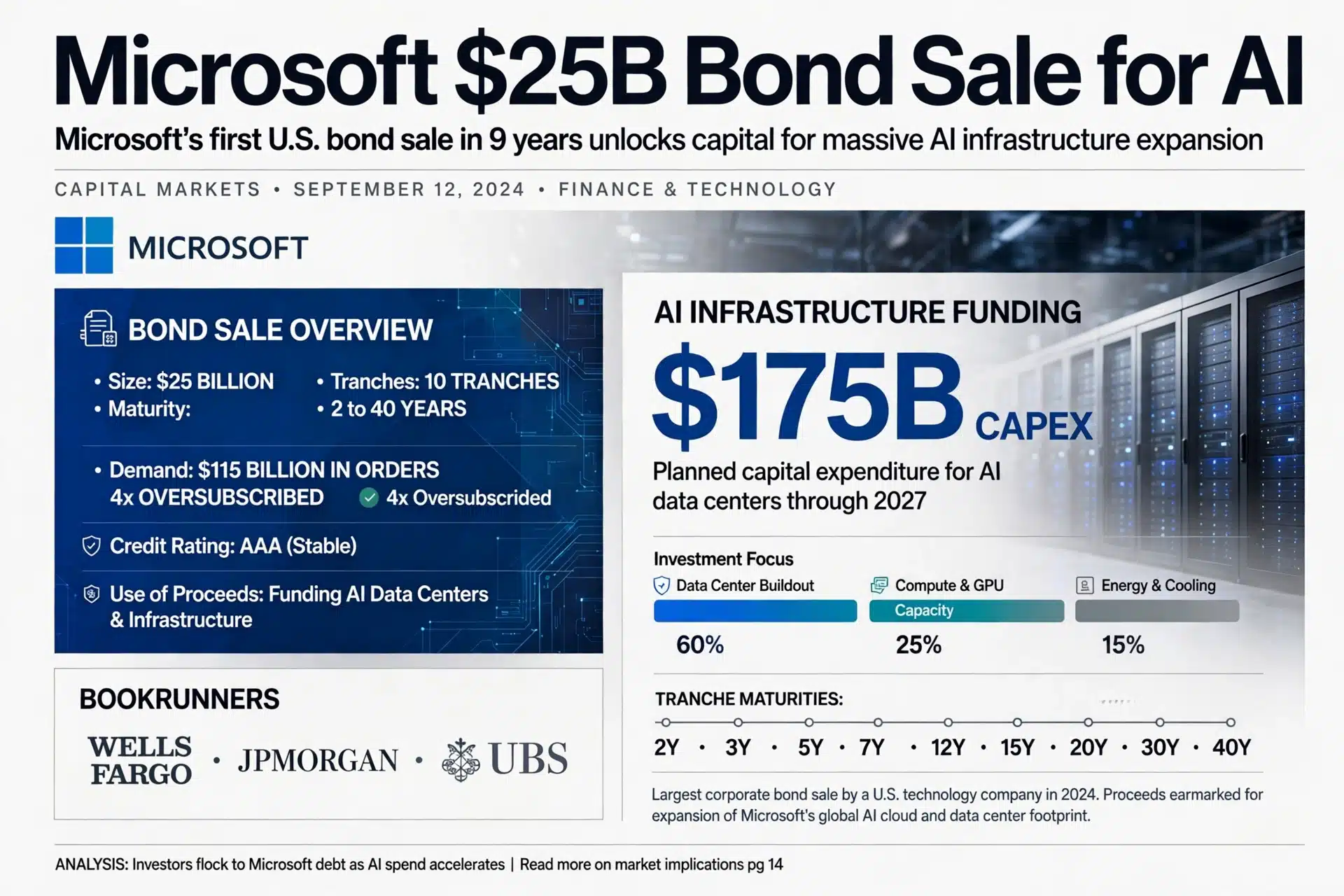
Microsoft launched a $25 billion bond sale on October 29, 2026, its first US investment-grade debt offering in more than nine years, and the Microsoft bond sale is now the clearest test yet of whether credit markets will keep funding the AI buildout. Proceeds feed a capital program headed toward roughly $170 billion in calendar-2026 spending, and the timing raises the bigger question for US readers: when the cash machine behind AI starts borrowing, does everyone else pay more to borrow too?
Key Takeaways:
- – Microsoft priced a $25 billion senior unsecured bond offering on October 29, 2026, its first US investment-grade sale since a $17 billion deal in 2017.
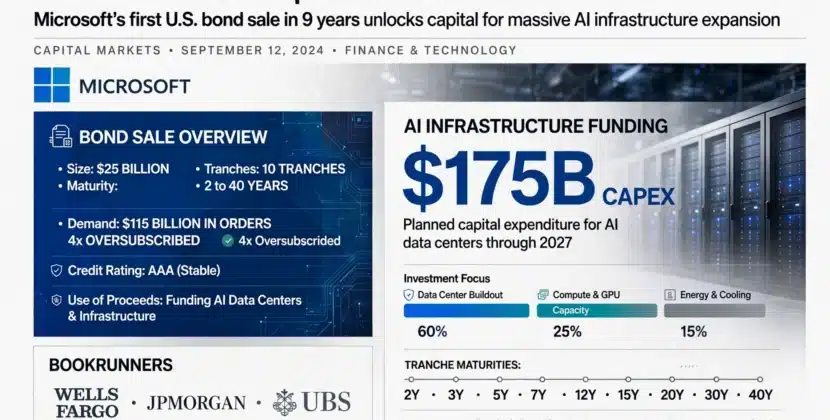
- – The deal splits into as many as 10 tranches with maturities from 2 to 40 years, and the longest tranche is due in 2066.
- – Microsoft is one of only two publicly traded US companies, alongside Johnson & Johnson, rated AAA by both Moody’s and S&P.
- – One day earlier, Microsoft reported fiscal Q1 2027 revenue of $92.3 billion, up 19 percent, and a record quarterly capital bill.
- – Hyperscaler and data-center investment-grade issuance has topped $313 billion in 2026 per Bloomberg data, so this deal sets the pricing benchmark.
What Microsoft is actually issuing
The offering is senior unsecured debt, meaning bondholders stand behind deposits and payroll but ahead of shareholders if things go wrong. Per the preliminary prospectus supplement, the structure includes two floating-rate notes priced off Compounded SOFR plus a spread and eight fixed-rate tranches. Maturities run from two years out to forty, with the 2066 note carrying initial price talk of up to 1.35 percentage points over Treasuries. J.P. Morgan, UBS Investment Bank and Wells Fargo Securities are the joint book-running managers, and the deal is expected to close on November 4, 2026.
A forty-year bond from a software company would have been unthinkable a decade ago. It is normal now because lenders are pricing Microsoft against sovereign-adjacent credits, not tech credits. The stated use of proceeds is general corporate purposes, which may include working capital, capital expenditures, repurchases of capital stock, acquisitions, and repayment of existing debt. In practice, every dollar supports an AI infrastructure pipeline: land, power, chips, and the data centers behind Azure’s reported 48 percent revenue growth.
Why AAA status is the whole story
Only two US public companies carry AAA ratings from both Moody’s and S&P, and Microsoft is one of them. That rating is what lets the company borrow at spreads barely above the US government. It also explains why CFO Amy Hood said on the October 28 earnings call that the company had not yet tapped debt markets and was fortunate to have access at its ratings level. She was signaling that the cheapest funding source in the corporate world had been deliberately saved for the moment capex crossed a threshold the balance sheet no longer wanted to carry alone.
The July 2017 comparison matters. Microsoft raised $17 billion then to fund acquisitions and buybacks during a low-rate era. This sale lands after the fastest rate cycle in decades, with Microsoft’s own 10.2 billion returned to shareholders in the quarter and $35.481 billion of total debt already on the books as of September 30. Borrowing while free cash flow is tightening is a different calculation than borrowing while it is expanding, and bond desks will price that difference into every AI-adjacent issuer that follows.
The earnings context behind the sale
The bond timing was not accidental. Microsoft reported fiscal Q1 2027 results on October 28: revenue of $92.3 billion, up 19 percent; net income of $36.6 billion, up 32 percent; Microsoft Cloud revenue of $63.9 billion, up 30 percent; and Azure growth of 48 percent to $33.17 billion. But capex plus finance leases hit $45.2 billion for the quarter, and free cash flow fell 27 percent to $18.63 billion. Commercial remaining performance obligations jumped 73 percent to $677 billion, which is the demand signal, yet the cash statement shows the bill arriving before revenue does.
That gap is precisely why the debt tap opened. Microsoft is targeting about $170 billion in calendar-year capital expenditures, a number that dwarfs what most US states spend on construction yearly. Free cash flow down 27 percent while capital spending climbs means the company is choosing to smooth that curve with debt rather than cut investment, a bet that AI demand keeps compounding faster than the interest bill.
How the Microsoft bond sale reshapes credit markets
Microsoft is not alone. Alphabet sold $25 billion of bonds on August 6, Oracle unveiled a $10 billion raise on October 28, and Amazon and Meta are regular issuers. Bloomberg data puts hyperscaler and data-center investment-grade issuance above $313 billion for 2026 already. When the strongest borrower in the group prices a forty-year note at roughly 1.35 points over Treasuries, that print becomes the reference every weaker credit gets marked against. Utility companies financing data-center power, municipal issuers, and eventually mortgage borrowers all sit downstream of that reference in a demand-heavy market.
There is also a supply effect. Ten tranches hitting a single week absorbs demand from insurance companies and pension funds that would otherwise spread it across other issuers. Dealers reportedly saw heavy interest in the deal, but heavy supply in a week when technology stocks sold off can widen spreads for mid-tier borrowers. For everyday US readers the transmission is indirect but real: corporate borrowing costs feed into the cost of everything from data-center electricity contracts to office construction, which feeds into household bills and hiring.
What happens next
Watch the final pricing when the deal closes on November 4, 2026. If the 2066 tranche prices tighter than the 1.35-point talk, markets are endorsing the AI capex story at the longest end of the curve. If it prices wider, bond investors are demanding a premium for duration risk on a forty-year bet that AI revenue arrives on schedule. Also watch whether Microsoft returns to the market within the fiscal year: a repeat tap so soon after the first would signal that internal cash generation is falling further behind the buildout. Competitor prints from Oracle’s October 28 raise and any Meta or Amazon issuance later in the quarter will show whether Microsoft’s spreads become the sector’s floor.
The honest caveat is that this is not distress borrowing. Microsoft generates some of the largest profits in corporate history and holds an AAA rating with no immediate maturity wall. The sale is strategy, not survival. But strategy at $25 billion scale still moves markets, and October 29 may be remembered as the week the AI boom formally moved from the equity ledger to the credit ledger.
Frequently Asked Questions
Why is Microsoft selling bonds now?
To fund an AI infrastructure buildout targeted at roughly $170 billion in calendar-2026 capital expenditures after free cash flow fell 27 percent in fiscal Q1 2027, per its October 28 earnings report. Debt lets the company spread that spending across years instead of draining cash reserves.
How big is the Microsoft bond sale?
At least $25 billion in senior unsecured notes across up to 10 tranches maturing between 2 and 40 years, with the longest tranche due 2066. It is Microsoft’s first US investment-grade sale since 2017 and is expected to close November 4, 2026.
Will the Microsoft bond sale raise interest rates for consumers?
Not directly, but heavy issuance from AAA-rated tech companies absorbs investor demand and can lift spreads for other corporate borrowers, which flows into business financing costs and eventually consumer prices. The Federal Reserve’s own rate path matters far more for mortgages and car loans.
Sources:
- https://www.cnbc.com/2026/10/29/microsoft-25-billion-debt-offering.html
- https://qz.com/microsoft-bond-sale-25-billion-ai-spending-102926
- https://finance.yahoo.com/markets/stocks/articles/microsoft-looks-raise-least-25-120029209.html
- https://news.microsoft.com/source/2026/10/28/microsoft-announces-first-quarter-results-2/
- https://www.cnbc.com/2026/10/28/microsoft-msft-q1-earnings-report-2027.html