






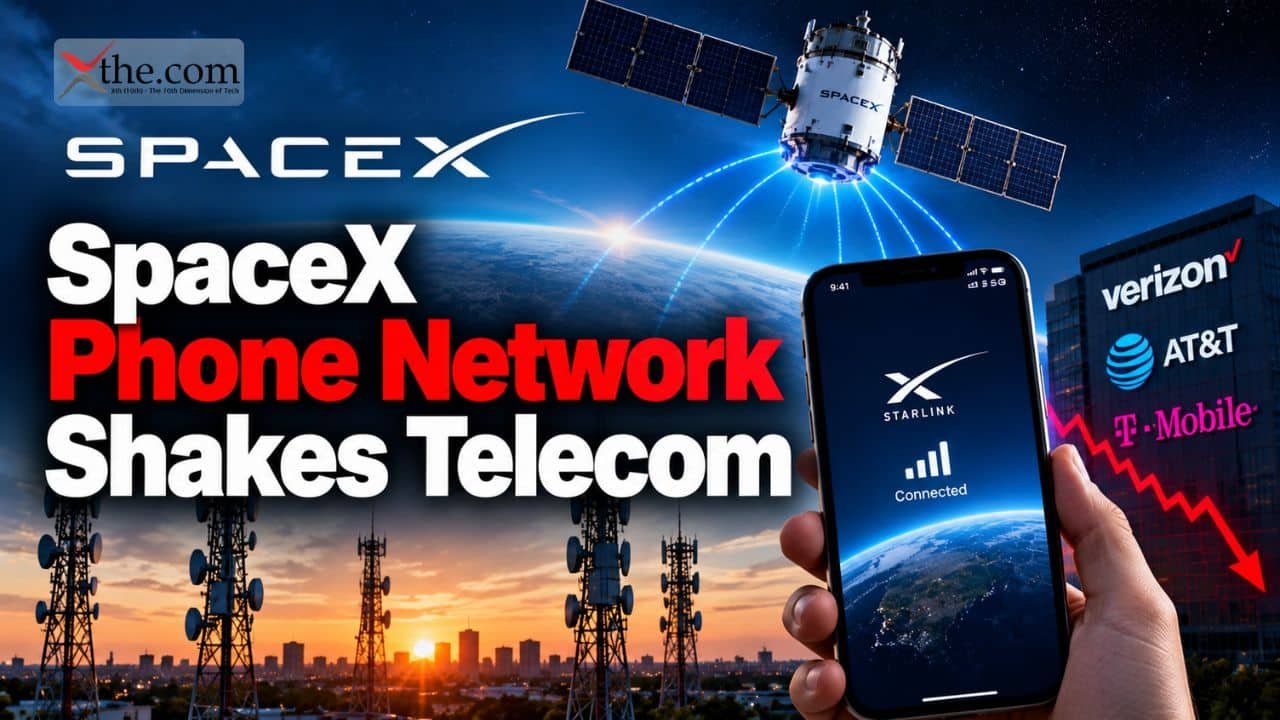
SpaceX Phone Network Plan Sent Carrier Stocks Reeling
SpaceX is negotiating access to at least 80,000 US cell sites as it builds Starlink Mobile into the country’s fourth nationwide phone carrier by 2028, and investors reacted fast: on October 23, 2026, AT&T and T-Mobile shares fell nearly 8 percent after Bloomberg’s report. The carriers’ trade group has already asked the FCC to intervene, with carriers warning the agency’s decisions carry real consequences for consumers. Here is how the SpaceX phone network plan would actually work and what it could mean for US phone bills.
Key Takeaways:
- – Bloomberg reported October 23 that SpaceX is in talks to access at least 80,000 US cell sites; AT&T and T-Mobile each fell nearly 8 percent that day.
- – SpaceX President Gwynne Shotwell said on the October 20 earnings call that new spectrum and FCC approvals pave the way for Starlink Mobile, with service targeted for early 2028.
- – SpaceX bought up to 14 MHz of nationwide 800 MHz spectrum in a deal valued near $8 billion, per the Wall Street Journal.
- – The FCC cleared SpaceX to deploy up to 15,000 next-generation direct-to-phone satellites on October 6.
- – The US has had three national carriers since the Sprint deal closed in 2020; regulators had counted on a fourth that never materialized.
Note: this article covers a competitive and regulatory story and is not investment advice.
How the SpaceX phone network would be built
A fourth carrier does not mean building 80,000 towers from scratch. SpaceX plans to pair satellite connections with ground-based radios, and Shotwell told investors the company will basically leverage the real estate from Starlink installs and other towers, per coverage of the earnings call and Bloomberg’s tower talks report. Tower landlords such as Crown Castle are reportedly in the conversation, and Goldman Sachs analysts estimate a tenant pays roughly $50,000 a year per tower, which would put rent for 80,000 sites near $4 billion annually before equipment. In parallel, satellites fill the coverage gaps that towers cannot reach economically, which is how Starlink already texts ordinary phones for partner carriers.
The spectrum stack is the other half. On October 6 the FCC cleared SpaceX to deploy up to 15,000 next-generation satellites built to connect directly to phones. Days later, SpaceX announced the purchase of up to 14 MHz of paired 800 MHz nationwide spectrum from Grain Management in a deal the Wall Street Journal valued around $8 billion; low-band spectrum like this travels far and penetrates buildings, and SpaceX says most phones already support the band. Both deals still need final FCC approval, and SpaceX separately picked up three licenses in the 1,695-1,710 MHz band on October 21.
Why carriers are mobilizing at the FCC
The carriers’ trade association CTIA filed a letter with the FCC following October 20 meetings, warning that the agency’s buildout decisions have real consequences for consumers, and pushing to keep satellites off bands, 2.5 GHz and 3.45 GHz, that carry much of the carriers’ 5G traffic, per the compiled reporting. A separate FCC proposal would open 482 MHz of spectrum to satellite-to-phone use, with a commission vote set for October 29; CTIA wants roughly 290 MHz of that kept terrestrial and wants carriers to keep approval rights over satellite leases of their spectrum.
The economics explain the alarm. The October 23 report produced a second selloff in October, with T-Mobile sinking 5 percent premarket and AT&T and Verizon falling more than 4 percent, per 24/7 Wall St. and Forbes. Musk told analysts he sees a clear path to several hundred billion dollars a year in connectivity revenue, and Starlink Mobile already counts more than 22 million monthly users worldwide through partner carriers.
What it means for your phone bill
The history cuts both ways. In the four-carrier era, the Bureau of Labor Statistics wireless price index dropped 13 percent from December 2009 to September 2015 while overall consumer prices rose, and T-Mobile’s 2010s price disruption is widely credited with forcing the market’s hand. After the market shrank to three in 2020, researchers split on what happened: Finnish firm Rewheel concluded US prices stopped falling or fell more slowly, while economists Thomas Hazlett and Robert Crandall read the data as consistent with consumer gains. Recent history tilts toward pressure: BLS data show wireless prices rose 5.9 percent in August 2026, the largest one-month jump on record, tied partly to AT&T and T-Mobile increases, including AT&T hikes of up to $20 a month on some older plans.
A real fourth competitor arriving in 2028 would be the first structural pricing shock in years. SpaceX has published no pricing or coverage map, so the honest expectation is uncertainty rather than savings on a timetable. But entry matters mechanically: the incoming operator has to win switchers, and the obvious weapon is a cheaper unlimited plan that pools satellite areas where it is genuinely better with terrestrial bandwidth rented from towers.
The fight over the FCC’s October 29 vote
The immediate regulatory marker is the FCC’s October 29 open meeting, where the commission votes on updating its satellite-to-phone rules, including whether to make the additional 482 MHz available and on what power and lease protections. Chairman Brendan Carr has pitched the expansion as a way to eliminate dead zones, while CTIA argues mid-band satellite operations are technically unworkable without degrading 5G networks. A yes vote would open the plan to public comment rather than immediately authorizing service, so the rulemaking fight continues either way.
Carriers also have their own satellite plans, having launched a joint venture to pool spectrum for satellite providers, and T-Mobile still sells a Starlink-based texting service that customers of other carriers can add for $10 a month. The tangle means the ultimate fight is over who controls the customer relationship on carrier airwaves, which is why the lease-rights dispute may matter more than any single satellite approval.
What happens next
Watch the October 29 FCC vote first, then the comment cycle that follows, including any conditions on SpaceX’s pending spectrum approvals. Watch Verizon’s and T-Mobile’s third-quarter earnings responses, which arrived on October 26 and October 28 respectively, for executive guidance on competitive risk. The date on the calendar that matters most is 2028: SpaceX’s own CFO has scoped first-half 2028 for US service, which slipped from a late-2027 target, and every quarter of delay gives incumbents time to lock in customers before the fourth network exists.
The realistic read for consumers: nothing changes on your bill this year, and the first concrete test of the fourth-carrier promise is whether SpaceX closes its tower leases rather than just announcing talks.
Frequently Asked Questions
Why did AT&T and T-Mobile stocks fall on October 23?
Bloomberg reported that SpaceX is in talks to access at least 80,000 US cell sites as part of a Starlink Mobile buildout, which investors read as a credible competitive threat to the three-carrier market; AT&T and T-Mobile each fell nearly 8 percent that day.
When would Starlink Mobile launch in the US?
SpaceX targets early 2028 for service on its own airwaves, per its October 20 earnings call, with the CFO having scoped first-half 2028 a few weeks earlier after a slip from a late-2027 goal. Regulatory approvals are still pending.
Could a SpaceX phone network lower US phone bills?
A genuine fourth carrier would be the first structural pricing shock since 2020, and parts of the four-carrier era saw the wireless price index fall. But SpaceX has published no pricing, so no savings are promised to date; watch spectrum approvals and tower-leasing progress for real evidence.
Sources:
- https://finance.yahoo.com/technology/articles/real-consequences-t-verizon-t-134500537.html
- https://www.forbes.com/sites/siladityaray/2026/10/23/att-verizon-t-mobile-shares-slip-as-spacex-reportedly-holds-cell-tower-talks-for-starlink-mobile/