




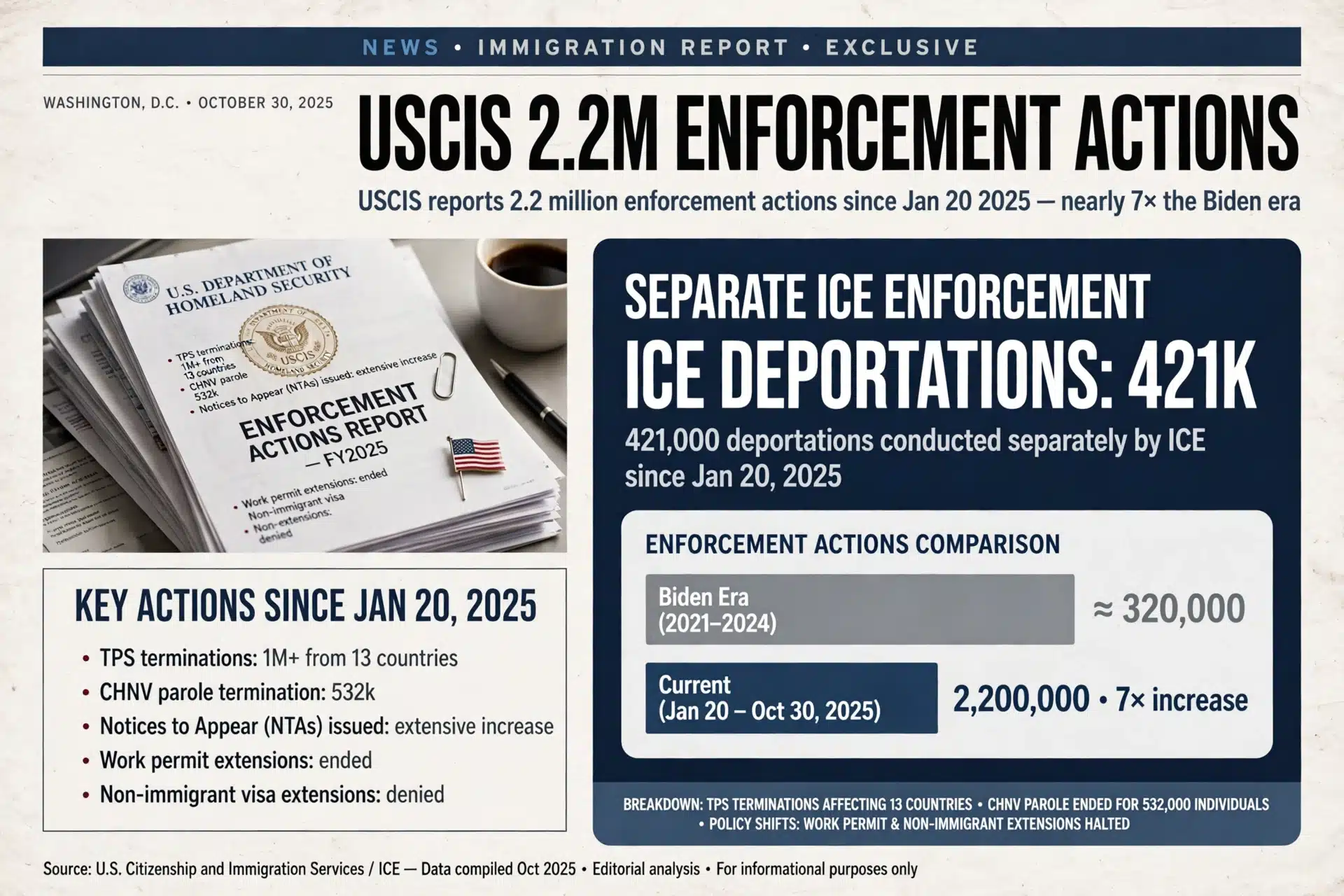
USCIS Enforcement Actions Reach 2.2 Million in Under Two Years
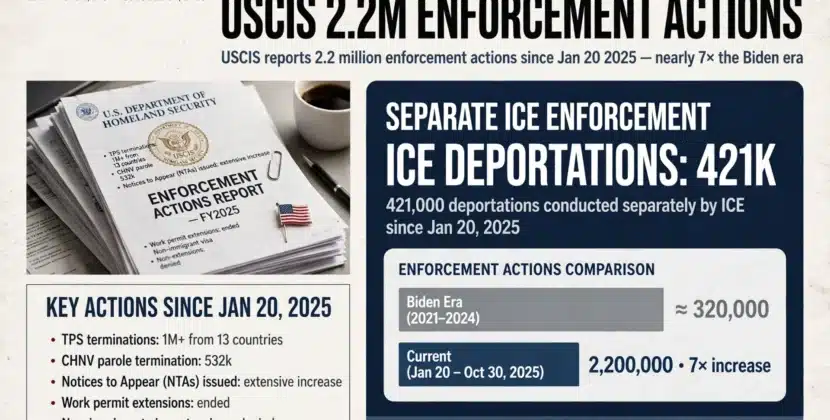
USCIS announced on October 29, 2026 that it had carried out USCIS enforcement actions to revoke or terminate the status of roughly 2.2 million people since January 20, 2025, a figure the agency calls unprecedented and read on Capitol Hill and campaign trails alike this week. The announcement lands five days before the November 3 midterms, and the paper trail behind it shows the count is not a deportation total. Here is what the number contains, who is actually affected, and what happens next for the people inside it.
This article is informational and not legal advice; individuals with status questions should consult a licensed immigration attorney or an accredited representative.
Key Takeaways:
- – USCIS announced on October 29, 2026 that approximately 2.2 million people have had status revoked or terminated since January 20, 2025.
- – The count spans five categories: TPS terminations, extension denials, Notices to Appear, ending automatic EAD extensions, and terminating categorical parole.
- – TPS terminations cover more than 1 million nationals of 13 countries, and the CHNV parole program covered about 532,000 travelers.
- – Some TPS terminations are enjoined in ongoing litigation, so not every counted action is currently in force.
- – No category-by-category breakdown has been published, which makes the headline figure impossible to audit independently.
What the 2.2 million figure actually counts
The USCIS release lists five categories of action. Terminating Temporary Protected Status designations, described as making TPS truly temporary again. Denying extensions or changes of nonimmigrant status when the agency finds no legal basis to continue. Issuing Notices to Appear in immigration court, which formally opens removal proceedings. Ending automatic extensions of Employment Authorization Documents, a change that hits green-card applicants who relied on continued work authorization while their pending cases sat in backlogs. And terminating categorical parole programs in favor of case-by-case parole decisions.
Two programs dominate the arithmetic. TPS terminations for more than 1 million nationals across 13 countries form the largest block, though several of those terminations are tied up in court. The CHNV parole process, which had allowed Cubans, Haitians, Nicaraguans and Venezuelans to enter with sponsors, covered about 532,000 people per DHS’s March 2025 Federal Register notice. An attorney analysis published the same day estimates the two programs account for roughly 70 percent of the total. The remaining categories, including Notices to Appear and EAD extension ends, fill out the rest without published subtotals.
Why this is not a deportation count
The most important caveat in the announcement is definitional. Revoking a status or terminating a program designation is an administrative action, not a removal. DHS has not confirmed that all 2.2 million people actually lost legal status, and it cannot yet, because some TPS terminations, including litigated designations, are enjoined pending appeal. Commentators and the agency itself both flagged the distinction, and the absence of a category breakdown means duplicate actions, such as a TPS holder who also received a Notice to Appear, may or may not be de-duplicated inside the total.
That does not make the number meaningless. It changes what it measures. The release is a scoreboard of administrative tightening: hundreds of thousands of people whose work authorization lapsed, whose pending petitions were denied, or whose court dates were set. For employers running I-9 compliance checks and for households relying on a single paycheck, those administrative consequences are as disruptive as formal removal in the short term, even though the legal avenues differ sharply.
Who is affected in practice
The affected population is no longer primarily recent arrivals. TPS holders from countries including Haiti, Venezuela, Honduras, El Salvador, Nicaragua and others have lived and worked in the US for years, many with US-citizen children and mortgages. CHNV parolees arrived under a program that required sponsors and flights, meaning many arrived with existing ties to US communities. The end of automatic EAD extensions ripples to green-card applicants in employment-based backlogs, who now face work-authorization gaps that can cost jobs, and to the US employers who sponsored them.
Adjacent figures released in the same week frame the broader enforcement picture. ICE reported about 421,182 removals between October 2025 and August 24, 2026 in its September report. The White House said in October that more than 300,000 visas had been revoked overall, including roughly 4,000 birth-tourism visas and about 6,000 held by foreign students with criminal or security flags. These sit alongside, not inside, the 2.2 million USCIS figure, and conflating them in coverage has been a recurring error this week.
How the number compares with prior administrations
The release frames the total as nearly seven times what the prior administration produced in its final two years, which implies a baseline of roughly 315,000 comparable actions, and the framing itself tells you how the milestone is meant to be used politically. Congressional Research Service reporting counts 13 of 17 TPS designations as terminated so far, most of them contested. For context, the CHNV parole program alone processed about 532,000 travelers in roughly 15 months, which shows the same administrative machinery installed people at speed even faster than it is now removing their status. Whether sevenfold speed in one direction cancels sixfold speed in the other is exactly the argument the midterms will answer.
Employers are the quiet audience for this announcement. The end of automatic EAD extensions means HR teams must now track expiration dates for employees in employment-based backlogs, request interim evidence, and budget for recourse when extensions are denied, work that previously ran on autopilot. The Department of Homeland Security has not published employer guidance alongside the milestone release, so trade associations are fielding the questions USCIS paperwork used to answer.
What happens next
Three developments will determine whether the milestone holds. Litigation: several TPS terminations remain before appellate courts, and a ruling in the coming months could restore status for a meaningful share of the count. Publication: if USCIS or DHS releases a category breakdown, the figure becomes auditable and its political use changes from talking point to dataset. And the midterm aftermath: with the announcement timed five days before November 3, expect it in campaign advertising this week and in budget or oversight hearings afterward, where DHS officials can be asked to reconcile the number against program-level records.
For individuals inside the affected groups, the practical steps have not changed since the underlying program terminations were first announced: check your EAD card against the automatic-extension rule in effect for your category, confirm any pending USCIS case status before making job or lease decisions, and respond to any Notice to Appear, because missed hearings are a leading cause of in-absentia orders. Community legal aid organizations remain the fastest free resource for confirming which of the five categories, if any, applies to your file.
Frequently Asked Questions
Does the 2.2 million figure mean 2.2 million people were deported?
No. It counts administrative actions, including status revocations, program terminations, extension denials, and Notices to Appear. ICE separately reported roughly 421,182 removals from October 2025 through late August 2026.
Which groups are inside the USCIS enforcement actions total?
Mostly TPS holders from 13 terminated designations, about 1 million people, and CHNV parole beneficiaries, about 532,000, plus Notices to Appear recipients, denied extensions, and people who lost automatic EAD extensions.
Is the 2.2 million number verified?
It is an official USCIS claim, but no category-by-category breakdown has been published and some counted TPS terminations are enjoined in litigation, so the total cannot be independently audited yet.
Sources:
- https://www.uscis.gov/newsroom/news-releases/under-president-trumps-leadership-uscis-takes-unprecedented-22-million-enforcement-actions
- https://www.dailywire.com/news/exclusive-trump-admin-hits-historic-milestone-in-immigration-crackdown
- https://immigration-analytics.com/2026/10/29/uscis-enforcement-actions/
- https://www.hindustantimes.com/world-news/us-news/us-immigration-crackdown-targeted-2-2-million-people-in-trumps-second-term-1793321327312.html
- https://www.dhs.gov/news-releases/press-releases