





CDC’s Ebola Attestation Order Tightens Rules for US-Bound Air Travel
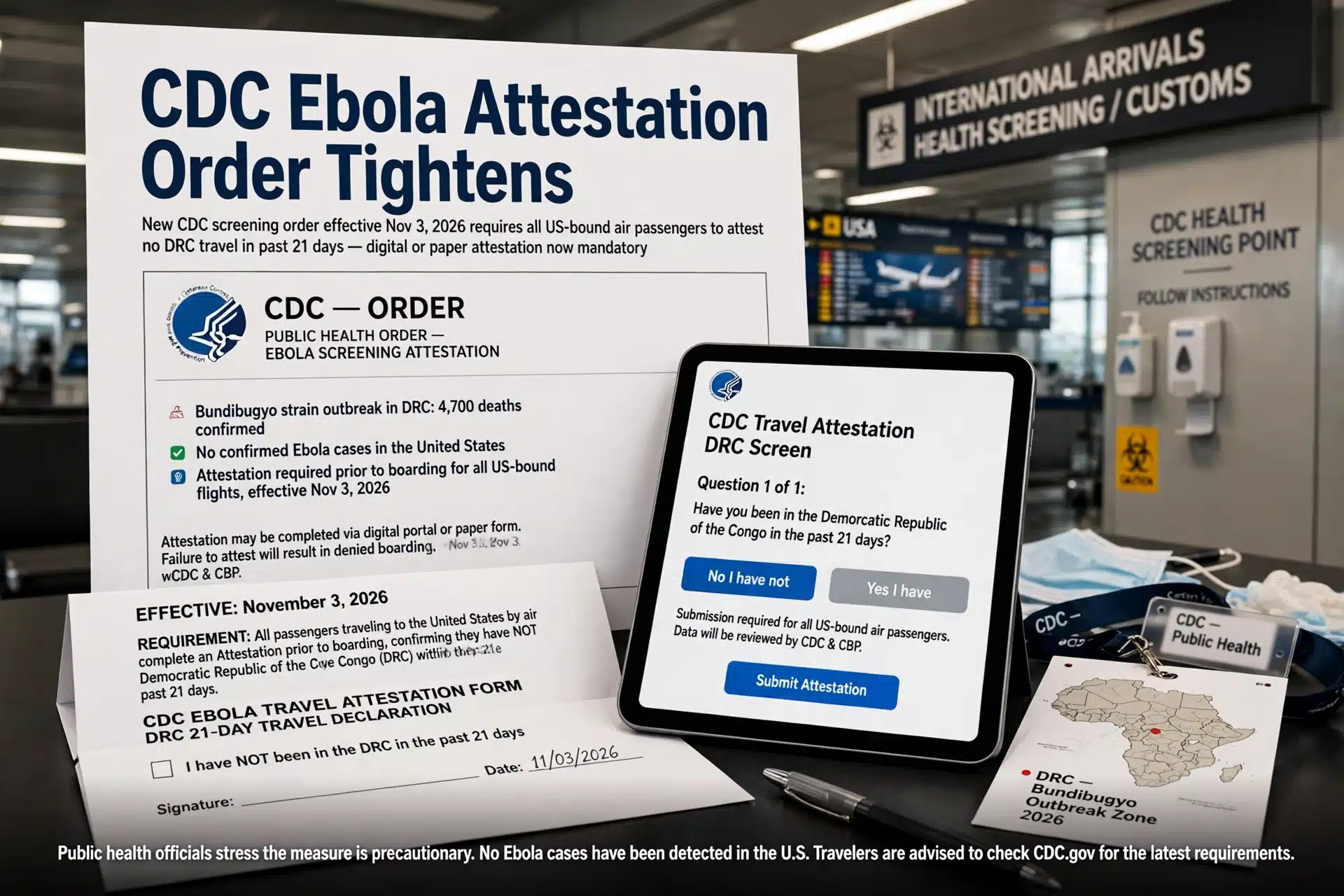
The CDC amended its Ebola attestation order on October 28, 2026, and the change is significant for anyone flying to the United States: airline crews are now covered alongside passengers, and no traveler from an affected list of countries can board without a signed statement that they were not in the Democratic Republic of the Congo in the prior 21 days. The Ebola attestation order takes effect at 11:59 p.m. EST on November 3 and runs through December 18, 2026. This explainer covers who is affected, what airlines say, and what US travelers should actually do.
This article is informational and not medical or legal advice; travelers with specific health or visa questions should consult a clinician or licensed immigration counsel.
Key Takeaways:
- – CDC issued an amended order on October 28, 2026, published in the Federal Register on October 30, requiring attestations from all persons arriving in the US by air.
- – The amendment changed passenger to person so crew members, including cargo pilots and deadheading crews, are covered for the first time.
- – Airline groups American Airlines-backed A4A and IATA asked CDC to delay the November 3 start date, citing two weeks of technical lead time.
- – CDC reports no Ebola cases linked to the current outbreak in the US, with a low overall risk level for the American public.
- – False attestations can be referred to the Department of Justice under the federal false-statements statute.
What the amended Ebola attestation order requires
The original order, signed October 22 and published in the Federal Register on October 27, barred boarding for any passenger on a US-bound flight unless that passenger presented a signed attestation, paper or digital, confirming no physical presence in the DRC during the 21 days before boarding. Airport transit counts as presence, even without leaving the aircraft. The October 28 amendment broadens the requirement to crews, applies to flights connecting through the United States, and exempts aircraft carrying authorized Ebola patients and travelers with individual CDC humanitarian or government exemptions.
Airlines must collect and retain attestations for 42 days after departure and can be compelled to hand them to the US government. Carriers may refuse boarding to anyone who will not sign. The order rests on the Public Health Service Act and its implementing regulations at 42 CFR 71.20 and 71.31 through 71.32(b). A companion Paperwork Reduction Act notice is open for comment at regulations.gov under docket CDC-2026-1750. Land borders and seaports are not covered, which becomes a central point of the airline pushback.
The outbreak behind the rule
The DRC declared its 17th Ebola outbreak in May 2026, caused by the Bundibugyo virus, and CDC’s situation page, updated October 29, counts 10,224 confirmed cases and 4,964 confirmed deaths as of October 27 across the affected region: 10,193 cases in the DRC itself, 20 in Uganda, 9 in Kenya, and 1 each in Nigeria and France. CDC describes it as the second-largest Ebola outbreak on record and notes it surpassed 1,000 confirmed cases within 40 days, roughly six times faster than the 2018 outbreak reached that mark.
Against those numbers, the screening logic is arithmetic: the virus has a 21-day incubation window, so a traveler with no DRC exposure in that window is extremely unlikely to be infectious on arrival. CDC’s guidance for US-bound travelers who were in the DRC is to remain outside the country for 21 days, with return permitted from day 22, and heightened screening applies at designated airports for travelers transiting Uganda and South Sudan. The agency counts roughly 500 staff on the response, more than 120 of them deployed overseas.
Why airlines are pushing back
Airlines for America, representing American, Delta, United and Southwest, wrote to CDC’s Division of Global Migration Health on October 26, and IATA wrote on October 27, urging a delay of the November 3 deadline. Their arguments, reported by Reuters on October 29: only about two weeks to rebuild check-in systems, capture electronic signatures, and train agents worldwide; some European hubs carry roughly 75 percent connecting passengers with boarding windows as short as one hour; and CBP screened about 130 million air passengers in 2025 with fewer than 25,000 holding any DRC connection, so the odds the rule ever catches a case are small while compliance costs are certain.
The groups also flagged the asymmetry with Canada and the United Kingdom, which rely on narrower travel-history-based measures rather than blanket attestations, and with US land and sea entry points, which face no equivalent requirement. CDC amended the order on October 28 but expanded coverage to crews rather than delaying the effective date. Enforcement teeth sat with carriers; the Transportation Department issued an enforcement notice on October 28 confirming airlines may deny boarding, including to US citizens, but must offer a rebooking, a prompt refund, or a transferable travel credit valid at least five years, with a written explanation within 10 days on request.
What US travelers should do now
First, check your itinerary against the requirement before November 3. Any onward journey routed through DRC airports, even an airside connection, triggers the attestation problem, so rebook or reroute through hubs outside the DRC if your trip window overlaps. Second, US citizens are not exempt: the attestation applies to all persons, and DOT’s notice confirms carriers can deny boarding to Americans as well, so travelers returning from DRC-adjacent itineraries should build refund flexibility into bookings. Third, if you were in the DRC within 21 days and need to reach the US, plan the 21-day wait outside the country rather than attempting an attestation you cannot honestly sign; false statements carry DOJ referral risk under 18 U.S.C. 1001.
Finally, note the expiration. The order lapses at 11:59 p.m. EST on December 18, 2026, squarely in peak holiday international travel. An extension or rescission will turn on case counts, geographic spread, and containment capacity in central Africa, so travelers booking December itineraries should expect the rule to still be in force and check CDC’s order page within 72 hours of departure.
What happens next
Watch three markers. Whether CDC grants any operational delay or exemption tweaks after the airline letters, expected in the final week before November 3. Whether the Federal Register docket at regulations.gov draws significant public comment, which shapes how the rule gets litigated or renewed. And whether a first confirmed US-linked case emerges, which would transform a low-risk screening measure into a politically durable policy. For now, the practical reality for US-bound flyers is simple: from November 4, the attestation is the price of admission, crews and passengers alike.
Frequently Asked Questions
Who must sign the CDC Ebola attestation?
Every person aboard a US-bound flight, including US citizens, children signed by a guardian, connecting passengers through airports transiting the DRC, and, since the October 28 amendment, crew members on both passenger and cargo flights.
When does the Ebola travel rule take effect?
At 11:59 p.m. EST on November 3, 2026, and it remains in effect through 11:59 p.m. EST on December 18, 2026, unless CDC extends or rescinds it.
Can an airline deny me boarding if I refuse the attestation?
Yes. Carriers may refuse boarding without a signed attestation, and a Department of Transportation notice confirms that denial is permitted, though airlines must then offer rebooking, a refund, or a transferable credit and provide a written explanation.
Sources:
- https://www.cdc.gov/port-health/legal-authorities/attestation-order.html
- https://www.federalregister.gov/documents/2026/10/30/2026-22211/notice-of-amended-order-requirement-for-attestation-by-all-persons-arriving-in-the-united-states
- https://www.cdc.gov/ebola/situation-summary/index.html
- https://visasnews.com/en/airlines-push-back-against-new-mandatory-health-declaration-for-us-bound-travelers/
- https://www.reuters.com/legal/government/airline-groups-urge-us-cdc-reconsider-ebola-declaration-requirements-2026-10-29/