




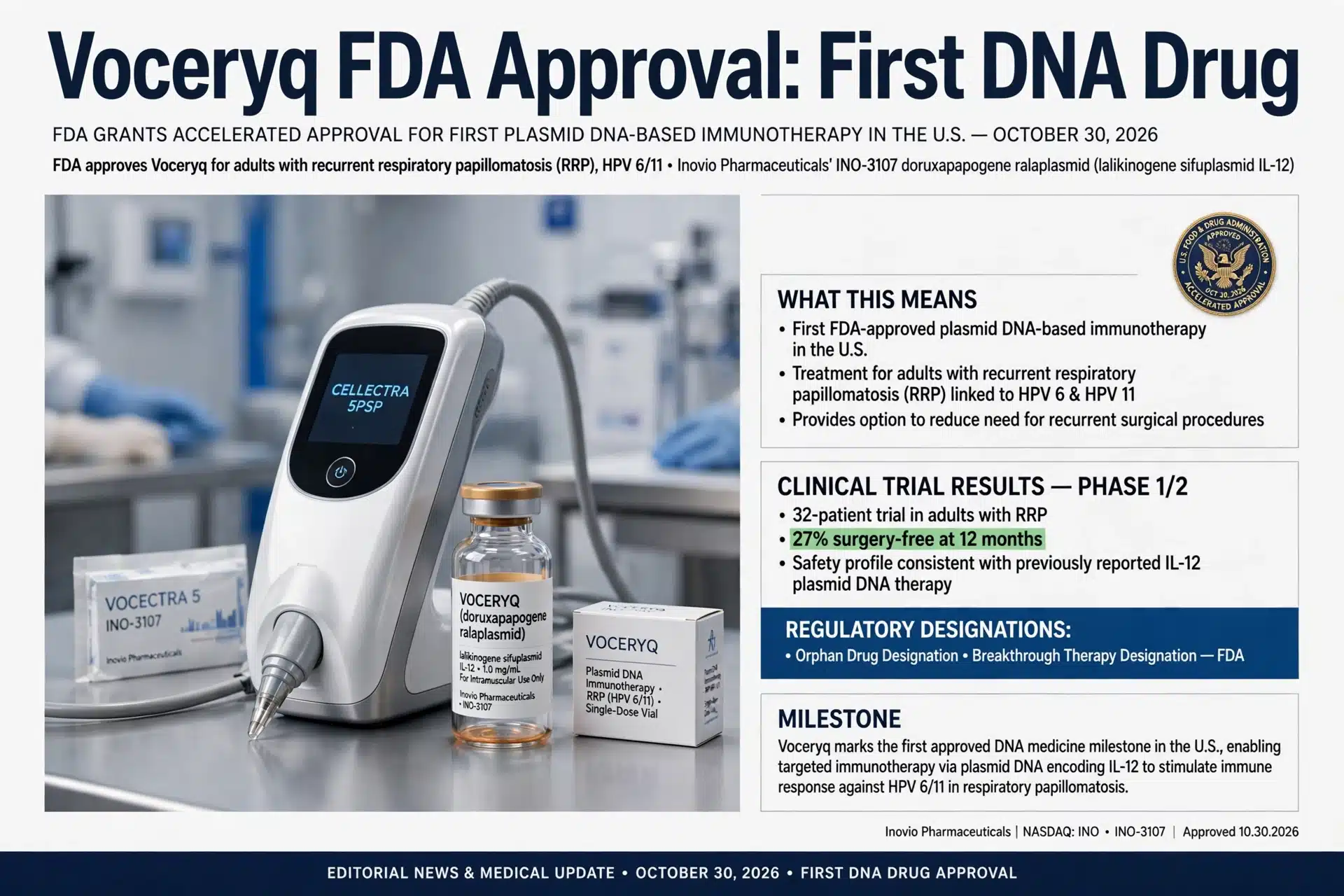
Voceryq FDA Approval Makes It the First DNA Medicine Sold in the US
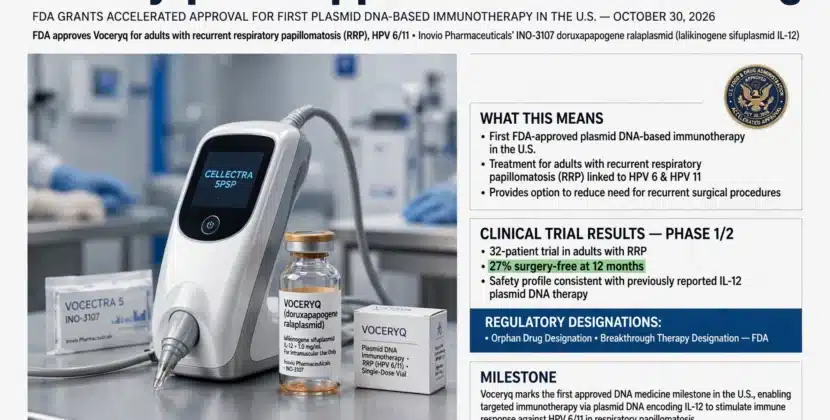
The FDA approved Voceryq on October 30, 2026 as the first plasmid DNA-based immunotherapy cleared in the United States, for adults with recurrent respiratory papillomatosis, and the Voceryq FDA approval matters to a small patient group that has spent decades cycling through throat surgeries. Approximately 27 percent of heavily-affected trial patients needed no surgery in the first year after treatment. Availability in the US is expected roughly 60 days from approval, with Inovio targeting a full commercial launch in the first quarter of 2027. This article is informational only and not medical advice; treatment decisions belong with your physician.
Key Takeaways:
- – The FDA granted accelerated approval to Voceryq on October 30, 2026 for adults with recurrent respiratory papillomatosis, a rare HPV-driven airway disease.
- – It is the first plasmid DNA-based immunotherapy ever approved in the US, following Inovio’s 2025 approval of Papzimeos, a different vector approach for the same disease.
- – Trial data showed 7 of 26 patients, about 27 percent, with three or more annual baseline surgeries required none in the first year after treatment.
- – The drug also holds FDA Breakthrough Therapy and Orphan Drug designations and is administered by intramuscular injection with the CELLECTRA 5PSP electroporation device.
- – Shipping is expected to start about 60 days after approval, per company statements, with a full commercial launch targeted for Q1 2027.
What recurrent respiratory papillomatosis does to patients
RRP is a chronic disease caused by HPV types 6 and 11, the same virus family behind common warts, but in the airway the papillomas grow on the larynx and vocal cords. The result is a hoarse voice, a persistent cough, and in serious cases growths that obstruct breathing entirely. Surgery removes the growths, but the tissue regrows, and the standard experience for severe patients is repeated procedures, sometimes several per year, for decades of their lives. Ask patients how this approval is different and you hear the surgical-count answer: fewer operations per year is the whole measure of a life changed.
The FDA’s own framing acknowledged the cycle. In the agency’s October 30 announcement, Center for Biologics Evaluation and Research director Karim Mikhail said adults with RRP often face an exhausting, relentless cycle of repeated surgeries that manage disease but never truly escape it, and called today’s approval a meaningful scientific breakthrough that harnesses the body’s own immune system to fight the underlying cause of RRP. That immunological framing is the technical dividing line between Voceryq and surgery: instead of cutting growths out, the therapy tries to train the immune response to stop the regrowth.
How the drug works
Voceryq is actually two recombinant plasmids given together by intramuscular injection. One carries the protein sequences for the HPV-6 and HPV-11 strains driving the disease, which presents a clear target to the immune system. The other encodes interleukin-12, a signaling protein that amplifies immune activity, which is the enhancer half of the pair. A small device called CELLECTRA 5PSP uses brief electrical pulses at the injection site to help cells take up the plasmid DNA.
The delivery mechanics shape some unusual acute reactions. Common adverse reactions listed in the FDA release cover the injection site, headache, fatigue, hypertension, nausea and dizziness, and electroporation-specific effects include brief muscle contractions, temporary bleeding, anxiety, vasovagal reactions and transient enzyme elevation. None of these change the structural math of the approval, but patients should expect the administration procedure itself, not lab follow-ups, to shape most of what they feel after a dose.
What the trial data actually shows
The pivotal evidence came from an open-label, multicenter trial in 32 adults who had at least two laryngotracheal papilloma surgeries in the prior 12 months and were scheduled for another at entry. In the group with three or more baseline surgeries, 26 patients were analyzed, and 7 of them, 27 percent, required no surgery in the first year after treatment. That is the endpoint the FDA relied on, the intermediate outcome the accelerated approval pathway permits when a disease lacks every other option.
Accelerated approval carries follow-on obligations. Full approval will hinge on post-approval trials confirming the clinical benefit, so the label today is conditional. Patients and insurers should read that as an honest signal: the drug is approved because the surgery-reduction evidence is strong enough for a rare disease with no equivalent alternative, and additional data will deepen over the next few years. The FDA simultaneously granted Breakthrough Therapy and Orphan Drug designations, the combination that typically speeds access for conditions affecting fewer than 200,000 US patients.
Why the 2025 Papzimeos approval does not make this redundant
Inovio already sells Papzimeos, an immunotherapy for the same disease approved last year, so why does a second RRP therapy matter? The reason is platform. Papzimeos is adenoviral-vector based, a viral delivery chassis that inserts its immunological payload differently. Voceryq is plasmid DNA, a non-viral chassis, delivered by electroporation. Clinically, both attack the HPV-6 and HPV-11 mechanisms behind RRP, but patients who do not respond to the vector approach may now have a non-viral alternative. For Inovio the approval validates nearly three decades of development into a DNA platform that Wall Street treated as perpetually early. The market agreed for an afternoon; shares more than tripled after hours on October 30, with gains above 215 percent per Reuters. Pricing remains undisclosed as of October 31, and the company expects orders and shipping within about 60 days, with full commercial launch in Q1 2027.
What happens next
Watch three dates. Roughly 60 days out, per Inovio’s announcement, Voceryq should become orderable, so late December 2026 is the realistic first-availability window for US clinics that treat severe RRP patients. Q1 2027, per the company, is the full commercial launch, which is when distribution broadens beyond initial specialty centers. Insurance coverage is the live question for individual patients; rare-disease accelerated approvals often open with case-by-case prior authorization while payers wait for real-world evidence, and November 2’s company investor call is where adoption math may surface. The accelerated approval also obligates confirmatory trials, so expect patient data to keep accruing through 2027 regardless of commercial tempo.
For the roughly tens of thousands of Americans managing this disease, the practical takeaway is discussion material for a laryngology or ENT follow-up: a non-surgical option now exists on the US approved list, its one-year track record shows roughly a quarter of severe patients going a year without an operation, and its non-viral delivery may matter if Papzimeos was unsuitable. Access logistics, price and payer coverage will decide how many patients actually get the improved year the trial promised.
Frequently Asked Questions
What is Voceryq and who can get it?
Voceryq is a two-plasmid DNA immunotherapy the FDA approved by accelerated approval on October 30, 2026 for adults with recurrent respiratory papillomatosis, the HPV-driven disease causing recurring airway growths. Eligibility is for adults whose disease keeps requiring surgery; it is not approved for children or as a general HPV treatment.
When will Voceryq be available?
Inovio says the drug should be available to order and ship about 60 days from the October 30 approval, putting the first shipments around late December 2026, with full commercial launch targeted for Q1 2027. Actual patient access also depends on clinic stocks and insurance approval.
Does Voceryq cure RRP?
No. The trial endpoint was a reduction in surgeries, and 27 percent of the analyzed patients with three or more baseline surgeries had none in the first year after treatment. The approval is accelerated, meaning it rests on an intermediate endpoint and confirmatory trials must still demonstrate lasting clinical benefit.
Sources:
- https://www.fda.gov/news-events/press-announcements/fda-approves-first-plasmid-dna-based-immunotherapy-adults-recurrent-respiratory-papillomatosis
- https://ir.inovio.com/news/news-details/2026/INOVIO-Announces-FDA-Accelerated-Approval-of-VOCERYQ-an-Immunotherapy-to-Reduce-the-Frequency-of-Surgery-in-Adults-with-Recurrent-Respiratory-Papillomatosis-RRP/default.aspx
- https://finance.yahoo.com/healthcare/articles/us-fda-approves-inovios-treatment-204453731.html
- https://www.morningstar.com/news/dow-jones/2026103012141/inovio-gets-accelerated-fda-approval-of-voceryq-shares-more-than-triple-after-hours