




OpenAI Funding Target Cut to $20B as AI Repricing Spreads
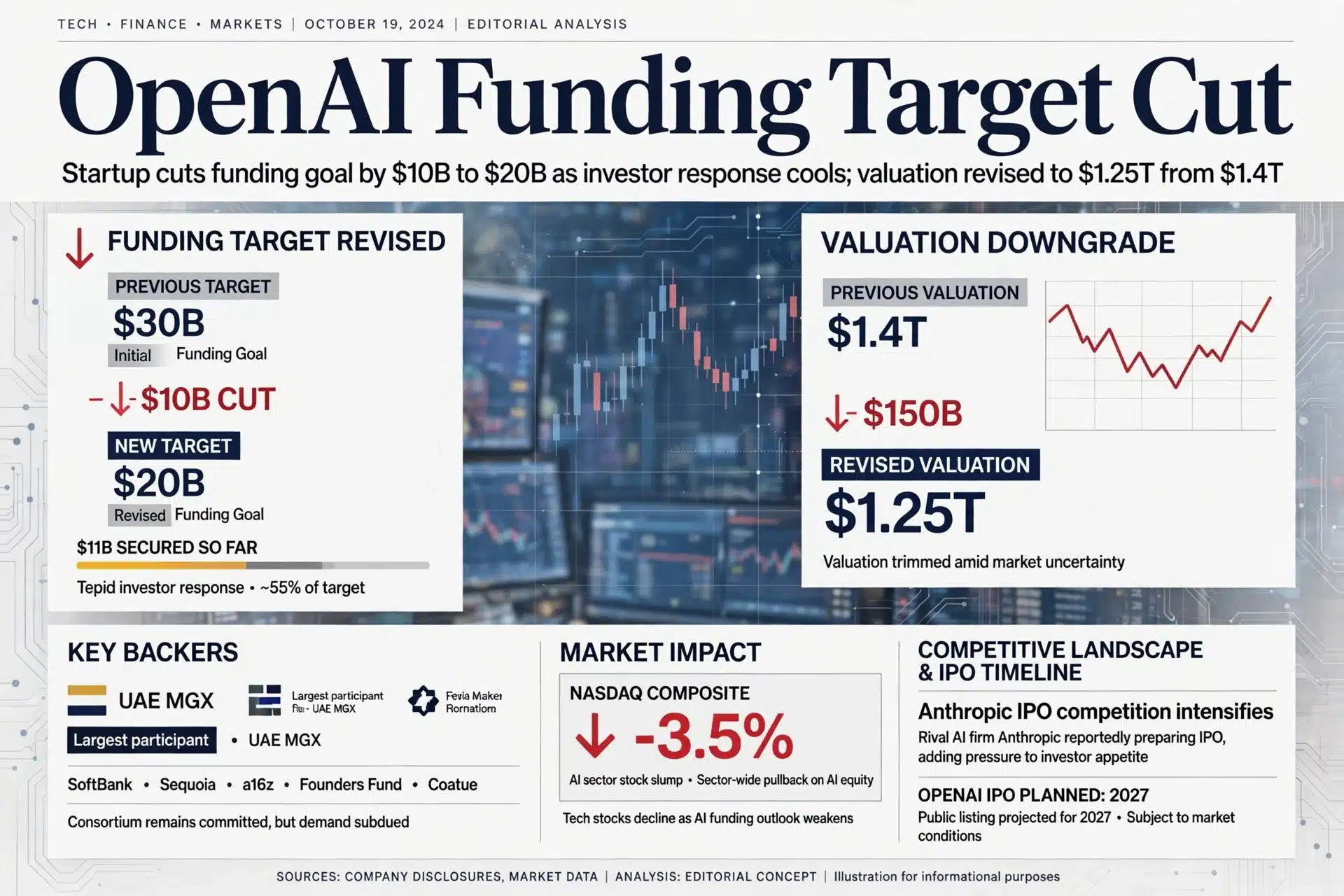
OpenAI cut its funding target from about $30 billion to roughly $20 billion, according to the Financial Times, while keeping its valuation at $1.25 trillion, and the OpenAI funding target cut lands one day after US chip and internet stocks took their worst day since June. The two moves are parts of one process: private and public markets repricing the AI buildout at the same time. For US readers the practical question is simpler, whether the companies running the AI boom can still fund it without pushing prices and borrowing costs up for everyone else.
Key Takeaways:
–
- – The News agency reported the cut on October 31, and OpenAI did not respond to a request for comment, so the numbers remain FT-reported rather than company-confirmed.
- – On Friday, October 30, the Nasdaq Composite fell 2.86 percent to 25,437.00, its largest one-day drop since June 5, per Reuters.
- – Intel plunged about 28.6 percent, its worst day since 1974, after weak forward guidance, per Reuters and CNBC.
- – Amazon posted negative free cash flow of about $42.4 billion while holding 2026 capital spending at $220 billion, per CNBC.
What changed in the OpenAI funding target
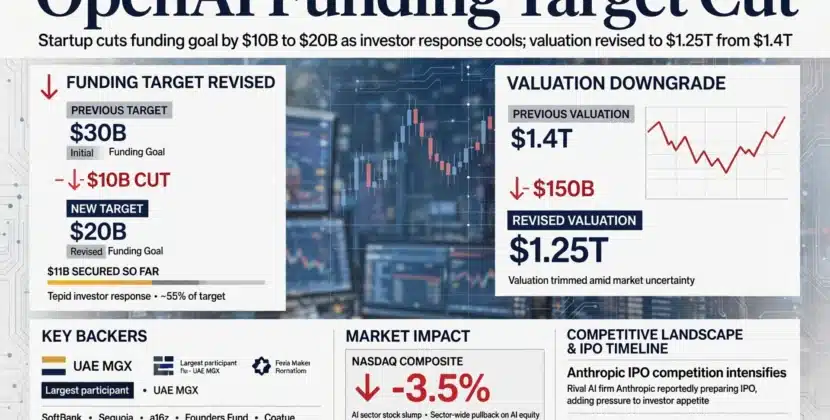
Three numbers define the new round: the raise shrank from about $30 billion to about $20 billion, the valuation held at $1.25 trillion, and the first close is expected to land below the target. The Financial Times reported that OpenAI set a Friday deadline for investor commitments and that investors trimmed their allocations. An earlier September cycle had reported a $1.4 trillion figure, a haircut of roughly $150 billion across the negotiation, on top of a March round at about $852 billion.
The careful read matters here. OpenAI has not confirmed the figures, and Reuters noted the company declined to comment. Treat $20 billion as the reported number of record while the final close remains unpublished. Still, a target cut of a third inside one cycle signals that even the recognized leader must negotiate with capital markets on their terms.
The selloff that framed the cut
The public market moved first. Recent markets closed sharply lower on October 30, with chip and internet stocks cratering to their worst day since midsummer. Momentum faded quickly across the space as investors rotated out of high-multiple technology names and into defensives, and the technology channel put the one-month damage in context: the chips index fell more than 7 percent that day alone and was down over 15 percent for October.
Intel became the emblem of the repricing after reporting results that missed on forward direction, and Amazon drew the other kind of scrutiny, the kind that focuses on cash flow. Posting a negative free cash flow of $42.4 billion while committing to a record $220 billion capital budget turned market attention from AI revenue ambitions toward the bill for those ambitions. Alphabet also recorded one of its worst single-day drawdowns on record after a quarterly miss that included negative free cash flow. These are all supply-side facts: the companies that fund AI infrastructure are spending more than they earn right now, and Friday’s market said it noticed.
Why investors are pressing pause
The core worry is not demand for AI models, it is the financing stack underneath them, and that worry now has a public paper trail. Rich technology company balance sheets work fine, but the model of the past two years has been to borrow and spend into capacity ahead of revenue. Regulators have started watching those disclosures. Reuters quoted SEC Enforcement Director David Woodcock on October 30 saying, “Our principal concern is that people are making accurate disclosures about material information so that investors know what they’re getting into.” When the Securities and Exchange Commission frames concern around disclosure accuracy in a fast-moving market, private funds cannot assume smooth exits. That is the indirect link to the OpenAI funding target cut. Private market prices need public market anchors, and public anchors pulled back on the day the private deadline landed. Crossover investors read the same models openAI’s underwriters do, and several declined to pay the last cycle’s clearing price.
What an OpenAI downshift means for pricing
OpenAI’s capital needs are real even at a reduced target: compute, data, energy and talent are all scarce inputs it is buying at industrial scale. A smaller raise suggests the company either expects to smooth costs across more time or expects cash flow from subscriptions and enterprise deals to carry more of the buildout. Either path affects consumers. If OpenAI leans more on paid products to fund infrastructure, expect tighter free tiers or higher list prices on the popular consumer plan at the next renewal. If OpenAI leans on less-expensive hardware and negotiated compute, costs inside the AI sector may actually compress, and some of that could pass through as broader access for smaller developers.
The repricing also reshapes rivals’ math. Anthropic filed its S-1 in late October and is expected to price its IPO in mid-November, and reports in the same window put its expected marks below where they sat a week earlier. A cheaper entry point for the second-largest frontier lab changes where talent, enterprise contracts and capital flow across the whole market, and it is a reminder that OpenAI’s leadership position is no longer priced as unassailable.
What happens next
The round’s first close is the near-term marker. If it lands well under $20 billion, the private market has put a hard ceiling on how much the flagship can raise at this valuation, and secondary pitches built on top of that mark will need rework. The next public marker is Big Tech quarterly reports in November, where investors will parse capex guidance for suppression and watch whether Amazon and Alphabet defend the spending that just cost them their best valuation weeks of the year. The two threads are connected: every basis point of credibility OpenAI loses on fundraising shows up in how generously the public markets treat the vendors selling compute to the whole ecosystem.
For US households the effects are indirect but real. Pension funds and 401(k) allocations carry large technology weights, so monthly statements echo these repricings. Energy markets absorb the demand side, because data centers buy power at scales that compete with municipal needs. The question of whether the AI wave delivers returns is no longer an investment community debate; it is now a consumer economy question, and October 2026 is when pricing power on both sides of the ledger started being renegotiated in public.
Frequently Asked Questions
Why did OpenAI cut its funding target?
The Financial Times reported the cut on October 30, 2026 from about $30 billion to roughly $20 billion at a $1.25 trillion valuation, citing investors tempering allocations, a day after the worst US tech session since June on AI cash-burn fears.
How much is OpenAI worth now?
The reported valuation is $1.25 trillion, down from a reported $1.4 trillion in September but up from about $852 billion in its March 2026 round. OpenAI has not confirmed the number and did not respond to a request for comment.
Is the AI bubble popping in October 2026?
Markets are repricing, not collapsing. The Nasdaq fell about 2.9 percent on October 30, down roughly 5 percent for the month, while Intel and Amazon drew selling for earnings and cash-flow gaps. Capital still flows into AI, but investors now demand evidence of returns.
Sources:
- https://www.ft.com/content/7a3ad950-1b3b-4d9e-8c15-65a61ae6180f
- https://www.reuters.com/business/openai-cuts-funding-target-by-10-billion-ft-reports-2026-10-31/
- https://www.cnbc.com/2026/10/29/stock-market-today-live-updates.html
- https://www.businesstimes.com.sg/companies-markets/us-wall-street-closes-sharply-lower-ai-cash-burn-fears-spark-tech-sell