





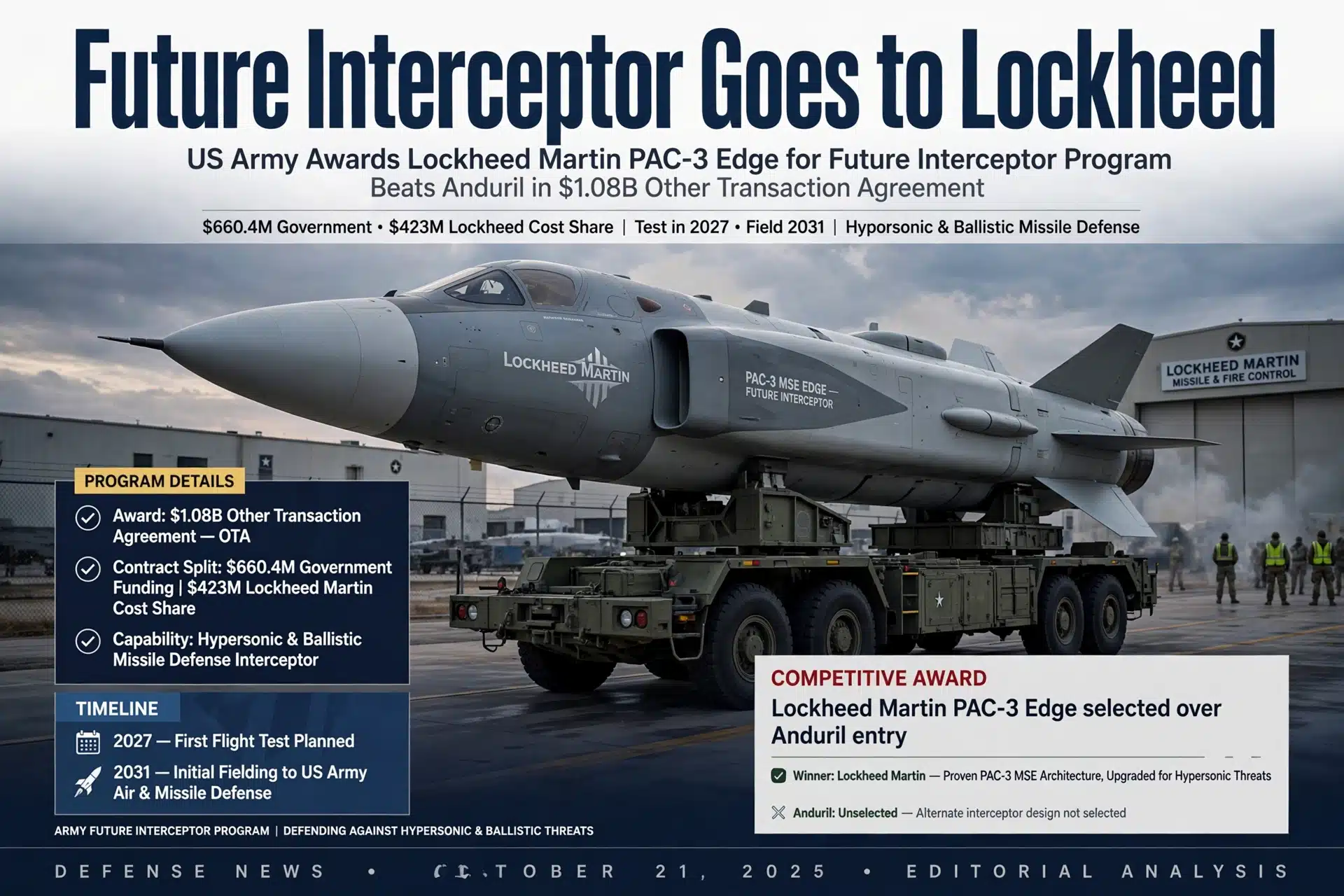
Army Future Interceptor Program Goes to Lockheed for $1.08B
The Army announced on October 29, 2026 that Lockheed Martin won the Future Interceptor program, a $1.08 billion prototype-and-development competition to build the successor to the PAC-3 Missile Extended Range interceptor. The award, structured as an Other Transaction Agreement, beat rival Anduril and hands the Army the Future Interceptor program’s most consequential decision of the year. Here is what the Army is buying, why the funding structure matters, and when shooters could see the new round in the field.
Key Takeaways:
- – Lockheed Martin won the Army’s Future Interceptor competition, announced October 29, 2026 in Huntsville, Alabama.
- – The effort is valued at $1.08 billion: $660.4 million in government funding plus $423 million of Lockheed cost share.
- – The winner is the PAC-3 Edge, built on the combat-proven PAC-3 MSE with a new seeker and a Northrop Grumman multi-pulse motor.
- – Lockheed plans to begin testing in 2027 and field the interceptor by 2031, and it beat Anduril for the award.
- – follow-on development and production are not guaranteed; decisions hinge on prototype performance.
What the Future Interceptor program is buying
The competition asked industry for a next-generation interceptor with improved engagement range, altitude, velocity, and maneuverability compared with the interceptors flying today in Patriot and Army Integrated Air and Missile Defense units. The requirement grows out of two intensity lessons: magazine depth matters when facing large raid sizes, and maneuvering hypersonic threats punish interceptors designed a decade ago. The Army wants a round that complements, not replaces, the existing layered architecture against ballistic missiles, cruise missiles, and jet-powered attack drones.
The winning design, PAC-3 Edge, was unveiled by Lockheed on October 9, 2026. It retains the PAC-3 MSE hit-to-kill heritage, the interceptor credited with the majority of successful Patriot engagements against ballistic threats in recent combat use, while swapping in a new Strigo Product Center seeker from Lockheed and a Northrop Grumman multi-pulse solid rocket motor whose pulses can be timed for different engagement profiles. Lockheed designed it for integration with the Army’s IBCS battle command system, existing M903 launchers, containerized launchers, and HIMARS Flex, which lets fielded units adopt it without new launch infrastructure.
Why the $1.08 billion deal is structured as an OTA
The award is an Other Transaction Agreement rather than a traditional FAR-based contract, and the money split tells the story: the government contributes $660.4 million while Lockheed puts up $423 million of its own capital, roughly 39 percent of the total. The Pentagon has leaned on OTAs since the 2010s to escape procurement rules it views as slow, and the cost-share design spreads risk: if PAC-3 Edge fails in prototype testing, taxpayers have not carried the full development bill, and the Army keeps an off-ramp.
Army officials framed it the same way. Brent Ingraham, the service’s acquisition executive for aviation and missile programs, said the arrangement is meant to reduce acquisition risk, while Lieutenant General Frank Lozano, the Portfolio Acquisition Executive for Fires, described it as a way to accelerate innovation by building on proven technology. General Christopher LaNeve, the Vice Chief of Staff serving as Acting Chief of Staff, tied the buy to the Army’s new warfighting guidance, How the Army Fights, with its mix of exquisite and low-cost munitions. Follow-on decisions, the Army notes, will be informed by prototype performance, operational requirements, available resources and applicable acquisition processes.
Lockheed versus Anduril and what it signals
Anduril pitched a cheaper, modular alternative called Steelfin, unveiled October 12, 2026, and for a company riding a string of recent defense wins, the loss stings. Aviation Week reported Lockheed prevailed in the head-to-head. The result signals how the Army weighs risk on its most safety-critical magazine items: against a startup’s cost advantage and software-forward pitch, the incumbent’s flight-test history and existing missile factory footprint won. It also tightens Lockheed’s already dominant position in Army air defense, following the $58.6 billion multiyear PAC-3 MSE production deal signed in July.
For Congress and oversight bodies, that concentration is the predictable next question, and it lands while Lockheed separately weighs an expansion of munitions capacity estimated at up to $9 billion across PAC-3, THAAD, and PrSM production lines. The Counter small-drone world, meanwhile, is drifting toward low-cost effectors such as microwave systems and cheap interceptors, so a billion-dollar program for an exquisite round coexists awkwardly with a parallel push for magazine depth on a budget. The Army’s answer is that this round targets the threats the cheap rounds cannot reach; the test will be whether both lines survive budget pressure together.
The four things to watch in the 2027 test campaign
Prototype testing in 2027 will answer the questions the award leaves open. Range-and-altitude demonstration: whether the new motor pulses and seeker deliver the engagement envelope the requirement demanded against maneuvering threats. Producibility: whether the design can be built on existing PAC-3 lines without a new factory, which determines if the 2031 fielding date is real or aspirational. Integration: whether IBCS cueing and existing M903 and HIMARS Flex launchers adopt the round without hardware changes. And unit cost: the Army’s stated preference for a mix of exquisite and low-cost munitions only works if this exquisite round’s cost stays predictable across production lots.
The fiscal context sharpens each of those. The Army has been pacing PAC-3 MSE production against burning demand, and every dollar of the $1.08 billion program competes with warhead, radar and C2 modernization inside the same missile-defense budget line. A clean test campaign cementing a Navy second customer, as Lockheed’s Modular Missile pitch would, muddies that trade; a slip does the opposite.
What happens next
The development clock is aggressive: Lockheed plans prototype testing beginning in 2027 and fielding by 2031. Watch the fiscal 2027 budget request for whether the Army carries the program’s growth beyond the OTA, the first flight-test results out of White Sands in late 2027, and one secondary front: Lockheed president Tim Cahill told Aviation Week the PAC-3 Edge is a candidate for the Navy’s Modular Missile Terminal Stage Interceptor competition, which would add a sea-based customer and dilute unit costs. If the Navy adopts it, the program’s economics improve sharply. If the prototype slips past 2027, expect Anduril’s Steelfin and other competitors to lobby for a restart.
For US readers the through line is interceptor magazine depth: the Patriot fleet has been spending rounds faster than production lines can replace them, and this program is the hedge that a next-generation, producible round arrives before the stockpile math becomes critical.
Frequently Asked Questions
What is the Army Future Interceptor program?
It is the Army’s competition to develop a next-generation interceptor with better range, altitude, speed and maneuverability than today’s PAC-3 family, structured as a prototype effort with an October 29, 2026 award to Lockheed Martin.
How much does the Future Interceptor deal cost?
The development effort is valued at $1.08 billion, split between $660.4 million in government funding and $423 million from Lockheed Martin as cost share under an Other Transaction Agreement.
When will the Future Interceptor field?
Lockheed plans testing to begin in 2027 and fielding by 2031, subject to prototype performance; follow-on production is not guaranteed under the award structure.
Sources:
- https://www.army.mil/article/296443/army_announces_selection_for_future_interceptor_program
- https://defensescoop.com/2026/10/29/army-selects-lockheed-martin-future-interceptor-program/
- https://aviationweek.com/defense/missile-defense-weapons/lockheed-martin-wins-us-armys-future-interceptor-contract
- https://news.lockheedmartin.com/2026-10-09-Lockheed-Martin-Debuts-PAC-3-Edge-TM-for-the-U-S-Armys-Innovative-Future-Interceptor-Program
- https://www.defensedaily.com/army-picks-lockheed-for-future-interceptor-development-effort-estimated-at-1-08-billion/army/