




DHS Employee Leak Exposes Contact Data on 41,000+ Workers
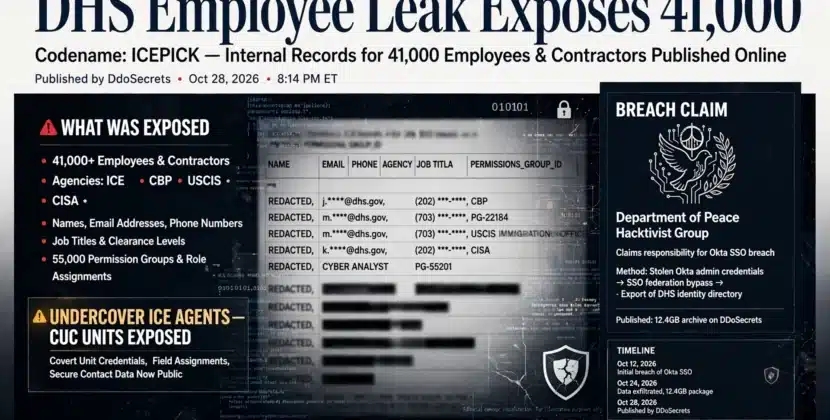
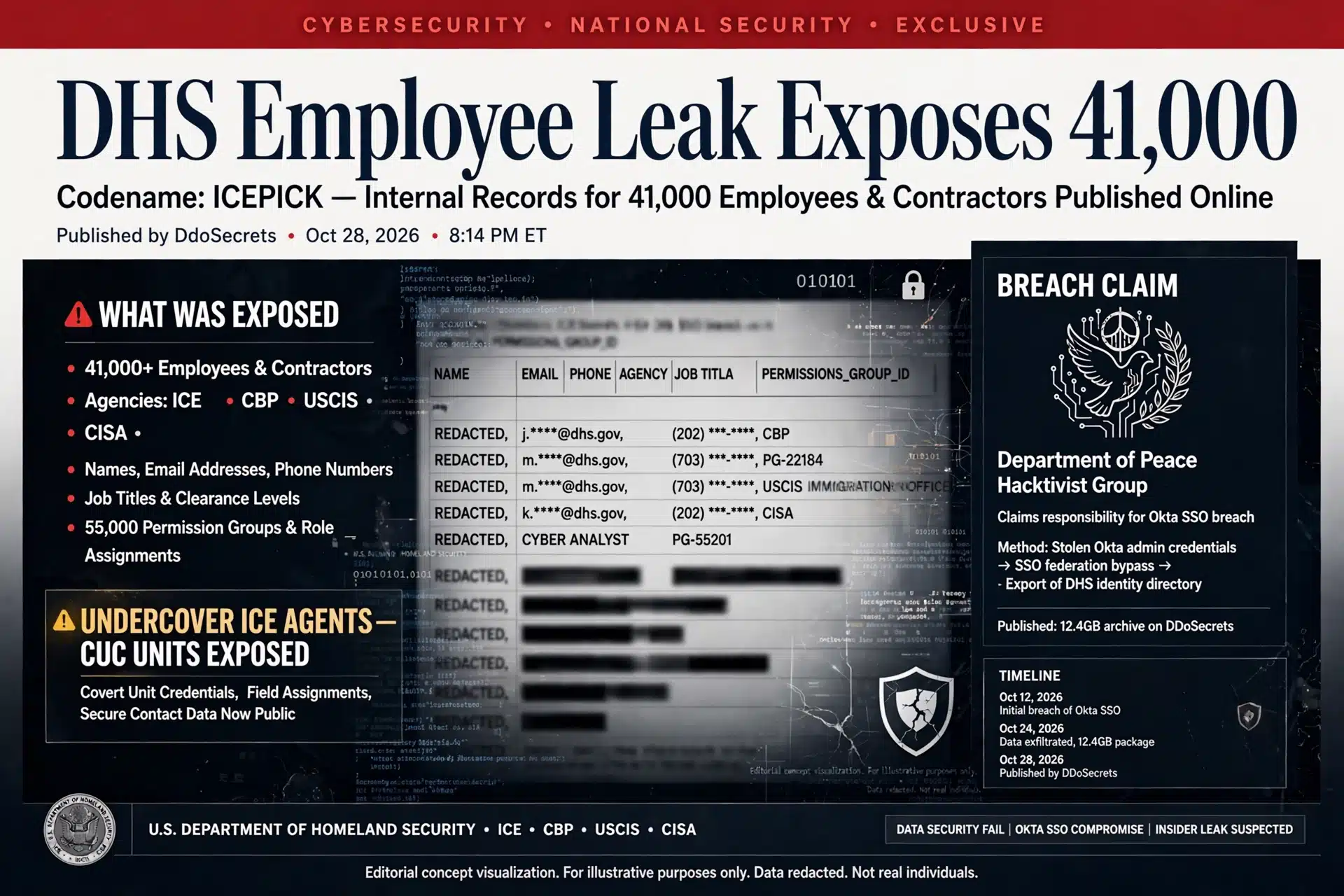
A hacktivist group published a 166 MB database of contact and personnel information on more than 41,000 current and former Department of Homeland Security employees on October 28, 2026, and the DHS employee leak is now one of the largest federal personnel exposures on record. Distributed Denial of Secrets, a transparency nonprofit, released the dataset under the name Icepick. DHS says it is aware of a potential breach; Okta denies its systems were compromised. Here is what is in the data, how it likely got out, and what federal workers should do.
Key Takeaways:
- – DDoSecrets published the Icepick dataset on October 28, 2026, covering more than 41,000 current and former DHS employees and contractors.
- – Exposed fields include names, work emails, phone numbers, job titles, offices, supervisors and internal permission-group memberships.
- – The hackers traced the data to an Okta single sign-on service used by DHS; Okta says it has no evidence of a compromise.
- – WIRED’s analysis found CBP accounts for more than half the records and ICE about 10,000, including staff tied to undercover units.
- – Independent outlet Nextgov verified portions of the dataset, including phone numbers and matching LinkedIn profiles.
What the Icepick DHS employee leak contains
The dataset is an internal directory export, not a financial or credential dump. Records identify staff across DHS headquarters and seven component agencies, roughly one-seventh of the department’s workforce. WIRED’s breakdown counts more than half from Customs and Border Protection, about 10,000 from Immigration and Customs Enforcement with roughly a third in Homeland Security Investigations, about 6,200 from USCIS, and about 1,000 from CISA, more than half of those contractors. The data was last updated August 19, 2026, so some records describe staff who have since moved on.
The sensitive part is not names and emails, which business cards or agency sites could produce, but the internal group memberships. WIRED documented references tied to undercover operations units, a Title III intercept program for court-authorized wiretaps, communications intercept technical teams, the Palantir Falcon platform, the PenLink analytics tool, a CBP face-recognition app with about 200 accounts, and about 700 Signal accounts. Dozens of records identify 287(g) officers embedded with county sheriff offices, and about 4,400 entries are associates, mostly contractors.
How the hackers say they got in
The group, calling itself Department of Peace, told DDoSecrets the data came from an Okta single sign-on service DHS uses. Okta, the identity company whose customer base spans most of the Fortune 500, rejected that framing directly, saying it is secure and has no evidence its data or systems were compromised. That leaves two possibilities: a misconfiguration or over-broad sync on DHS’s tenant exposed directory data without any breach of Okta itself, or an intrusion into a downstream system Okta did not originate. DHS has said only that it is aware of a potential breach; it has not confirmed the dataset’s authenticity.
What strengthens the picture is independent corroboration. Nextgov verified portions of the data, including an official’s work phone number it had obtained separately, AT&T-associated numbers consistent with DHS’s carrier, and matching LinkedIn profiles. CyberScoop verified numerous current CISA employees plus former leadership. Both outlets also found stale or historical records, a reminder that directory exports age fast and headlines claiming all 41,000 people are exposed overstate the current data.
Why this DHS employee leak is a security event, not just a privacy one
Work emails and cell numbers plus org charts are the raw material for targeted phishing, impersonation, and credential-reset attacks against specific federal staff. Security analysts quoted by WIRED called the dataset, if authentic, extraordinarily valuable to anyone trying to penetrate DHS, especially when correlated with prior breach data and commercial records. The group framed its motive as retaliation for immigration enforcement policy, citing a July 17 public vow by Secretary Markwayne Mullin to escalate enforcement, which makes targets selected for policy rather than for vulnerability, a pattern that historically escalates rather than subsides.
There is also a legal and speech dimension. DDoSecrets frames Icepick as an accountability tool akin to FOIA material rather than doxing, and civil-liberties attorneys argued basic business-card details are protected speech. WIRED reported the social platform Bluesky blocked links to the leak. DHS has spent the year expanding doxing enforcement, so expect the dispute to move toward prosecution attempts and First Amendment litigation rather than fading like an ordinary breach story.
What federal employees and contractors should do
The practical steps mirror any targeted-exposure incident. Assume targeted phishing: any message referencing your unit, supervisor, or an internal system name is now possible for strangers to craft, so verify sender identity out of band before clicking. Enable phishing-resistant multi-factor authentication, FIDO security keys over SMS. Review agency guidance before discussing the leak at work, since personnel rules still apply. If your record ties you to sensitive units, report unusual approaches to your security office promptly. Contractors should notify their contracting officer too, because incident-response obligations differ from federal staff.
The history and the open question of authenticity
This is not DHS’s first large personnel exposure. CyberScoop’s reporting cites a 2014 incident potentially affecting 390,000 DHS employees, applicants and contractors, and a separate 2018 notification to nearly 250,000 people. What distinguishes Icepick is intent and packaging: the 2014 breach was accidental, while this dataset was published deliberately as a searchable accountability archive, which is a different threat model for affected staff and a different legal posture for the publisher. WIRED also contextualizes it alongside a ShinyHunters claim of stolen data on nearly every FBI employee, suggesting coordinated releases against federal agencies rather than a lone incident.
The unresolved authenticity question matters more than usual here. DHS has acknowledged only a potential breach, Okta denies compromise, and independent outlets verified samples, not the full set. If incident response later shows the export came from a misconfigured tenant with no intrusion, the remediation is policy, not forensics. If it shows an intrusion into personnel systems, that is a named actor case with breach-notification obligations cascading through contractors. Both outcomes are live until DHS speaks specifically, and the department’s silence so far is itself information.
What happens next
Watch three threads. DHS and Congress: expect oversight letters asking whether the data originated in an Okta tenant misconfiguration or an intrusion, and how directory exports are access-controlled. Okta: the company’s denial will be tested by incident-response findings, and its stock and enterprise customer trust hang on the answer. And the search tool: DDoSecrets says the first searchable domain, icepi.cx, was taken offline by its registrar, with a mirror moved to icepicx.is, so availability stays volatile. This is a developing story, and the authenticity question DHS has left open is the single fact that determines whether it remains a leak story or becomes a named intrusion case.
Frequently Asked Questions
What is the Icepick DHS leak?
A 166 MB database of contact and personnel information on more than 41,000 current and former DHS employees and contractors, published by the nonprofit Distributed Denial of Secrets on October 28, 2026 at the claim of a hacker group called Department of Peace.
Was Okta breached in the DHS hack?
The hackers attributed the data to an Okta single sign-on service used by DHS, but Okta says it has no evidence its systems were compromised, and DHS has not confirmed the dataset’s authenticity or the intrusion path.
What should DHS employees do after the leak?
Treat the exposure of work contacts and group memberships as phishing ammunition: verify unexpected contacts out of band, use phishing-resistant multi-factor authentication, follow agency security guidance, and report any suspicious approaches, especially if your record references sensitive units.
Sources:
- https://ddosecrets.org/article/icepick
- https://www.cnbc.com/2026/10/29/dhs-data-breach-ice-cdp-deportations.html
- https://www.wired.com/story/massive-leak-exposes-41000-homeland-security-workers-including-undercover-ice-agents/
- https://www.nextgov.com/cybersecurity/2026/10/dhs-personnel-leak-exposes-contact-details-and-sensitive-job-information/416901/