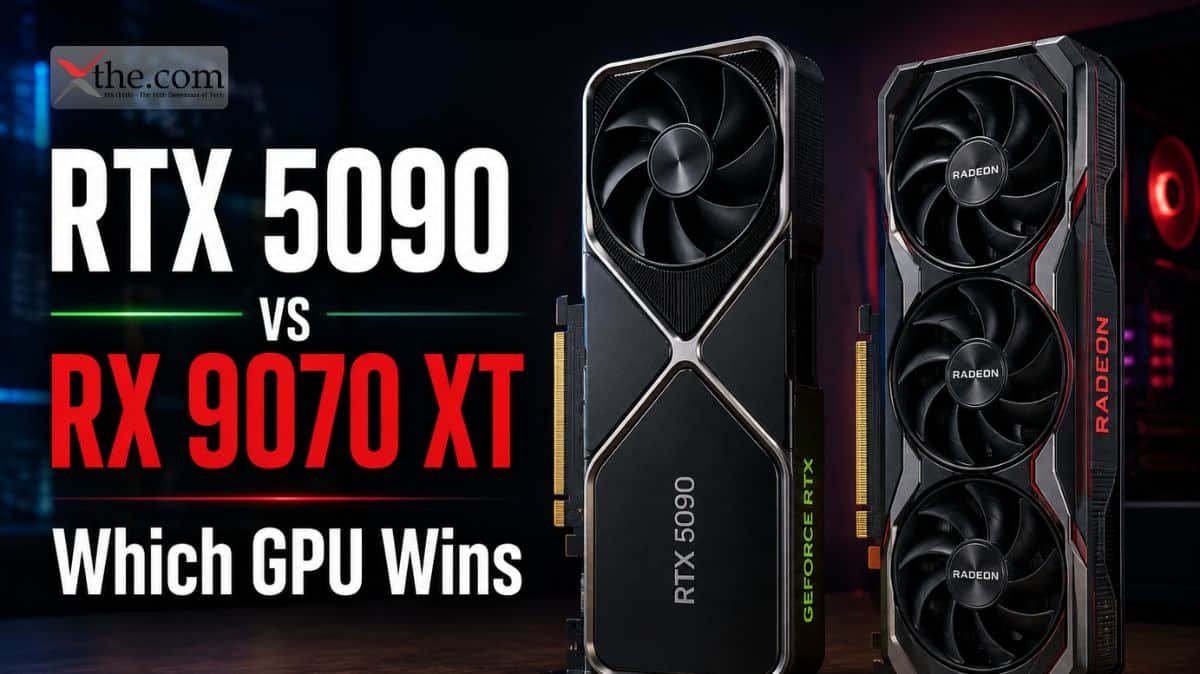
The Nvidia GeForce RTX 5090 and AMD Radeon RX 9070 XT represent two very different approaches to high-end PC gaming in 2026. Nvidia flagship GPU targets enthusiasts who demand absolute maximum performance at any price, while AMD mid-to-high-end offering aims to deliver exceptional value by providing near-flagship performance at a fraction of the cost.
Price and Value Proposition
The RTX 5090 carries a MSRP of 1,999 dollars, making it one of the most expensive consumer GPUs ever released. The RX 9070 XT is priced at 549 dollars, roughly 72 percent cheaper.
For most gamers, the value proposition of the RX 9070 XT is simply unbeatable. You get a card that handles 1440p gaming at maximum settings with ease and can even tackle 4K gaming at high settings.
Performance and Benchmarks
In raw GPU performance, the RTX 5090 is approximately 85 to 90 percent faster than the RX 9070 XT across gaming benchmarks.
At 1440p resolution, the performance gap narrows significantly. The RX 9070 XT delivers well over 100 frames per second in most modern games at maximum settings.
At 4K resolution, the RTX 5090 truly separates itself. The card maintains smooth 60-plus frame rates in virtually every modern game at maximum settings with ray tracing enabled.
Ray Tracing
Ray tracing is where the RTX 5090 demonstrates its most significant advantage. Nvidias fourth-generation RT cores deliver up to twice the ray tracing performance of AMD competing technology.
The RX 9070 XT ray tracing performance has improved significantly but still trails Nvidias best by a wide margin in the most demanding ray-traced games.
AI and Machine Learning Features
Nvidias DLSS 4 technology uses artificial intelligence to upscale lower-resolution images in real time. DLSS 4 Multi Frame Generation can effectively triple or quadruple frame rates while maintaining excellent image quality.
AMD FSR 4 has made significant strides but still does not match DLSS 4 in image quality and stability. For content creators and AI researchers, the RTX 5090 CUDA ecosystem is unmatched.
Power Consumption and Cooling
The RTX 5090 has a TGP of 575 watts, requiring a 1,000-watt power supply. The RX 9070 XT has a TGP of 304 watts, roughly half the power consumption, fitting in a wider range of cases with quieter operation.
VRAM and Memory
The RTX 5090 comes with 32 gigabytes of GDDR7 memory on a 512-bit bus. The RX 9070 XT features 16 gigabytes of GDDR6 on a 256-bit bus.
Who Should Buy the RTX 5090?
The RTX 5090 is right if you demand absolute best 4K performance with ray tracing, need maximum GPU power for content creation, rely on CUDA for AI workloads, or want the best regardless of cost.
Who Should Buy the RX 9070 XT?
The RX 9070 XT is right if you play at 1080p or 1440p, want best value per dollar, do not prioritize ray tracing, or want a capable GPU that runs cool and quiet.
Final Verdict
The RTX 5090 is the undisputed performance champion. However, at nearly four times the price, it is a luxury most gamers do not need. The AMD RX 9070 XT delivers outstanding value at roughly 25 percent of the cost. For most American gamers, the RX 9070 XT is the smarter buy.
The competitive landscape between Nvidia and AMD has never been more interesting. For years, Nvidia has dominated the high-end GPU market with little meaningful competition. The RTX 5090 continues this trend by offering performance levels that AMD simply cannot match at any price point.
However, AMD strategy of offering excellent value at lower price points has resonated strongly with the majority of gamers who do not need or want to spend 2,000 dollars on a graphics card. The RX 9070 XT represents the sweet spot of performance and value that most PC builders are looking for.
For American gamers building a new PC in 2026, the decision often comes down to budget. If you have unlimited funds and want the absolute best, the RTX 5090 is the obvious choice. If you want to build a capable gaming rig without breaking the bank, the RX 9070 XT is the smarter investment.
The availability situation also favors AMD. While the RTX 5090 has been difficult to find at retail price due to extremely high demand and limited supply, the RX 9070 XT has been much easier to purchase at or near its suggested retail price. This accessibility makes AMD card a more practical choice for gamers who do not want to wait weeks or months for stock to become available.
Software support is another important consideration. Nvidias CUDA ecosystem provides unmatched support for content creation applications, machine learning frameworks, and professional software. If you use your GPU for work in addition to gaming, the RTX 5090 offers capabilities that AMD simply cannot match.
For pure gaming, however, the experience gap between the two cards is smaller than the raw benchmark numbers suggest. DLSS and FSR upscaling technologies both deliver excellent results, and the visual difference between high and maximum graphics settings in most games is subtle enough that most players would not notice it in real gameplay.
The future of GPU competition looks promising for consumers. AMD RDNA architecture continues to improve with each generation, and the RX 9070 XT demonstrates that AMD is closing the gap with Nvidia in key areas like ray tracing and AI-powered upscaling.
For gamers who prioritize longevity, the RTX 5090 32GB of VRAM provides more headroom for future games that may demand more video memory. The RX 9070 XT 16GB is sufficient today but may become a limitation in three to four years as games continue to evolve.
Ultimately, both cards represent excellent choices for different types of gamers. The RTX 5090 is for those who want the absolute best and are willing to pay a premium for it. The RX 9070 XT is for smart shoppers who recognize that excellent gaming performance does not require spending a fortune.
The bottom line is clear: the RTX 5090 wins on performance, the RX 9070 XT wins on value, and most gamers should choose the card that best fits their budget and gaming needs.