Santa Clara, California.
The Labor Equation That American Agriculture Cannot Ignore
The USDA estimated that American farmers were short about 2.4 million agricultural workers over a recent five-year period. No changes to immigration policy or wage increases have fully solved this problem. In California, some strawberry fields are left unpicked. In Texas, there aren’t enough workers to harvest all the cotton. The crops that do make it to market end up costing more at the grocery store because of this shortage.
Advanced Micro Devices entered this equation not as a farming company but as a silicon architect one who recognized the intelligence bottleneck sitting at the center of agricultural automation. Making farm robots smart enough to operate independently in unstructured outdoor environments requires processing power that can survive dust, vibration, temperature swings, and intermittent connectivity. It requires computation that happens on the machine, not in a distant cloud data center, waiting for a 5G signal that may never arrive in a rural Iowa field.
Why the Cloud Cannot Run a Tractor
Most AI systems are designed to send data to a server, process it there, and then send back a decision. This approach works for things like recommendation engines and fraud detection, where there’s a consistent internet connection. But on a 200-acre farm early in the morning, this method just doesn’t work.
Edge computer vision needs a different approach. For example, when a robotic weeder on a tractor has to distinguish between a weed and a soybean seedling, it needs the answer in less than 50 milliseconds. If the image is sent to a remote server and the system waits for a response, even a fast network can cause delays. This lag can lead to mistakes, such as the machine acting on the wrong plant, because at the speed these machines operate, even a 200-millisecond delay is too much.
This is the core engineering problem that the Advanced Micro Devices embedded AI processor agriculture robotics manual framework handles. The intelligence must live inside the equipment itself, processing camera feeds, making classification decisions, and triggering mechanical reactions entirely onboard without any external dependency.
Advanced Micro Devices’ Rugged Embedded Processing Architecture
AMD’s embedded processor line, particularly its Ryzen Embedded and EPYC Embedded series, illustrates a deliberate departure from the data center chip design philosophy. These processors prioritize continuous performance under thermal stress, extended product lifecycles measured in years rather than product cycles, and power envelopes calibrated for battery-backed or generator-dependent field deployments.
The design combines high-performance CPUs with built-in graphics processing. This combination is important for computer vision tasks at the edge. Classifying plant species in a live video feed needs lots of parallel calculations, which a CPU alone can’t do well. AMD’s integrated graphics can handle this work efficiently, so there’s no need for a separate, power-hungry accelerator board.
For companies that build farm robots, this implementation makes the onboard computer smaller and less susceptible to vibration-induced failure. This is important because these machines often run for 10 to 12 hours a day over rough fields, which can cause significant wear and tear.
This level of embedded processing also enables combining data from different sensors, which is needed for advanced crop tending. A robotic weeder doesn’t just use regular cameras. It also uses multispectral sensors to detect plant health, depth cameras to measure plant shapes, and GPS to know its position in the field. AMD’s processors can handle all these data streams at once, so no single sensor slows down the others.
Autonomous Agriculture in the Field: What It Actually Looks Like
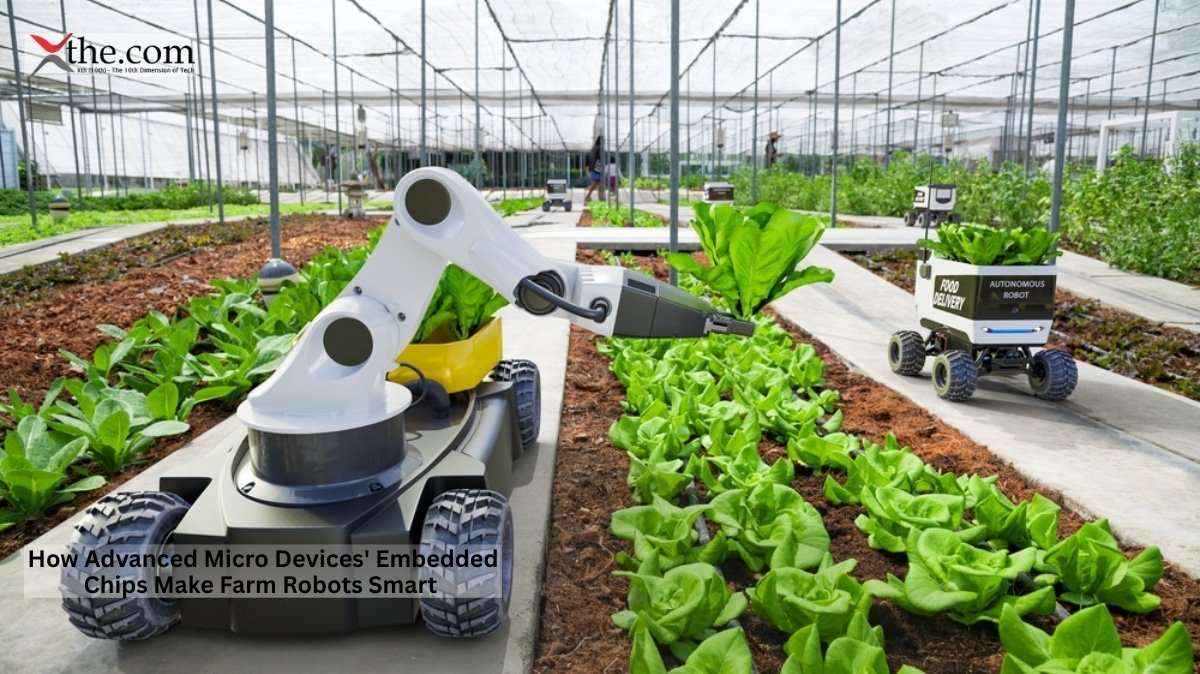
Imagine a 600-acre corn farm in central Illinois. The farm uses two robotic crop-tending machines. Each one has a set of forward-facing cameras and a mechanical arm that can apply herbicide to specific spots or pull out weeds. These machines move at about three miles per hour and can cover around 40 acres each day.
The edge computer vision system on these machines, powered by AMD processors, captures about 30 frames per second from each camera. For every frame, the onboard neural network identifies each plant it sees corn, weeds, soil, or residue and gives each individual a confidence score. If the score is high enough, the machine acts. If not, it records the event for later review.
This is what autonomous agriculture looks like in real life. These aren’t remote-controlled machines waiting for someone to tell them what to do. They make thousands of decisions every hour, all derived from real-time visual data processed right on the machine.
The economic benefits come straight from how these systems work. The University of Illinois Extension found that weeds can cut corn yields by 10 to 50 percent if not managed. Using AI-powered precision weeding means herbicides are used only where needed, reducing chemical costs and helping keep the soil healthy for future crops.
The Advanced Micro Devices Embedded AI Processor Agriculture Robotics Manual Approach to Field Conditions
Building equipment for farms requires engineering standards that regular consumer or business hardware doesn’t have to meet. For example, inside an uncooled cab in Kansas in July, temperatures can hit 140°F. Dust, hydraulic fluid mist, and constant vibration can ruin standard circuit boards in just one growing season.
AMD’s embedded products are built to handle these tough conditions. They are rated for temperatures from -40°C to 85°C, can be coated for added protection, and meet strict shock and vibration standards. These aren’t just marketing claims they’re based on real tests in the places where farm equipment is actually used.
Manufacturers who use AMD’s embedded platform for autonomous farm equipment benefit from long-term supply commitments. AMD keeps these products available much longer than consumer chips, which often change every 18 months. Tractor makers can’t redesign their computers every two years, so this long product life lets them build a system once and use it for an entire generation of machines.
Putting Intelligence Where the Dirt Is
Advanced Micro Devices didn’t start with the goal of fixing the farm labor shortage. Their aim was to make processors that could run AI in harsh conditions with limited power, high heat, and heavy vibration. It turns out that American farm robots, which need to quickly distinguish crops from weeds, are a perfect fit for this technology.
The wider implication runs past any single crop or farm. As autonomous agriculture platforms mature and per-acre deployment costs decline, the economics of robotic crop tending will become accessible to mid-scale operations that currently lack a viable automation path. The intelligence that AMD’s embedded processing architecture places directly onto field equipment does not replace the farmer. It extends what a single operator can manage, monitor, and sustain across acreage that no human crew could cover with equivalent precision. That is the more durable story not automation displacing labor, but computation amplifying it.
Source: AMD Press Releases