



Redmond, Washington | July 2, 2026
An analyst working with emerging-market debt might spend up to ninety minutes each day switching between different platforms one for bond prices, another for earnings transcripts, and a third for macroeconomic data. When you consider this across a trading floor of 200 people, the time lost to switching tools becomes a high hidden cost. Microsoft believes it has solved this problem by building a solution into the world’s most widely used financial data platform.
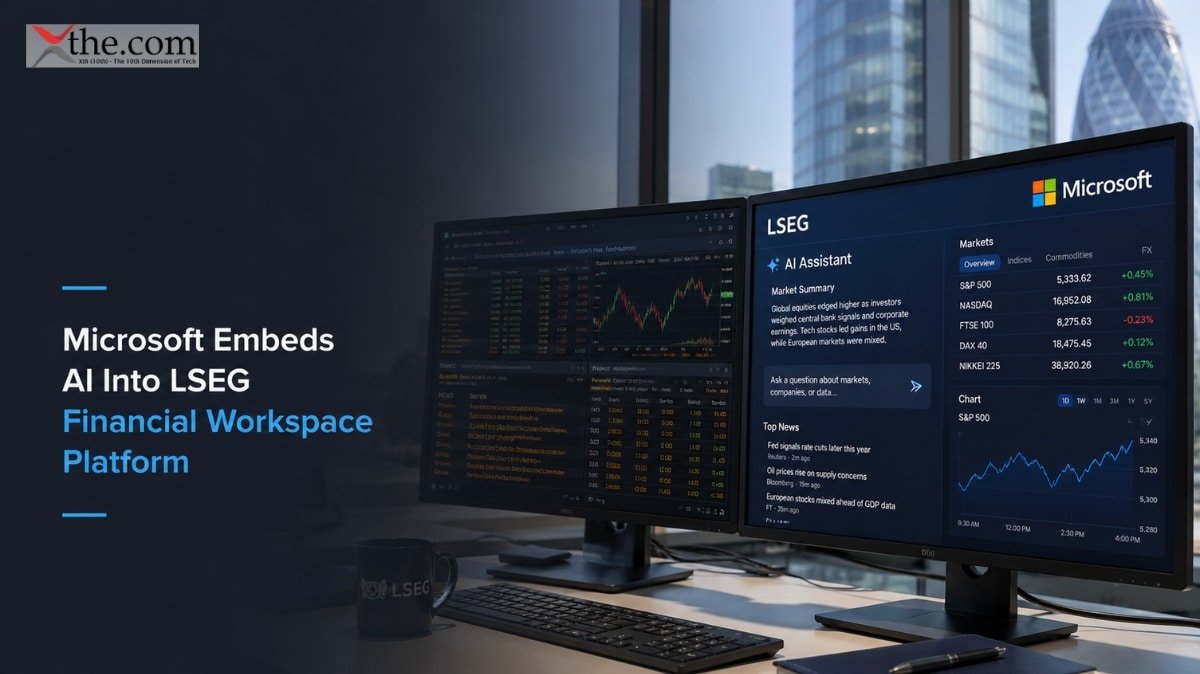
Microsoft Commercial Business CEO Microsoft Judson Althoff LSEG confirmed on July 2 that Microsoft’s engineers and industry experts worked directly with the London Stock Exchange Group to add artificial intelligence to LSEG Workspace. This terminal is used by hundreds of thousands of finance professionals worldwide. The result is a Microsoft LSEG AI partnership that allows analysts to ask complex questions spanning both structured data, such as pricing and index numbers, and unstructured data, such as filings and call transcripts, all within one platform. This move is perhaps Microsoft’s strongest indication so far that enterprise AI will first create value in financial services.
Why LSEG Workspace Was the Proving Ground
LSEG Workspace was chosen for a reason. It is central to the daily work of traders, portfolio managers, and risk officers who must match fast-changing market data with slower corporate disclosures. Before this implementation, analysts did this work manually. For example, someone tracking a mid-sized industrial company would review the latest earnings call, compare it with changes in bond spreads, and then check inflation data to see how interest rates might affect refinancing costs. Each step required opening a new tab, logging in again, and changing focus.
With LSEG Workspace AI, that entire process can be done with a single query. Now, an analyst can ask the platform to compare an earnings transcript with bond market movements and macroeconomic data all at once, and get a combined answer instead of three separate data pulls. This is how Microsoft defines AI financial data analysis not as a simple chatbot added to a terminal, but as a reasoning tool that integrates diverse financial information into a single dataset.
The Mechanics Behind the Integration
This partnership was more than merely a licensing agreement. Microsoft sent its engineers the same experts involved in its $2.5 billion Frontier Company initiative to work directly within LSEG’s workflows. Althoff explained that the system is designed as a continuous improvement loop between the two platforms, using real client feedback and live user testing instead of relying on one-time model training. This difference is important. A model trained only once can become outdated as markets change, but a system adjusted based on real trading-desk use becomes more useful over time, according to Microsoft.
This is the wider thesis behind Microsoft enterprise AI finance work: value comes not from a general-purpose assistant but from deep, iterative integration with the specific data plumbing of an industry. LSEG’s Workspace platform, built on the legacy of the Refinitiv data business, already carries decades of structured financial content. Layering reasoning capability on top of that foundation, rather than building a rival dataset from scratch, is what allowed Microsoft to move quickly.
The Bloomberg Terminal Problem
Any discussion of LSEG Workspace naturally brings up comparisons to Bloomberg Terminal, which has set the standard for professional financial data access for over thirty years. Bloomberg’s strength comes from its closed system: unique hardware, a well-known yet unusual interface, and a subscription that costs more than $20,000 per user each year. This advantage has lasted because competitors have not offered a truly different way to work with financial data just less expensive versions of the same process.
London Stock Exchange AI capability changes that calculus. Rather than competing on data breadth alone, where Bloomberg still holds real advantages, the Microsoft-LSEG integration competes on reasoning speed across data types Bloomberg users currently have to assemble by hand. If an analyst can get a synthesized answer to a cross-asset question in seconds within Workspace, the incentive to pay a premium for a terminal that requires the same manual assembly erodes. This is not a knockout blow. Bloomberg’s network effects, particularly its instant-messaging layer used for interbank communication, remain a genuine switching cost. But industry observers are already calling this the most credible challenge to Bloomberg’s default status in years.
What Finance Professionals Should Expect Next
So far, the rollout has centered on query-based analysis instead of letting the AI make decisions on its own. This is intentional, given the strict regulations around financial advice. Compliance teams at large asset managers will want to know that AI-generated answers are based on clearly sourced data, and Microsoft has stressed that the system uses LSEG’s licensed content rather than information from the open web. This detail will likely determine how quickly risk and compliance teams approve wider use in regulated organizations.
For anyone tracking Microsoft embeds AI into LSEG Workspace financial platform and what it means for investors in 2026, the immediate effect is not about a single distinctive feature. Instead, it is about changing expectations. Finance professionals who are used to switching between several systems to answer a single question will now expect that process to become much smoother. Competing data-terminal providers will feel pressure to keep up or explain why they cannot.
The Wider Stakes for Microsoft’s AI Finance Ambitions
This LSEG project is not happening on its own. It was announced alongside Microsoft’s launch of Frontier Company, a $2.5 billion plan to send about 6,000 engineers and industry experts directly into client organizations to build AI systems for specific needs. LSEG is one of the main examples Microsoft uses to demonstrate the value of this investment, alongside clients in consumer goods, agriculture, and pharmaceuticals. The framing is deliberate: Microsoft wants the market to see its Microsoft AI finance tools not as a bolt-on feature to Office or Azure, but as proof that its enterprise AI approach delivers real results in some of the world’s most complex, data-heavy industries.
For anyone following the Microsoft-LSEG AI partnership, Judson Althoff’s financial data intelligence explained, July 2026, the main point goes beyond a single product update. Microsoft is betting that the future of enterprise AI will be decided by how deeply it integrates with real industry data, not just by model size. If this approach succeeds, the long-standing competition among financial terminals could be entering its first real change since Bloomberg’s rise in the 1980s. Competing data providers are likely to respond soon, as the need to match this level of integration becomes hard to ignore.
Source: AI Age Microsoft commits $2.5 billion and 6,000 employees to new AI implementation unit