






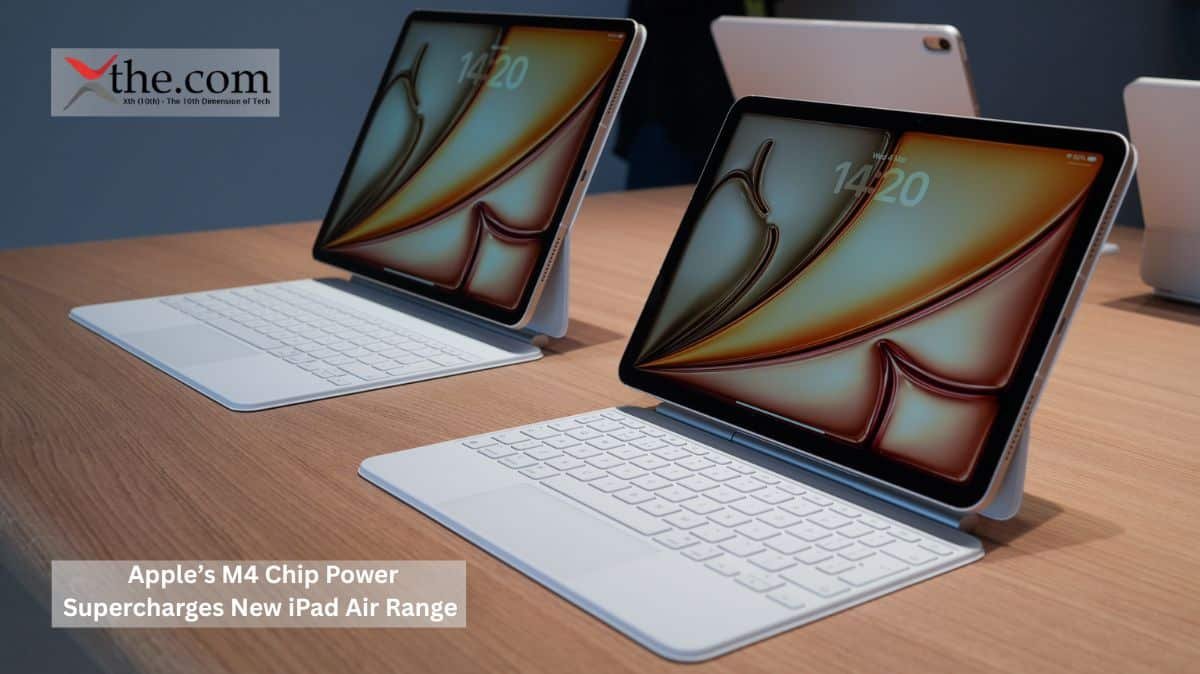
Cupertino, CA.
Atomic Answer: Apple Inc. (AAPL) has officially scaled its advanced M4 custom silicon architecture into the redesigned iPad Air series, pushing massive computational performance gains out to mobile professional workstations. The hardware integration features an advanced 16-core neural engine and a 12 GB unified memory architecture, yielding a 50% increase in overall system memory bandwidth. The underlying silicon upgrades enable mobile creative professionals to execute highly demanding local rendering tasks and complex machine-learning visual adjustments with desktop-class efficiency.
A 4K video timeline that stutters during rendering costs more than patience. For creative teams, it burns billable hours. For developers, it delays deployment cycles. Apple’s latest iPad Air line eliminates those bottlenecks by bringing desktop‑class silicon into a thinner, lighter device category. The new M4‑powered tablets place edge-silicon performance and creative-production hardware at the center of mobile computing rather than treating them as secondary benefits.
This change is important because tablets are no longer just for casual browsing. Designers edit RAW photos on location; architects check 3D models from job sites, and video editors start cutting footage before leaving the set. Apple clearly wants the iPad Air to be seen as a real production tool, not just a device for consuming content.
The M4 Architecture Pushes Beyond Incremental Upgrades.
The headline feature behind the Apple iPad Air M4 chip performance upgrade specifications 2026 discussion is the company’s strong focus on silicon efficiency. Apple built the M4 on a more advanced processing node, allowing the chip to deliver better thermal efficiency while increasing computational throughput.
That directly affects edge silicon performance in professional workloads. Applications like Final Cut Pro, Logic Pro, and Adobe Lightroom demand sustained processing under heavy multitasking. Earlier iPad Air generations balanced performance with battery preservation, forcing compromises during long editing sessions. The M4 changes that.
Apple’s upgraded neural engine processing deserves attention as well. The company claims the chip executes AI‑driven tasks at much higher speeds than previous iPad and iPad Air models. This affects everything from automatic photo enhancement to live transcription and AI‑assisted video masking.
For creative professionals, these gains are practical. A freelance editor handling multi‑cam interviews can process scene detection and voice isolation directly on‑device without pushing workloads into the cloud. This reduces latency and improves privacy protections.
Why Unified Architecture Matters For Creative Workflows.
Apple continues to refine its unified memory architecture with benefits extending beyond benchmark charts. Traditional mobile systems separate memory pools for graphics and CPU operators, leading to inefficiencies when handling large media assets.
The M4’s integrated design lets applications access the same memory resources without duplication. This improves responsiveness during intensive workflows like 3D rendering, layered illustration files, or high‑resolution video editing.
The impact is clear in professional software ecosystems. A designer moving between Procreate, Blender, and DaVinci Resolve can keep larger project files in active memory without frequent app reloads. Combined with stronger system memory bandwidth, the device sustains smoother transitions across complex workflows and workloads.
Apple also recognizes that modern software increasingly relies on GPU‑intensive operations. The inclusion of hardware‑accelerated ray tracing signals a deeper push into advanced graphics rendering. Game developers, industrial designers, and AR creators benefit immediately because lighting simulations and reflection processes are more efficient in real time.
This upgrade turns the iPad Air from just a productivity tablet into real creative hardware. It brings Apple’s mobile devices much closer to workstation‑level laptops, something earlier models couldn’t quite do.
App Developers Gain New Optimization Opportunities
The M4 rollout pressures developers to rethink software design strategies. More processing headroom creates opportunities for deeper app layout optimization, especially in multitasking environments.
Applications can now support more responsive split‑screen workflows, richer animations, and AI‑driven interface adjustments without overwhelming system resources. Productivity apps benefit greatly. Financial analysts reviewing dashboards alongside video calls, for example, require stable multitasking under sustained workloads.
Apple’s silicon strategy increasingly focuses on local intelligence rather than remote dependency. Faster neural-engine processing enables real‑time contextual adjustments directly on the device. Translation apps respond faster. Drawing tools predict brush behavior with lower latency. Educational platforms personalize interfaces dynamically during use.
This combination of edge silicon performance and efficient software integration reflects Apple’s longstanding advantage: vertical ecosystem control. The company designs the chip, operating system, and hardware together instead of coordinating across multiple vendors.
The Competitive Pressure On The Tablet Market Intensifies.
The broader tablet market faces a difficult challenge. Competing manufacturers can match display quality or battery life, but replicating Apple’s balance of silicon integration and software optimization remains hard.
The Apple iPad Air M4 chip performance upgrade specification 2026 conversation centers on workflow consolidation. Users increasingly want one portable device capable of professional editing, entertainment, collaboration, and AI-assisted productivity.
Apple’s focus on creative production hardware suggests the company sees tablets evolving into primary computing platforms for certain industries. That prediction no longer sounds speculative. A photographer editing commercial campaigns from an airport lounge or a developer compiling code during travel reflects reality rather than a futuristic concept.
The M4 iPad Air doesn’t replace high-end desktops. Big film projects and large-scale engineering still need powerful workstations. But Apple is closing the performance gap faster than its competitors can keep up.
That trajectory may define the next phase of personal computing, where mobility no longer requires compromise or a limit on system memory bandwidth. AI acceleration and graphics rendering coexist inside devices thin enough to fit into a messenger bag.
Technical Stack Checklist
- Refactor visual editing application rendering pipelines to harness local hardware-accelerated ray tracing.
- Adjust application memory allocation caps to make full use of the expanded 12GB unified memory space.
- Update local machine learning models to leverage the performance gains of the 16-core Neural Engine.
- Test application UI responsive layers to ensure they map cleanly to updated platform layout standards.
- Validate secure on-device file storage parameters to support heavier processing tasks without causing lag.








