






San Francisco, California.
Most laptop owners don’t pay attention to the details of their AI features, but it’s worth knowing how they work. Almost every smartphone on a Windows or Mac laptop, like writing assistants, image generators, or meeting summarizers, sends your data to a remote server before giving you a result. This means your words, files, and ideas travel over the internet before you can use them. If you’re on a plane in a remote office or using a VPN that blocks cloud access, these features won’t work.
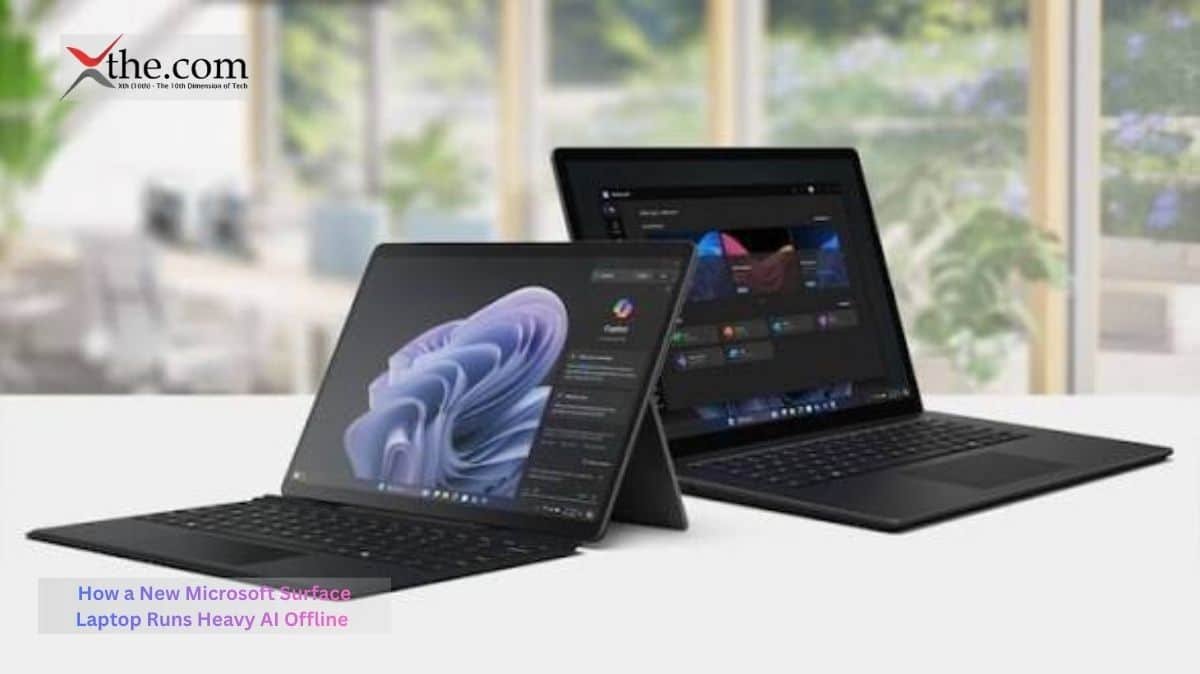
The Microsoft Surface Laptop Ultra, introduced here at Computex 2026, removes that reliance by handling AI tasks directly on the device.
The Microsoft Surface Laptop Ultra And How It Runs AI Offline.
Microsoft introduced the Surface Laptop Ultra at Computex 2026 in Taiwan, calling it the most powerful device they’ve ever built. It’s designed for creators,developers, and AI researchers who need strong performance in a portable laptop. Instead of relying on faster connections to better servers, this laptop removes the need for a server for most tasks.
The chip delivers 1 petaflop of AI computing power, enabling the Surface Laptop Ultra to run 120-billion-parameter AI models right on the device without sending data to the cloud. To put this in context, these models are similar to advanced large language models that most people can access only online with a subscription. Being able to run such a model on a laptop privately and instantly, even without an internet connection, is a big change from what smartphones and portable computers have offered before.
The NVIDIA RTX Spark Mobile Superchip, Where the Capability Lives.
This is possible thanks to the NVIDIA RTX Spark Mobile Superchip, which is new to the Windows laptop market. It’s built using TSMC’s 3 nm process and includes a 20-core ARM-based Grace CPU from MediaTek, plus a Blackwell-based GPU with 6,144 CUDA cores and fifth-generation Tensor cores for running AI tasks directly on the laptop.
The NVIDIA RTX Spark Mobile Superchip is based on the same Grace Blackwell family used in large enterprise data centers. It combines a 20-core ARM CPU with a powerful Blackwell generation RTX GPU. This is important because the same technology that runs AI in big data centers now fits into a laptop that’s less than 18 millimeters thick and weighs under two kilograms.
Microsoft Surface Laptop Ultra NVIDIA RTX Spark Hardware Specs: The numbers that define the machine
The hardware specs of the Microsoft Surface Laptop Ultra with the NVIDIA RTX Spark chip are best explained with a real-world example. Picture a cybersecurity analyst who needs to run a local AI model on sensitive network logs that aren’t cleared from the company’s network. Before, this analyst had to choose between going without AI help or using a bulky desktop workstation. Now, with Surface Laptop Ultra offering another option, up to 128 GB of shared memory for the CPU and GPU to use together via NVIDIA’s NVLink service interface. This allows AI models, 3D rendering, and multiple tasks to run simultaneously without exceeding memory limits.
Andrew Head, Microsoft’s corporate vice president of Surface, called the device “the most powerful thing we’ve ever made.” The NVIDIA RTX Spark chip offers graphics performance similar to an RTX 5070 laptop GPU, and its power use ranges from just a few watts to up to 80W, depending on what you’re doing. This broad power range means the chip can save battery during light tasks and ramp up for demanding work, all without needing a remote server.
Shared Memory Architecture And Why It Ends the Bottleneck.
The shared memory design isn’t just a selling point. It fixes a long-standing problem in laptop AI. Normally, the CPU and GPU each have their own memory. If an AI model needs more memory than the GPU has, the system slows down or stalls. The Surface Laptop Ultra is the first Surface device to use the Blackwell RTX GPU with a unified memory setup, which can be configured to 128 GB. This memory is shared between the CPU and GPU as needed, so you can run AI tasks, 3D rendering, and multiple workflows at once without slowdowns.
For example, a video editor using a local AI upscaling tool on a 4K timeline and asking a local language model for caption ideas doesn’t have to pick which task gets the memory. The system automatically shares memory, so both tasks run properly without interruptions.
Build Keynote Launch Context: What This Signals To Competitors
The build keynote launch happened just hours after NVIDIA CEO Jensen Huang introduced the RTX Sparks platform at his Computex keynote in Taipei. This marks the first time NVIDIA chips have powered a robust PC as the main processor, ending Intel and AMD’s longstanding dominance in the PC market.
This isn’t just a small update. It’s a major change in the Windows hardware world, and it puts pressure on Apple’s well-known approach to efficient integrated processing. NVIDIA’s new Windows on the ARM platform claims to be more powerful than any competitor, with 20 ARM CPU cores, a Blackwell GPU with 6,144 CUDA cores, 128 GB of unified LPDDR5X RAM, and up to 300 GB of memory bandwidth.
For enterprise buyers who have seen AI features grow in software but lack the hardware to run them securely, the Surface Laptop Ultra sets a new standard. Relying on the cloud for AI tasks isn’t a technical requirement; it was a hardware limitation. Now, by running AI locally, professionals can keep sensitive data secure, use advanced AI tools on their own devices, and work faster and more privately.
The laptop will be available later in 2026, but pricing hasn’t been announced yet. Once the price is set, it will determine whether this technology becomes widely available to professionals or remains limited to large companies. That decision will also determine how quickly Windows hardware makers respond.
Source: Microsoft Blogs








