






Austin.
Atomic nature: Meta, and AMD have committed to a six-gigawatt GPU deployment centered on the custom MI450 Instinct chip. This massive power allocation signals a shift toward massive sovereign AI factories that require HBM4 memory and next-gen Venice EPYC CPUs.
Today, a single hyperscale AI campus can use more electricity than a mid-sized American city. Because of this, cloud providers are rethinking rack density and cooling systems. Simply adding more GPUs no longer guarantees better AI performance as energy needs approach six gigawatts.
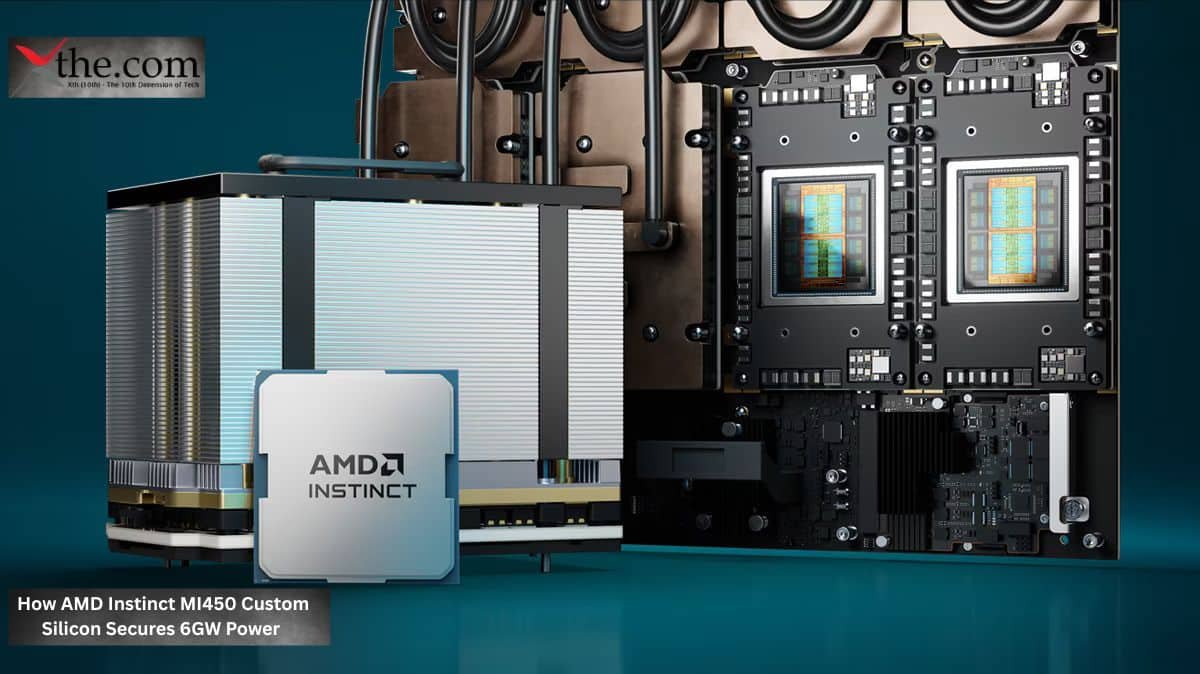
This pressure is why GPU networking and AI circuits are now boardroom priorities, not just technical topics for infrastructure teams. It also explains the focus on AMD Instinct accelerators and the upcoming AMD Instinct MI450 Meta product, which many analysts view as a key test for the future of AI infrastructure.
Why 6GW Changes the Economics of AI Infrastructure
Six gigawatts is a concrete number. It equals the output of seven nuclear reactors or large utility energy networks focused almost entirely on AI computing.
For hyperscalers such as Meta, the main challenge is not only building faster processors. They need to keep large compute clusters running efficiently without power bottlenecks that could delay deployments.
This is where AMD Instinct comes in.
AMD’s next MI450 platform is expected to offer better memory efficiency, improved interconnects, and stronger thermal management for large AI workloads. Experts think it will use HBM4 memory to boost bandwidth and reduce energy waste per inference task.
This engineering change is important, because modern AI factories are different from traditional data centers. Regular workloads can handle some delays, but training large language models can’t. These environments require synchronized performance spanning thousands of accelerators running nonstop for weeks or months.
If GPU networking is not highly optimized, these clusters quickly lose efficiency.
The Networking Bottleneck No One Can Ignore
Discussions about AI infrastructure often focus on GPUs, but the network fabric is just as important.
If the interconnect design is poor, thousands of costly accelerators can sit idle waiting for data to sync. This inefficiency is a serious financial risk at the multi-gigawatt scale.
AMD’s latest AMD Instinct strategy reflects this reality. Instead of treating networking as a secondary hardware layer, AMD appears to be positioning interconnect performance as a core part of the compute stack.
The planned integration of MI450 accelerators with a high-speed fabric could significantly reduce communication overhead between nodes. This is crucial for distributed training where huge models constantly share data across thousands of systems.
For companies building large AI factories, network congestion is now a direct cost. Every millisecond of data syncing increases power consumption and reduces throughput.
This is why hyperscalers now judge AI hardware by overall system efficiency, rather than just individual benchmark scores.
How 6th Gen EPYC Expands the AI Factory Model
The processor next to the GPU is more important than many executives think.
AMD’s 6th gen EPYC platform is expected to play a key role in managing AI workloads, storage, and inference coordination for accelerator clusters. While GPUs handle heavy computation, CPUs still perform tensor-intensive tasks such as scheduling, memory management, and workload balancing.
This is especially important in large AI circles where keeping compute resources fully utilized is necessary to justify major investments.
Picture a 500,000-GPU setup running below peak efficiency because storage management introduces small delays between nodes. Even a slight drop in performance at this scale can cost millions in electricity each year.
The combination of AMD Instinct 6th-gen EPYC and HBM4 is meant to solve these infrastructure problems holistically, not just in small steps.
This systems-level approach is similar to how hyperscalers build their own custom cloud infrastructure. Vendors who do not optimize the whole stack risk becoming less relevant in big enterprise projects.
Meta’s Influence on the MI450 Rollout
Few companies shape infrastructure trends like Meta.
When Meta changes its hardware-buying strategies, suppliers in power, networking, semiconductors, and cooling often adjust their plans accordingly. This is why the industry is watching the AMD Instinct MI450 deployment timeline so closely.
If the rollout speeds up as expected, it could prove that AMD’s focus on energy efficiency and networking scalability, not just raw power, is the right approach.
Meta faces huge infrastructure demands from generative AI, recommendation systems, video processing, and new virtual environments. Running these systems well means balancing compute density with real power limits.
The economics are tough.
At the multi-gigawatt scale, even small efficiency improvements can save billions in operating costs over time. This is why hyperscalers now pressure custom silicon partnerships and tightly integrated hardware systems.
The AMD Instinct MI450 Meta rollout is more than just a product launch. It could indicate whether hyperscalers are ready to move beyond traditional GPU supply chains that have driven AI infrastructure spending in recent years.
Why AI Factories Depend on Energy-Aware Silicon
The term ‘AI factories’ now describes real industry operations, not just marketing.
Modern AI campuses use supply chain coordination, energy planning, cooling logistics, and backup systems, much as advanced factories do. Every design choice affects long-term success.
In this environment, silicon designs that deliver more computing power per watt are more valuable than those that just post bigger benchmark numbers.
Edge using HBM4 in future AMD Instinct systems could be a key since memory bandwidth limits are holding back large models. Faster memory helps reduce bottlenecks, but it also creates more heat, so efficient packaging is just as important as compute density.
At the same time, improvements in GPU networking are changing how hyperscalers design their data centers. Old rack-level designs do not work when AI clusters need very low-latency communication across large spaces.
The companies that first solve these engineering challenges will shape the next decade of AI infrastructure economics.
The race is no longer about making the fastest chip. It is about building integrated systems that can keep AI running at huge energy magnitudes nonstop.
- Enterprise Procurement Checklist:
- $AMD Data Center revenue up 57% YoY; focus is now MI450/EPYC.
- Infrastructure: First 1-GW of Meta capacity is now scaling.
- Thermal: 6th Gen EPYC (Venice) is optimized for high-density power per watt.
- Supply: AMD is scaling Samsung HBM4 supply for MI455X variants.
- Action: Secure Q4 allocation for 5th Gen EPYC VMs (Google H4D/Azure).








