





San Diego, California.
Not long ago, building a drone that could recognize faces, avoid obstacles, and log its own flight data would cost a university lab between $2,000 and $5,000 just for the hardware, even before any coding began. For American hobbyists, high school robotics teams, and hardware startups working out of garages and maker spaces, that price has been a major barrier to turning an idea into a working prototype. The Arduino Ventuno Q is designed to remove that barrier, and with a price under $300, it brings impressive capabilities.
What the Arduino Ventuno Q Qualcomm Chip Processing Specs Actually Deliver
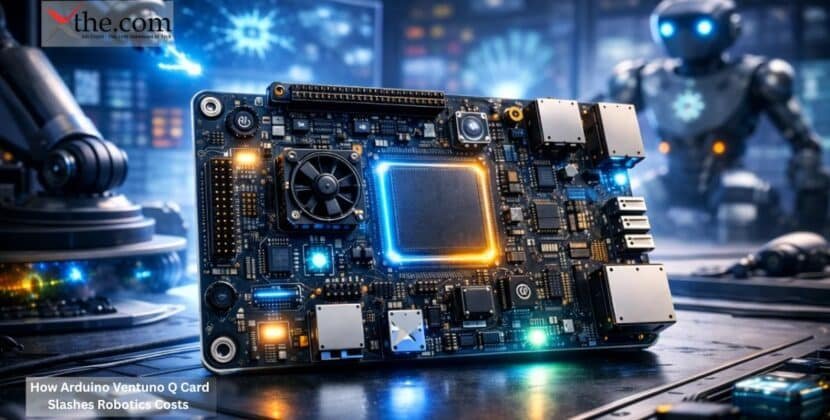
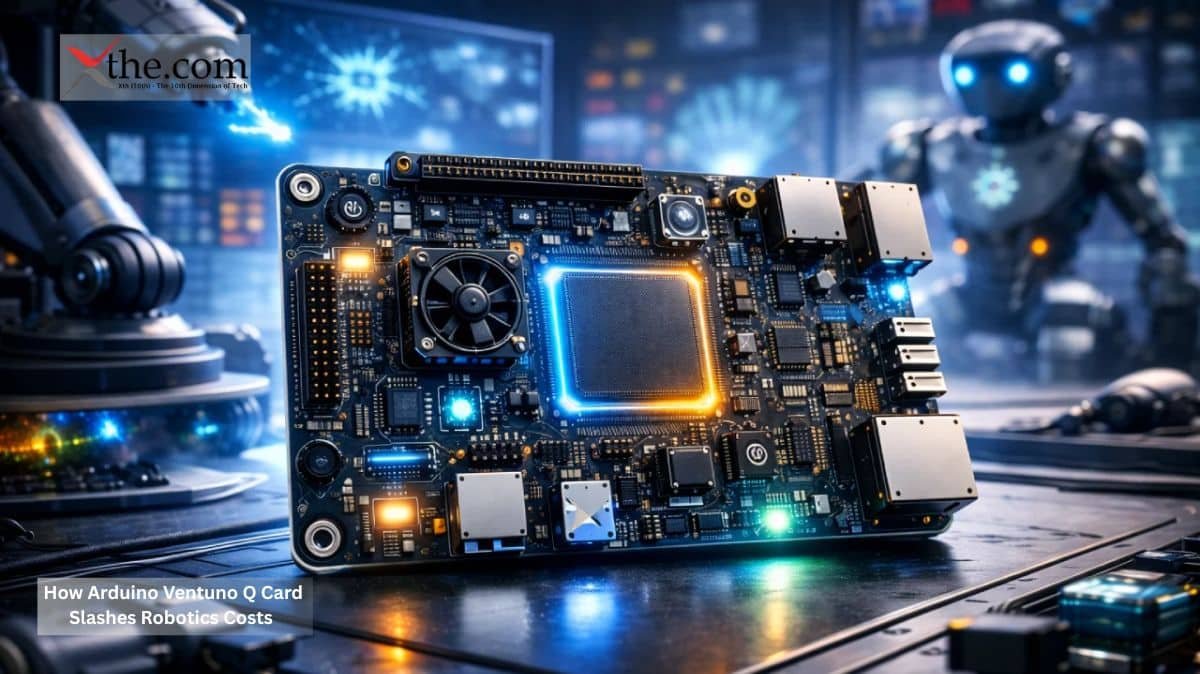
The Arduino Ventuno Q is the first high-performance development board from Arduino, which Qualcomm acquired in 2025 to fully integrate Qualcomm’s advanced chipset technology. At its core sits the Qualcomm DragonWing IQ 8 (IQ-8275) system-on-chip, which includes an eight-core ARM Cortex CPU, an Adreno GPU, a Hexagon Tensor NPU capable of up to 40 TOPS, and a Qualcomm Spectra 692 image signal processor. Alongside the main chip, an STM32H5F5 microcontroller runs in parallel to provide precise industrial control.
That dual brain architecture is the technical detail worth dwelling on. Most micro-computer development boards force a trade-off: either you get a powerful processor capable of running AI models, or you get a real-time microcontroller that will work with the deterministic timing that motors and servo actuators require. The Ventuno Q runs both simultaneously, connected via a remote procedure call bridge that lets the high-level AI processor and the low-level motor controller communicate without interfering with each other’s timing requirements.
With 16GB of LPDDR5 RAM, users can load bigger models, handle high-definition images, and run demanding robotics algorithms smoothly. The 64GB eMMC offers reliable storage for operating systems, frameworks, models, and data, and there is an M.2 NVMe Gen4 slot for more storage if needed.
To put 40 TOPS in perspective, the Apple M4 chip offers about 38 TOPS, and Nvidia’s Jetson Orin Nano, a popular choice for edge AI developers, reaches 40 TOPS. The Ventuno Q matches this performance, but costs much less than the Jetson Orin Nano.
How the Qualcomm DragonWing Partnership Makes Smart Tech Sourcing Viable.
After Qualcomm acquired Arduino in 2025, the Ventuno Cube became the first product to fully show what this partnership can do. It combines Qualcomm Dragon Wing processing power with Arduino’s well-known developer ecosystem, all in a microcomputer board that is affordable for everyday builders. This combination is important for smart tech sourcing decisions at the individual and institutional level.
A student robotics lab can now buy 5 of these boards for less than $1,500 hardware that would have needed a grant and a budget request just 2 years ago. A startup working on a small-scale manufacturing inspection system can build and test the entire process on a single board before spending money on production hardware. When a development platform costs $300 instead of $3,000, it completely changes how teams can experiment and improve their ideas.
Arduino says its goal with the Ventuno Q is to make cutting-edge robotics and edge AI available to every developer, educator, and innovator. The board supports a complete robotics stack, including vision processing and precise motor control for detailed tasks.
What Small-Scale Manufacturing and Drone Builders Can Actually Build
What sets the Ventuno Q apart from other computing models is its connectivity. The board supports Wi-Fi 6, Bluetooth 5.3, 2.5 Gbps Ethernet, USB camera support, and expansion through an M.2 NVMe Gen 4 slot. It can handle three or more camera streams at once via USB and MIPI-CSI interfaces, works with both Raspberry Pi HATs and Arduino Uno shields, and uses 3.3V logic, eliminating the need for voltage conversion in mixed-hardware projects.
For a drone builder, that specification profile means onboard vision processing across multiple camera fields, real-time motor control, and wireless telemetry connectivity, all from a single board that draws modest power. For a small-scale manufacturing shop building an automated inspection arm, this means simultaneous image capture, defect classification, on-device NPU processing, and motor commands to the arm’s actuators without any cloud dependency, thereby slowing the response loop.
The board can also run AI systems that work completely offline, such as smart kiosks, healthcare systems, and traffic flow analysis. It is also useful for edge AI vision and sensing projects where internet access is not always available. This offline feature is especially important for American builders working in places where Wi-Fi is unreliable, like factories, farms, field sites, and mobile setups.
The App Lab: Where Smart Tech Sourcing Meets Software Accessibility
Hardware specifications tell only part of the story of Slash’s Robotics costs. The software environment that ships with the board determines whether a first-year engineering student can use it easily or if the learning curve will eat up any savings.
When Arduino released the UNO Cube in October 2025, it also launched AppLab, a single environment for creating Arduino sketches, Python scripts, and AI models. AppLab connects embedded programming, Linux development, and edge AI, giving users a complete environment for their projects. The Ventuno Q uses the same ecosystem.
The Arduino App Lab includes pre-trained AI models for large language tasks, vision-language, speech recognition, gesture recognition, pose estimation, and object tracking. All of these work offline without needing a cloud subscription. For example, a hobbyist making a gesture-controlled home automation system can use a pre-trained gesture model from App Lab, adjust it for their phone gestures, and have it run in just an afternoon.
The Arduino Ventuno Q is launching at a time when hardware costs for building smart systems are dropping, yet professional-grade robotics hardware remains expensive for individuals and small teams. With a price under $300 and availability starting in Q2 2026, the Arduino Store and other retailers will offer it. This board offers the most direct way for makers to turn a robotics idea into a working AI-powered prototype at this price. Now, American builders don’t have to ask if they can afford the hardware. They just have to decide what to build first.
Source: Qualcomm Newsroom