




Austin, Texas.
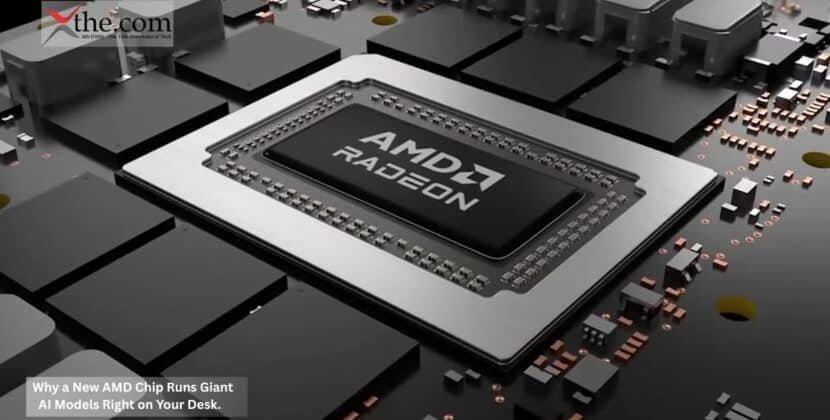
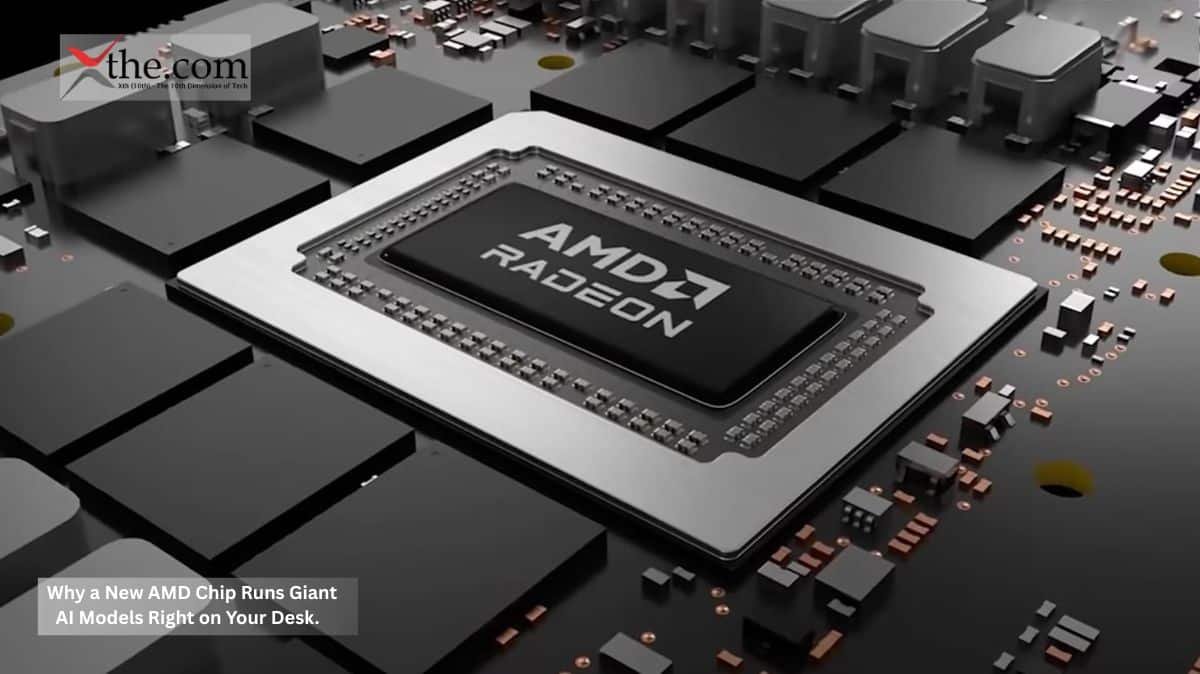
Whenever you send your source code, client contracts, or financial models to a cloud-based AI tool, they travel across networks you do not control. AMD’s new AMD chip, the Ryzen AI Halo, changes that equation by letting you run giant AI models right on your desk, with no need for a cloud connection. For American developers and small business owners worried about data exposure, AMD has just opened a new option.
The Memory Problem That Kept AI Locked in Data Centers
Running a complex large language model depends more on memory than on processing speed. A 200-billion-parameter model needs a huge amount of fast, accessible memory just to store its weights before it can process any input. This is why, for years, serious AI work was limited to large data centers filled with expensive server hardware. Regular desktop computers simply did not have enough memory.
The AMD Ryzen AI Halo directly tackles this limitation. It supports up to 128 GB of unified memory, enough to run models with up to 200 billion parameters locally. This lets developers use large, powerful models that once needed cloud infrastructure. This is not a feature for laptops or mobile chips centered on efficiency. It is a workstation-class engine meant to sit on your desk and handle workloads that data centers would consider serious.
What the AMD Ryzen AI Halo Computer Memory Chip Specifications Actually Mean.
To understand why unified memory is important, it helps to look at computer architecture. In most regular computers, the CPU and GPU can have their own separate memory. When the GPU needs data from the CPU, it has to copy it, which adds delay and limits how much each processor can handle independently.
Unified memory removes this barrier. The Ryzen AI Max Plus 395 in the Ryzen AI Evo has 16 Zen 5 CPU cores and 32 heads, a Radeon 8060S RDNA 3.5 GPU with 40 compute units, and an XDNA 2 NPU that delivers 50 TOPS of AI compute. It supports a 256-bit LPDDR5X memory interface running up to 800 MTs with a quad-channel setup built on TSMC’s 4nm process. All parts of the chip use the same memory simultaneously without needing to copy data back and forth. For AI inference, where the GPU must process billions of model parameters each time, this shared memory is essential. It is what makes running 200-billion-parameter models locally possible.
For comparison, Apple’s Mac Mini M4 offers up to 64 GB of unified memory, which is only half of what the AMD Ryzen AI Evo provides. AMD has created a system that goes far beyond what other popular desktop AI options can offer.
The Cloud Bill Your Business Is Already Paying
Now, let’s look at the financial side. AMD says developers who switch AI workloads from the cloud to local hardware processing could save up to $750 each month. The Ryzen AI halo costs $3999 upfront and about $16.20 per month in electricity if it runs at 150W. According to AMD, this setup can pay for itself in about six months compared to using cloud services.
Over three years, running AI locally on the Ryzen AI Halo costs about $4,500 to $4,600 compared to more than $25,000 for similar cloud services. For a solo developer with a small team using lots of API tokens to build and test applications, these savings are hard to overlook.
Privacy is an additional important factor. The Horizon AI Halo lets developers build and test applications free of ongoing cloud subscription fees or data protection concerns. For example, a law firm analyzing contracts, a healthcare startup handling financial forms, or a defense contractor creating internal coding systems can avoid sending sensitive data through a third-party cloud service.
ROCm Software and the Software Stack That Actually Ships
And that alone is just an idea without the right software support. AMD learned this from its GPU business, where Nvidia’s CUDA platform has attracted AI developers for more than ten years.
The AMD stack, the Ryzen AI Halo, includes pre-configured software for building, running, and scaling locally. It’s fully optimized for AMD’s ROCM software stack and supports both Linux and Windows. It comes ready for PyTorch, ZLLM, Llama.cpp, and Olama, tools developers actually use, not just experimental SDKs that require months of setup. This single system lets developers go from Linux prototyping and fine-tuning to Windows deployment on one machine, making it easier to manage both development and production.
The open-source ROCM stack offers greater flexibility for teams that want hardware options. Decentralized AI projects that used to rely on a single vendor’s proprietary software now have a practical, bundled alternative in a ready-to-use workstation.
What Changes for Engineers Who Build Smart Programs?
The bigger impact here is on system design, not just business. As agentic AI moves from simple prompts to complex multitask workflows, issues including latency, data privacy, and infrastructure costs become key concerns. Each of these elements makes on-device processing more attractive than relying on the cloud.
Today, an engineer building a coding assistant sends a prompt, waits for a cloud API response, and then uses the result. This wait is manageable for a single query, but it becomes a real problem for an autonomous agent making many decisions per minute, where each step depends on the preceding one. Running the model locally on an AMD chip and giant AI models right at your desk reduces latency to almost nothing, since the model never leaves your machine.
A more advanced version, the Ryzen AI Max Plus Pro 495, is expected around Q3 2026. It will have 128 GB of unified memory and support models with more than 300 billion parameters. This shows that AMD sees the Ryzen AI family as more than just a niche product. It is a platform with a clear future, designed to meet the growing need to run sensitive, latency-critical AI workloads on hardware you own rather than rented cloud infrastructure.
Today’s standard AI desktop computer is starting to match the capabilities of yesterday’s data centers. For businesses that are watching closely, this change is happening at just the right time.
Source: AMD Newsroom