






Round Rock, TX.
Atomic Answer: Dell Technologies Inc officially rolled out its localized agent computing framework on May 21, altering how corporate campus networks handle sensitive enterprise telemetry by routing multimodal models down to local workstations via its native data orchestration engine. The deployment shifts the data boundary away from external muted public and cloud endpoints. This systemic shift directly alters daily IT workflows, enabling on‑premise parsing, local chunking, and sector indexing of private internal documents without risking IP exposure or incurring public cloud API access fees.
Over the upcoming fiscal cycle, engineering departments must re‑architect local hardware boundaries to accommodate the massive constraints imposed by 70 billion- to one trillion-parameter models. Teams must plan for sharp spikes in local compute loads, moving away from simple web‑based application delivery to dedicated processing fabrics that balance memory loads across regional client units. This requires strict governance rules for non‑human software agents, with real-time throttling of automated resource consumption to prevent local data from being stretched at hardware bottlenecks during complex data processing.
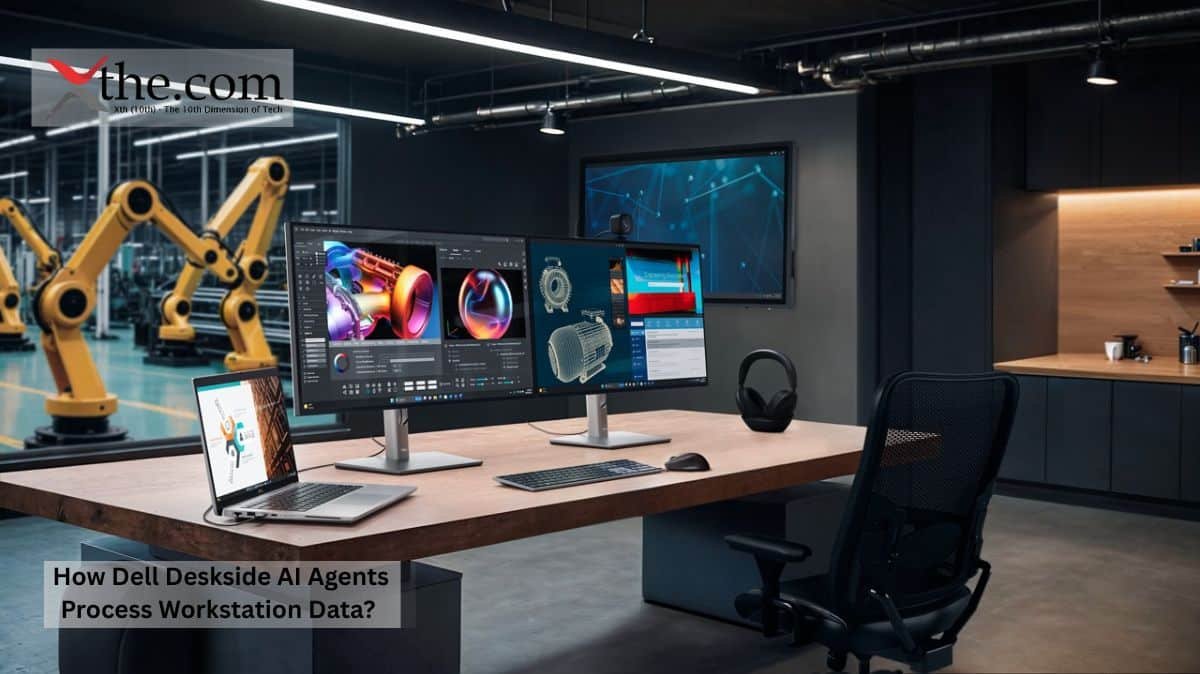
An engineering workstation can produce over 40 GB of telemetry, simulation results, and GPU memory traces in a single day. Many companies still send this data to centralized cloud systems, which can cause delays, higher storage costs, and unnecessary movement of sensitive project data. Dell’s desk‑side AI approach is different. It keeps processing close to the workstation.
This change is why local token execution and desk‑side agent infrastructure are now key topics in enterprise AI conversations in 2026.
Why Desk-Side AI Processing Matters
Traditional AI systems expect a constant connection between devices and central computing clusters, but this setup does not work when engineers, financial analysts, or healthcare researchers need real-time processing and strict control over their data.
Dell’s workstation strategy places AI agents directly in the user’s operating environment. Instead of sending raw data to remote systems, desk‑side agents process information locally through offline inference runtimes designed for low‑latency execution.
This approach greatly reduces delays. For example, a CAD engineer working on aerodynamic simulations can run inference tasks locally on stored geometric data without waiting for the cloud to respond.
Local token execution changes enterprise workflows. Tokens generated from user prompts, telemetry logs, and documents stay on the workstation whenever possible. Dell’s system reduces outgoing token traffic by syncing only when needed, not continuously.
The Role of Desk-side Agent Infrastructure.
How Local AI Agents Coordinate Workloads.
The core of Dell’s design relies on distributed desk-side agent infrastructure operating across high-performance workstations and edge clusters within departments.
Each agent performs multiple simultaneous functions such as information indexing, context retention, model routing, runtime orchestration, and hardware-aware scheduling.
The system works particularly well when used with NVIDIA RTX-class GPUs or dedicated AI accelerators built into enterprise workstations.
Dell’s engineers reportedly focus heavily on processing fabric constraints, especially memory bandwidth and PCIe bottlenecks that can appear during multi-agent inference tasks. A workstation running simulation software, security scans, and real-time language processing can quickly overload standard data paths.
To solve this, Dell agents continuously rebalance workloads via adaptive token-optimization loops. These loops reduce unnecessary inference cycles while maintaining accurate results through active sessions.
Structured Database Modeling and AI Memory Layers.
AI agents become ineffective when contextual memory degrades over time. Dell’s approach leans heavily on structured database modeling to maintain persistent relationships between files, prompts, telemetry, and inference outputs.
For example, a semiconductor design team reviewing thermal simulation issues can use the workstation agent to link past simulation runs, sensor data, internal documents, and engineering notes in a structured way. This helps the AI system spot repeated thermal failures without having to retrain from scratch.
This is very different from generic chatbot systems, which depend heavily on short-term context windows.
Adding vector telemetry streaming also improves how the system monitors operations. Instead of saving telemetry as separate log events, Dell agents run— excuse that. Agents convert workstation activity into vector embeddings, making it easier to search and spot problems.
An enterprise administrator could query:
Show GPU instability patterns matching last quarter’s rendering failures.
The system can find related operational events from local vector stores in just a few seconds.
Dell DeskSide Agentic AI Data Orchestration Engine
The term “Dell DeskSide agentic AI data orchestration engine May 21, 2026 ” has started appearing frequently in enterprise infrastructure discussions because it captures a wider architectural trend rather than a single product release.
This strategy shows a wider industry shift toward local AI coordination engines that work between endpoint hardware and enterprise cloud systems.
These orchestration engines handle:
- Local inference prioritization
- context-aware synchronization
- resource arbitration
- runtime compression
- semantic caching
The most important technical challenge is managing performance against processing‑fabric constraints that workstations still face: finite thermal envelopes, GPU memory limits, and power‑delivery limitations. Therefore, AI agents require aggressive token‑optimization modes to sustain throughput during prolonged inference sessions.
This kind of careful management is essential. If a local agent is not optimized, it can consume workstation resources even faster than a centralized system.
Offline Influence Runtimes Release Enterprise Risk
Security teams now prefer offline inference runtimes because they lower the risk of inter‑external exposure. Sensitive data stays inside company‑controlled hardware rather than moving through public AI APIs.
In domains such as aerospace, banking, and healthcare, this defense is important for both legal and operational reasons.
A pharmaceutical research worker with molecular simulation results may not be allowed to send proprietary compound data to external cloud systems. Dell’s desktop setup lets them run inference directly on secure workstations while remaining compliant. The same principle applies to defense contractors managing classified engineering workflows.
This is also why local token execution is now attracting the attention of procurement teams, not just infrastructure architects. Companies want clear reductions in data movement, reliance on the cloud, and unpredictable inference.
The Emerging Enterprise AI Model
Dell’s focus on workstation-based AI is part of a bigger change in enterprise computing. Companies no longer think every smart workload needs to run in massive cloud systems. Instead, businesses are increasingly distributing AI across localized execution layers using desktop agent systems, semantic memory, and vector telemetry streaming. It may come from deciding where inference occurs, how efficiently tokens move, and whether enterprise systems can operate intelligently without constant reliance on the cloud.
Technical Stack Checklist
- Calibrate Dell Trusted Device configuration profiles to continuously monitor autonomous local agent credentials.
- Enforce hardware execution barriers within corporate routing tables to block local model data from leaking to external cloud hosts.
- Map internal unstructured file share directories into the local data orchestration engine for automated vector indexing.
- Update workstation memory allocation matrices to carve out dedicated system RAM blocks for offline inference runtimes.
- Deploy localized performance tracing utilities to continuously audit time-to-first-token latency benchmarks across client hardware.
Source: Dell Technologies World: A Bright and Beautiful Road Ahead








