






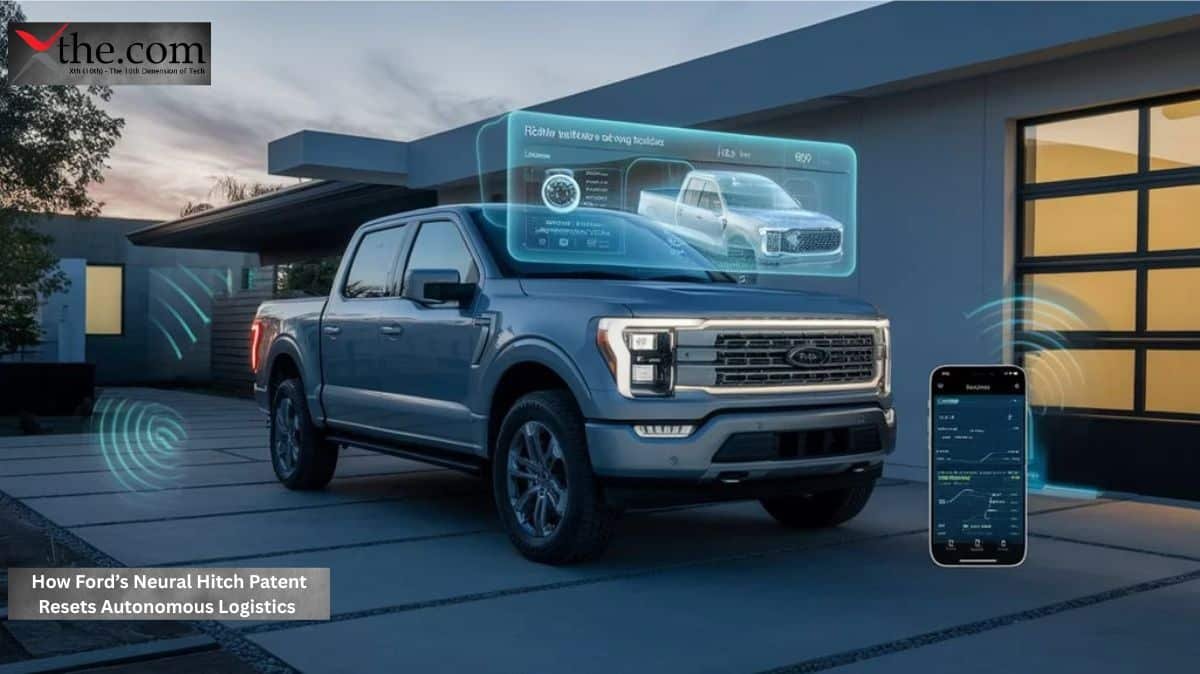
Dearborn, Mich. If a trailer is off by just two inches, a freight operator might have to restart the docking process, wasting fuel and time. These small inefficiencies quickly add up across the US trucking industry. The American Transportation Research Institute says that detention and delays cost the industry billions each year. In response, Ford Pro quietly filed a patent that could change how commercial vehicles connect with trailers, warehouses, and self-driving systems.
The patent recently disclosed by the USPTO describes a neural network-based hitching system that automates trailer positioning with minimal driver input. Although the technology may sound complex, its business impact is clear. For fleet operators, warehouse managers, and logistics leaders, this points to a scenario in which autonomous vehicle intelligence handles not only navigation but also the hands-on work of moving freight.
Why Ford’s Patent Matters Beyond Parking Assistance
Automakers have long seen trailer assistance as a convenience. Backup cameras made it easier to see, sensors help with blind spots, and semi-autonomous steering made reversing into tight spots simpler. This patent aims for something much bigger.
The new system uses machine learning, sensors, and alignment software to determine trailer positions in real time, rather than relying solely on people to make adjustments. The vehicle reads the hitch shape, trailer angle, and movements as they happen. This brings physical AI into commercial transportation.
The difference is important. Most discussions of autonomous driving focus on highways and passenger cars. But in logistics, delays usually happen in loading yards, busy depots, distribution centers, and city delivery routes where accuracy matters more than speed.
Ford Pro seems to see its opportunity here.
The Commercial Logic Behind Neural Pitch Technology.
In freight, consistency pays off. A logistics company with 500 vehicles tracks more than just miles. It also looks at idle time, docking speed, fuel use, insurance risks, and worker productivity.
Imagine a warehouse in Texas handling 1,200 trailer moves each day. If AI helps cut three minutes per docking, the site saves 60 labor hours daily. Over a year, these savings could be big enough to affect which fleet companies choose to buy.
That’s why both investors watching Ford (F) and engineers working on automation should pay attention to this patent.
Ford has already set up Ford Pro as a software and services business, not just a vehicle maker. Things like fleet telematics, charging management, predictive maintenance, and software subscriptions are now key to its commercial value. Neural hitch automation aligns with this plan because it generates useful data and keeps customers reliant on Ford’s integrated fleet systems.
In simple terms, this patent extends fleet management beyond just route planning into hands-on freight coordination.
Autonomous Driving Expands Into Industrial Logistics
The transportation industry often talks about autonomy as a race to build robotaxis, but this view overlooks where the biggest economic benefits might first appear.
Commercial logistics work within controlled environments. Delivery hubs have mapped layouts, trailers are standard sizes, and fleet vehicles follow established routes. These factors make the freight operations a great place to test advanced autonomy.
This patent shows that Ford Pro understands this situation.
The neural hitch system could one day work with warehouse software, trailer ID systems, and automated loading tools. A truck pulling up to the dock might automatically find its trailer, line up the hitch, and park itself with little help from people.
That represents a significant evolution for EV trucking as well. Electric commercial vehicles lose efficiency when forced into repeated stop-and-go maneuvers or when subjected to extended idle time during trailer alignment. Automated precision could reduce energy waste while improving delivery cycle efficiency.
Bringing together physical AI, electric vehicles, and logistics software offers a much bigger opportunity than just another driver-assist feature.
The Patent Race Signals A Larger Industry Shift
Many automotive patents end up forgotten in company archives. Some never make it to production, while others hint at big changes years before the public sees them.
That’s why technology investors and supply chain analysts should pay closer attention to USPTO signals.
Big automakers now compete more on software than just engine power. Patents for neural networks, sensor fusion, and AI-based systems reveal where they expect future profits to come from.
For Ford (S), commercial transportation is one of the few car markets with steady long-term demand. E-commerce keeps putting pressure on delivery networks. Warehouses need better scheduling, and labor shortages are common. In short, even small improvements can lead to big financial gains.
This patent directly addresses those challenges.
More importantly, this shows that autonomous driving might grow gradually rather than all at once. Full self-driving is still controversial and tightly regulated, but AI-assisted logistics are easier to adopt because they work in professional fleets and deliver clear business results.
The Competitive Stakes for EV and Fleet Operators
The push for smarter freight systems is no longer just about building vehicles. Now, software platforms play a bigger role in keeping commercial customers loyal.
When choosing a connected commercial platform, fleet operators may prioritize uptime, analytics, charging management, predictive diagnostics, and automated trailer handling over engine specs. This changes how EV trucking companies now compete in North America.
Tesla, Daimler, Volvo, and Rivian are all working on AI-powered commercial logistics. But Ford Pro has an edge that many Silicon Valley companies don’t: strong ties with city fleets, contractors, utility companies, and local delivery businesses.
These customers care less about flashy branding and more about cutting downtime in real, measurable ways.
The main point of this pairing is that AI-driven trailer alignment could boost US freight efficiency. Even small improvements in docking accuracy can affect delivery schedules, fuel use, labor planning, and warehouse timing.
This makes the technology valuable even before fully autonomous freight vehicles are common.
Why Physical Infrastructure Becomes the Next AI Battleground
For a long time, people discussed AI in digital spaces such as chatbots, recommendations, and search. Logistics is different because AI has to deal with real-world factors such as weight, movement, distance, and physical constraints.
This is where physical AI shows its real business value.
A neural hitching system has to make decisions in the real world, even when conditions aren’t perfect. Things like rain, rough terrain, trailer movement, busy yards, and blocked sensors all make the job harder. Solving these challenges could lead to smarter automation in other industries, too.
The impact goes beyond just trucking.
Construction sites, farm equipment, shipping terminals, and warehouse robots all need precise mechanical coordination. Companies that get this right could lead the next wave of industrial automation.
For Ford (F), this patent isn’t just about making trailer hookups. It’s about adding more intelligence to the entire logistics process. process.
The next big step in transportation technology won’t be about self-driving vehicles on highways alone. It will be about how smart machines manage the many physical tasks that keep freight moving across the U.S. every hour of every day.
Source: Ford Motor Company








