






Santa Clara, CA
Atomic answer: In a historic shift, Intel’s 14A manufacturing node has been designated for the production of Apple A21 SoCs. This partnership brings the most advanced mobile AI silicon production to USA soil, drastically reducing lead times and geopolitical risk for American tech giants.
Smartphones now handle tasks that once required full data center racks, such as real-time translation, image generation, biometric analysis, and predictive automation. However, battery limitations remain severe. Each new AI workload must contend with heat, power consumption, and limited space in increasingly thin devices.
This engineering challenge explains the industry’s focus on Intel (INTC) and its 14A process node. If Intel secures Apple’s A21 SoC for the iPhone 18, the impact will reach well beyond supplier diversification.
The larger issue is the economics of edge computing.
Why Intel (INTC) Wants the Intel 14A Opportunity
Intel has struggled for years to lead in advanced foundry competition while competitors dominated premium mobile chip production. This has eroded investor confidence and weakened Intel’s position in advanced consumer electronics manufacturing.
The Intel 14A node is more than a process improvement; it’s a test of Intel’s credibility.
Modern smartphone AI systems demand both high transistor density and power efficiency. A future A21 SoC must handle complex workloads while maintaining thermal stability and battery life.
That challenge directly aligns with Intel’s broader foundry ambitions.
The company has invested heavily in advanced packaging, power delivery innovations, and high-end, high-volume semiconductor manufacturing capacity. If Intel can prove the viability of USA-based fabrication for flagship mobile chips, it could position Intel as a strategic alternative in the global foundry market.
That possibility carries geopolitical significance alongside commercial value.
The Shift Toward Edge AI Changes Chip Priorities
Five years ago, cloud AI was the primary focus. Now, device makers increasingly seek to process AI workloads locally.
The reasons are practical.
Routing every user request to external servers increases latency, bandwidth costs, and privacy risks. Consumers now expect smartphones to summarize meetings, generate content, process images, and run large language models instantly without relying solely on cloud connectivity.
That trend places new emphasis on the efficiency of edge AI.
An iPhone 18 with an advanced A21 SoC will require significantly improved neural processing and strict thermal management. Increased compute power alone is insufficient; the chip must sustain inference performance without rapidly depleting battery life.
This is where the architecture behind Intel 14A becomes strategically important.
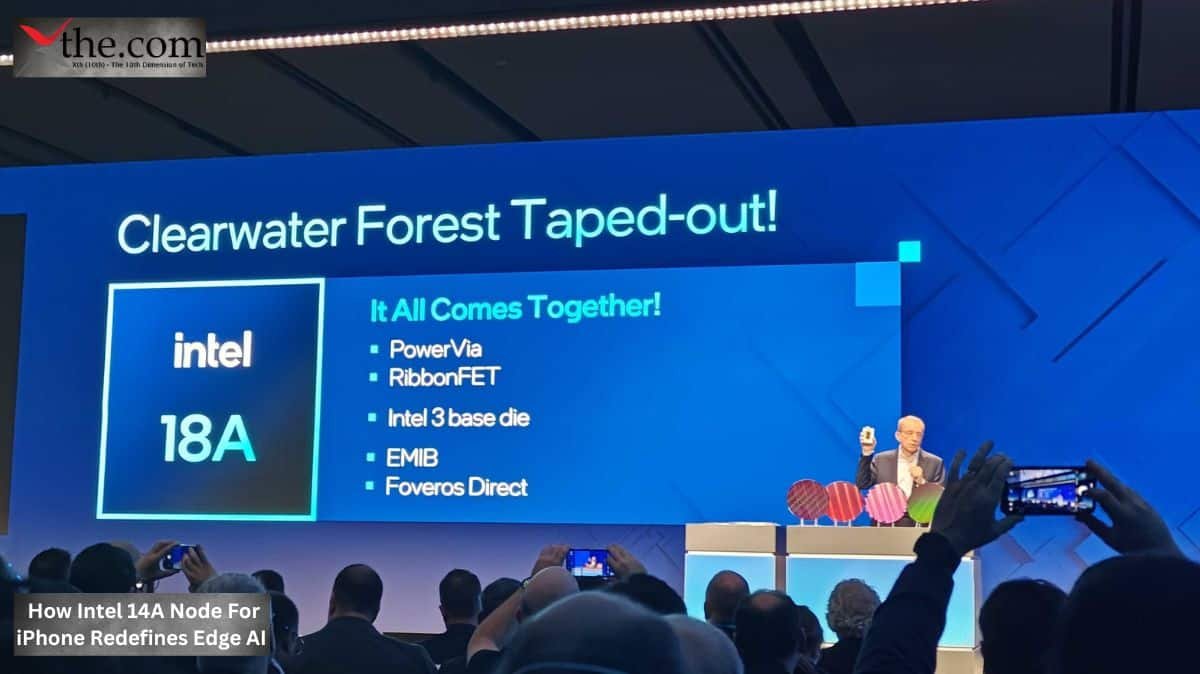
Advanced transistor scaling and backside power delivery could enable higher AI throughput with lower energy use. For edge AI, this balance is essential to keep features practical for mass-market devices.
Why USA-Based Fabrication Matters More Than Ever
The semiconductor industry now prioritizes supply chain resilience alongside manufacturing efficiency. This shift influences procurement decisions at the highest levels of corporate and government leadership.
Recent geopolitical tensions have revealed the vulnerability of advanced chip supply chains when production is concentrated in a few regions.
That shift benefits Intel.
A successful Intel 18A node iPhone A21 chip production scenario would strengthen the argument for geopolitically diversified manufacturing. Apple and other major technology firms now assess suppliers based on both operational and geopolitical factors.
For the United States, expanding USA-based fabrication aligns with broader industrial policy goals focused on technology independence and national competitiveness.
The stakes extend well beyond smartphones.
Advanced mobile processors now support defense, healthcare, finance, and industrial automation. Manufacturing leadership thus impacts economic security as much as consumer electronics.
The Economics Behind Semiconductor Manufacturing
Producing next-generation chips has become extraordinarily expensive.
A modern fabrication facility can cost tens of millions of dollars before producing any commercial chips. At the same time, process complexity increases as transistor sizes shrink and AI workloads require greater efficiency.
This environment rewards companies that can secure long-term manufacturing contracts with premium customers.
Securing future mobile production for the A21 SoC would send a strong signal to enterprise buyers, cloud providers, and government agencies assessing Intel’s foundry capabilities.
The reputational impact could matter as much as the revenue itself.
A successful mobile deployment would demonstrate that Intel’s advanced manufacturing can compete in one of the industry’s most demanding categories: flagship smartphones with global volume requirements and strict thermal constraints.
Why Edge AI Could Reshape the Smartphone Market
Consumers are less concerned with technical specifications and more focused on device responsiveness.
Devices that run advanced AI models locally, with minimal delay, transform user interaction, real-time summarization, intelligent photo editing, predictive assistance, and multimodal search into more seamless experiences.
That is why edge AI efficiency increasingly defines competitive advantage in premium smartphones.
The industry is now moving toward devices that behave less like traditional mobile phones and more like persistent AI companions that operate continuously in the background.
If Intel (INTC) delivers advanced Intel 14A manufacturing for future Apple silicon, it will mark more than a foundry achievement. It would signal a broader change in the semiconductor industry’s approach to AI performance, supply chain strategy, and local computation economics.
The next major AI competition may not take place in large data centers, but rather in the pocket-sized devices consumers use daily.
Enterprise Procurement Checklist
- INTC Impact: Monitor Intel’s yield rates as they transition to the “Angstrom” era (14A).
- Infrastructure Redesign: Edge-compute nodes must now align with Intel-fabricated mobile architectures for better parity.
- Procurement Risk: Massive capacity allocation to Apple may squeeze out second-tier workstation vendors.
- Deployment Impact: Significant reduction in thermal leakage on mobile chips allows for longer “High-Performance” AI modes.
- Operational Step: Factor in a 15% increase in mobile hardware costs due to domestic-premium fabrication.
Source: AI Inspired. Systems Accelerated








