MIAMI, FL —
Atomic Answer: Enterprise network architects are building dedicated multi-cloud mesh environments to systematically eliminate critical IAM propagation delays across global infrastructure. When organizations deploy hybrid cloud databases, standard directory syncing engines introduce replication delays that temporarily block legitimate employee access credentials. Centralizing security perimeters within a global network mesh model enforces a unified policy, preventing synchronization drift across cloud endpoints.
The procurement intelligence case for multi-cloud mesh networks is built on a deceptively simple observation: IAM propagation delays are not a configuration problem; they are an architectural one. As enterprise AI ROI depends increasingly on agent fleets and automated pipelines that require instantaneous credential state across hybrid cloud infrastructure, synchronization drift across isolated directory syncing engines introduces access gaps that neither faster replication schedules nor tighter SLAs can structurally eliminate.
Why Standard Directory Syncing Fails at Hybrid Cloud Scale
In hybrid cloud environments, IAM delays occur because standard directory engines propagate user credentials to all cloud endpoints. Information on user roles, permissions, or credentials is propagated between cloud environments at set intervals or through batch-scheduled jobs. If a user’s role or permission changes in one cloud environment, that data will not be synchronized to other connected clouds immediately; rather, it will remain in a pending state until the next scheduled synchronization window (i.e., when the scheduled job runs). As a result, for a defined period, access control policy enforcement across all connected clouds is inconsistent.
Inconsistent identity synchronization during this time frame creates two separate risk profiles simultaneously. One risk occurs when an authorized employee loses access to a resource that they are authorized to use (i.e., a problem with productivity and business continuity). The second risk occurs when a user with revoked credentials can still access resources that have not yet received the synchronization update, creating a security vulnerability that the initial access control policy change was intended to eliminate.
Enterprise multi-cloud network mesh deployment models provide a method for completely eliminating identity synchronization drift by addressing both types of risk profiles through an identical architectural change, which involves replacing batch-scheduled replication with real-time cryptographic token verification of credentials, thereby enabling credential state changes to be propagated to all connected endpoints at the same time instead of sequentially.
How Multi-Cloud Mesh Eliminates Synchronization Drift
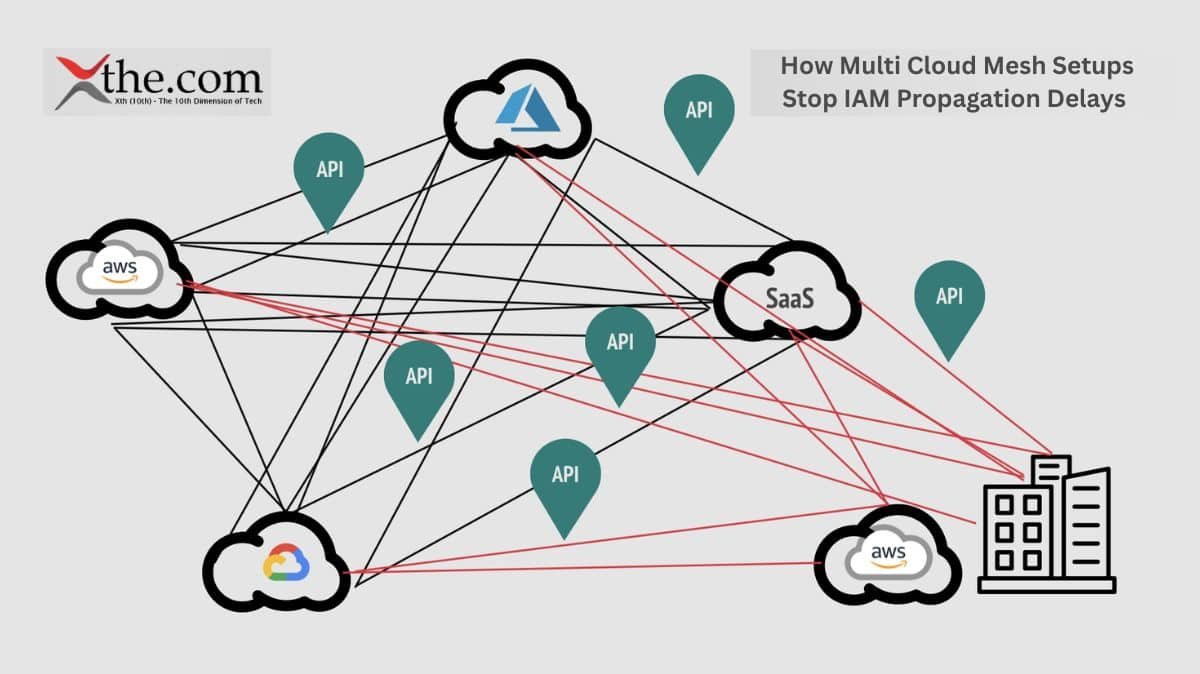
Multi-cloud mesh networks help avoid synchronization drift by providing a single point of identity policy enforcement for all resources in the mesh, rather than multiple points (one per cloud) that are independently managed and asynchronously synchronized. When an ad-hoc credential state change occurs anywhere in the mesh, it is propagated to all other endpoints simultaneously, thanks to enforcement by the same mesh fabric. The result of these three facts: no replication queue, no sync schedule, and no per-endpoint delay, means that a single user can change their credential state, and that change can be applied to every other user connected to the mesh at the same time.
Access control policies applied within the mesh model are evaluated at the mesh enforcement layer rather than at individual cloud endpoint directory services. This architectural shift means that a high-privilege service account revocation takes effect across the entire hybrid cloud environment at the moment the policy change is committed—not when each endpoint’s directory service receives and processes the synchronization update.
IAM propagation delays that batch synchronization models measure in minutes are reduced to mesh propagation delays measured in milliseconds — eliminating the credential state inconsistency window that security exposure and access disruption incidents exploit.
Cryptographic Token Verification and Compliance
The integrity of identity synchronization in the mesh model critically requires cryptographically verified tokens at every step of the access-control assessment – meaning tokens must be verified not only during the initial username/password authentication, but also for every subsequent access to the resource within the system.
The possibility for the existence of stale token validities created by the synchronization drift associated with batch-replication synchronization processes is eliminated through cryptographic verification by tying the token’s valid state to the current mesh policy state at the time of evaluation, rather than tying the valid state of the token to the previous synchronization cycle’s credential snapshot.
The ROI of a Mesh IAM deployment for enterprise AI extends well beyond direct security improvements; it also supports the compliance framework. When procuring intelligence for regulated enterprises, the compliance audit evidence generated by real-time cryptographic token verification in mesh IAM is an enduring, tamper-evident verification of the credential’s state and the access-control evaluation, which cannot be matched by the batch synchronization process in terms of completeness and freshness.
Compliance frameworks that require demonstrable real-time access control enforcement — in financial services, healthcare, and federal contractor environments — will find the mesh IAM architecture directly applicable to audit requirements that batch-synchronization models address only partially.
Configuration Complexity and Deployment Timeline
Creating multi-cloud mesh networks adds complexity for IT operations teams, increasing project completion timelines. When establishing an identity mesh over different types of clouds, it can be more challenging to do this because of all the different types of infrastructure (IAM services) in a cloud and how they connect to each other (API), as well as what is required to connect them to an existing directory.
To justify extending the timeline for each project due to the elimination of potential syncing issues in the hybrid cloud environment, where you will not have two identical states across all credentials for the same entity (user), is considered by many companies a significant issue. The initial phase of the mesh (provisioning) has the highest configuration complexity (building the mesh across all individual cloud environments), but it will have lower operational costs after your initial period than if you had multiple independent entities synchronizing your directories.
Access control policies that previously required per-cloud configuration and per-engine synchronization tuning consolidate into unified mesh policy management after deployment reducing the ongoing operational complexity that multi-cloud IAM without mesh architecture requires.
The Directory Provider Ripple Effect
Enterprise AI ROI pressure, driving the adoption of multi-cloud mesh networks, is forcing standalone directory service providers to redesign their integration architectures for native mesh compatibility. Directory providers built around batch-scheduled synchronization models face a product architecture decision: build native mesh overlay integration or watch enterprise buyers route around their synchronization limitations through third-party mesh solutions.
Procurement intelligence for enterprise IAM platform selection should include native mesh integration capability as an evaluation criterion alongside synchronization performance specifications. Directory providers that offer native mesh integration eliminate the third-party overlay layer that adds deployment complexity and cost providers that require third-party mesh solutions to achieve real-time identity synchronization add integration overhead that native mesh architecture avoids.
Conclusion
The architectural layer, which is responsible for originating IAM propagation delays, has been resolved by using a multi-cloud mesh network to replace the legacy batch-scheduled identity sync with real-time cryptographic enforcement of credential state change propagation across multiple cloud endpoints. The synchronization drift that batch replication models accepted as a structural limitation will no longer be a risk management issue under a mesh architecture.
Cost factors to be addressed in procurement intelligence of hybrid cloud IAM investment include: (1) Total costs associated with synchronization drift including not just direct cost due to security exposure but also productivity disruption associated with legitimate access blocks during synchronization periods, and cost of compliance documentation due to gaps in access control audit trails created by batch replication; and (2) Enterprise-AI ROI will compound as security improvements, compliance framework benefits and reduced operational overhead will accumulate through the consolidation of per-cloud directory management into unified mesh policy administration methods following mesh deployment.
By using real-time cryptographic token verification, mesh networks can enforce access control policies that generate continuous audit records that meet regulatory requirements, whereas batch synchronization models do not. Multi-cloud Network Mesh deployments used by enterprises to eliminate identity sync error define an architectural standard that eliminates the credential state inconsistency time window, caused by IAM propagation delays, which cannot be replicated via legacy sync engine configuration optimization.
Enterprise Procurement Checklist
- Infrastructure Risk: Relying on basic, batch-scheduled directory synchronization routines exposes the network perimeter to security gaps during administrative role changes.
- Cybersecurity Compliance: Identity tracking frameworks must feature real-time cryptographic token verification to ensure access changes apply instantly to all connected infrastructure.
- Deployment Bottleneck: Provisioning a comprehensive multi-cloud identity mesh introduces configuration complexity, initially extending infrastructure engineering engineering timelines.
- Cross-Manufacturer Ripple Effect: The enterprise demand for real-time mesh security pressures standalone directory companies to integrate natively with global network overlays.
- Operational Action Step: Audit global cloud access controls to identify high-privilege service endpoints vulnerable to credential state replication lag.
Primary Source Link: Inside the AI Data Cloud