






Santa Clara, California
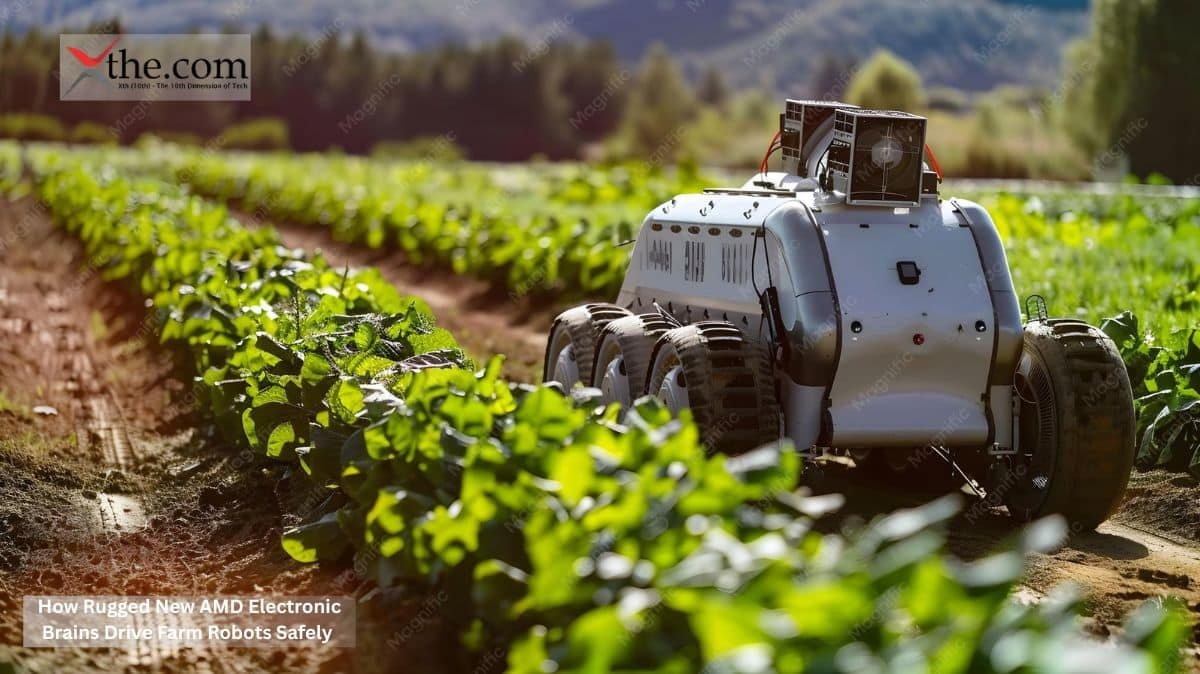
At 3 a.m. in a Nebraska soybean field, a driverless tractor moves through the crops. Dust fills the air, and visibility is low. Still, the machine spots a small pigweed seedling among the soybeans, targets it, and removes it without harming the crop.
A decade ago, that level of precision belonged in a research lab. Today, it is happening in commercial agriculture, powered by AMD Electronic Brains designed to Drive Farm Robots operating in some of the harshest environments in America.
This is more than just another upgrade in farm technology. It denotes a shift in where advanced computing occurs. Instead of relying on remote cloud servers, smart technology is now built directly into farm equipment. This lets machines make decisions instantly, even while working in fields full of dust, heat, moisture, vibration, and constant motion.
Why Farms Are One of Computing’s Toughest Environments
Modern processors work best in cool, controlled data centers. Farm equipment faces a much tougher environment.
A tractor in an Iowa cornfield in July might deal with temperatures over 100 degrees Fahrenheit. The equipment also faces mud, rain, dust storms, shocks, and constant shaking. Regular computer hardware struggles to handle these problems.
These tough conditions have increased the need for Embedded Industrial Processing, a type of computing made for harsh environments. Advanced Micro Devices has met this need by adapting technology first used in aerospace and defense for use in farm machines.
The company’s tough Versal adaptive system-on-chip platforms are built to keep working even in extreme conditions. For equipment makers spending hundreds of thousands on autonomous machines, durability is not simply a selling point—it is essential for business.
If a processor fails during harvest, farmers can lose thousands of dollars in productivity. Being reliable is directly tied to making a profit.
How AMD Electronic Brains Drive Farm Robots in Real Time
The Speed Problem Human Workers Cannot Solve
Weed management has always been one of farming’s most expensive and labor-intensive tasks.
A young waterhemp seedling can look a lot like a soybean plant when it first starts growing. Even skilled farm workers sometimes mistake weeds for crops, especially after long hours. Autonomous machines have an even harder job because they work nonstop and at high speed.
As a robotic tractor moves through the field, its cameras take thousands of pictures every minute. Each one needs to be analyzed right away.
This is where AMD Electronic Brains that Drive Farm Robots really prove their worth. Servers for analysis, the processor executes calculations directly on the machine. The system captures images, identifies plant species, determines whether action is required, and executes commands within milliseconds.
Timing is important.
A tractor moving at four miles per hour has only about 40 milliseconds to spot a target plant before it moves out of sight. Any real delay would make precise, autonomous farming impossible.
Why Edge Computer Vision Matters
The technology enabling these decisions is known as Edge Computer Vision.
Unlike cloud-based systems that need an internet connection, Edge Computer Vision analyzes images right where they are taken. Cameras on farm equipment scan the fields, and onboard processors instantly review the visual data.
Processing data locally reduces delays that could undermine the performance of autonomous machines.
If a farm robot had to send video to a remote server and wait for a response, network delays could make it miss its targets. A 200-millisecond delay is fine for streaming a movie, but it makes a big difference when a machine has to distinguish between a valuable crop and a weed.
For American farmers, speed means more productivity. Making faster decisions allows the equipment to cover more ground without sacrificing accuracy.
Role of Machine Learning in Modern Agriculture
Teaching Tractors to Recognize Plants
Modern farm robots rely heavily on Machine Learning models developed on millions of labeled agricultural images.
Engineers train these systems with photos of crops, weeds, soil, and different growth stages from many types of farms. Over time, the software learns to spot small differences that usually need a human eye.
When combined with AMD’s adaptive processing architecture, Machine Learning becomes practical for field deployment.
The processors can handle taking pictures, running neural networks, steering the vehicle, and controlling equipment all at once, without slowing down. Each part of the computer does its own job, so the system stays quick even when it’s busy.
This setup is especially important during the busiest growing seasons, when autonomous equipment might run almost nonstop.
Embedded Industrial Processing Beyond Weed Control
Embedded Industrial Processing does more than just help with weed control.
Autonomous tractors are now used for seeding, crop monitoring, irrigation checks, soil assessment, and harvest assistance. Each of these jobs needs immediate data processing, even when conditions are unpredictable.
A processor that handles one job today might be updated to support several farm tasks tomorrow, just by changing the software or settings.
Such flexibility helps equipment makers reduce development costs and lets farmers access new features throughout the life of their machines.
The Technology Behind the Long-Tail Keyword
Industry professionals evaluating autonomous agricultural systems frequently refer to the Advanced Micro Devices embedded AI processor agriculture robotics manual when examining deployment configurations and performance-tuning options.
The Advanced Micro Devices embedded AI processor agriculture robotics manual outlines how developers can regulate power consumption, processing performance, and operational requirements across several agricultural applications.
For example, a high-speed autonomous sprayer may prioritize rapid image analysis, while a soil-monitoring platform may emphasize energy efficiency and long-duration operation. The same underlying hardware platform can support both use cases through software-level optimization.
This pliability also makes it easier for manufacturers to manage inventory and simplifies maintenance and deployment for large farm fleets.
Why American Consumers Should Care
People often talk about new engineering advances in farm technology, but the economic effects might matter even more.
According to estimates from agricultural researchers, weeds reduce crop productivity by billions of dollars annually across the United States. Farmers spend heavily on herbicides, labor, and equipment to control invasive plant species.
When Autonomous Agriculture systems remove weeds more accurately and efficiently, it lowers operating costs. Farmers can use fewer chemicals, spend less on labor, and get better yields.
These savings eventually affect the whole food supply chain.
A lettuce farmer in California who spends less on weed control can grow crops more efficiently. A soybean farmer in Nebraska can cut losses from invasive plants. Over time, these lower costs help keep food prices steady for shoppers at local grocery stores.
The connection might not show up right away, but it is real.
The Future of Self-Driving Agriculture
The biggest change in Autonomous Agriculture is not just that machines are taking over certain jobs. It’s that smart technology is now right where decisions are made.
For years, advanced computing was mostly found in data centers and labs. Now, AMD Electronic Brains that Drive Farm Robots show that complex decisions can be made right in muddy fields, remote farms, and tough outdoor settings.
The next wave of farm machines will likely be even more autonomous, leveraging Edge Computer Vision, Machine Learning, and advanced embedded systems capable of operating independently for extended periods.
For farmers, the goal is simple: grow more food with greater accuracy and at lower cost. For AMD, the mission is just as clear—put computing power right where it’s needed, whether that’s in a server room or under the wheels of a tractor rolling through a field before sunrise.
The dust-covered machines already working in the Midwest show that the future has come earlier than many people thought.
Source: AMD Press Releases








