






San Jose, California
Today’s enterprise AI clusters can respond to chatbot questions in milliseconds, but they often struggle with and will be challenged: running thousands of self-directed workflows simultaneously without human help. Because of this, artists in this group, IT bands, are shifting their focus from single benchmark scores to ongoing, reasonable performance. NVIDIA Vera Rubin is designed to meet this need.
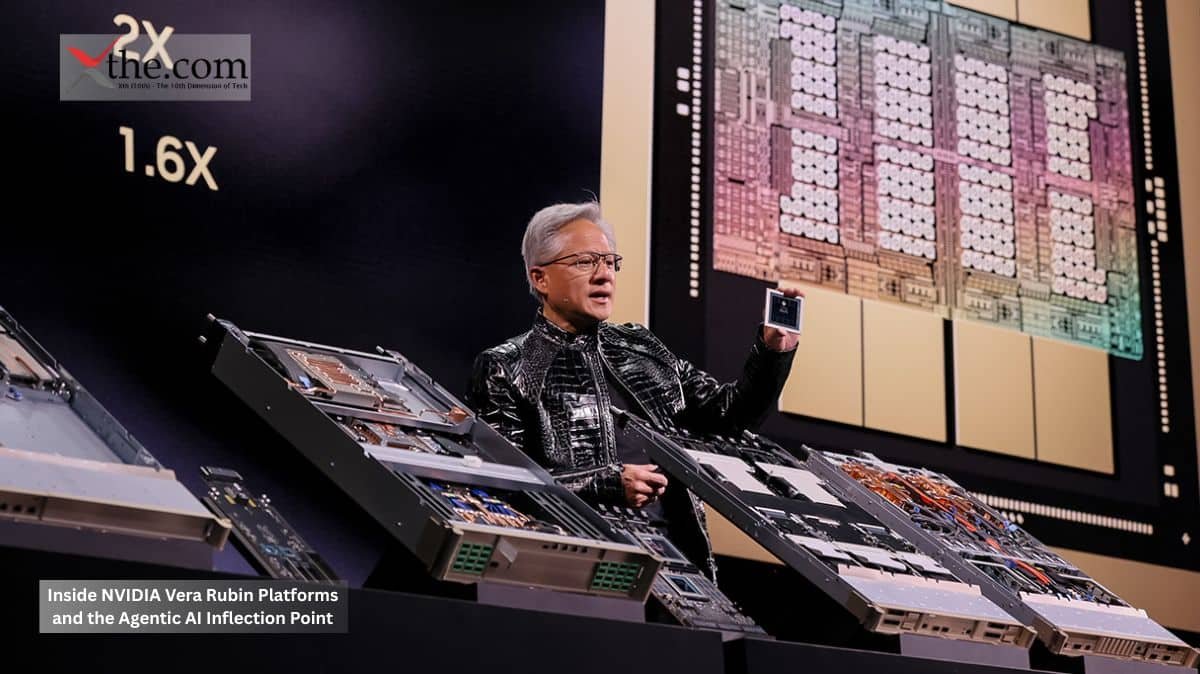
This new platform differs from traditional GPU servers, which handle one task at a time. Instead, it works more like an always-on industrial system for AI thinking. It brings together the Vera CPU, Rubin GPUs, high-speed memory, and closely connected NVL72 Racks into one system built for long-range autonomous reasoning. This change puts agentic influence at the heart of modern data centers.
Why Agentic Inference Changes in Infrastructure Economics
Traditional LLMs handle prompts one at a time. A user asks something, the model replies, and then the system waits for the next request. Autonomous AI agents work differently. They plan, gather outside data, carry out tasks, check their results, work with other agents, and keep repeating these steps nonstop.
This way of working creates a completely different demand on computing resources.
For example, one AI coding agent might run multiple reasoning processes in parallel while testing software changes in the pharmaceutical industry. A research agent could keep memory graphs active for weeks while conducting simulations. When thousands of these agents run together in a company, traditional GP areas can’t keep up.
This is where Nvidia Vera Rubin separates itself from earlier accelerator generations.
This system is built to keep inference running smoothly over time, not just handle quick bursts of prompts. NVIDIA focused on memory speed, strong connections, and fast coordination between CPUs and GPUs. The goal is to assist ongoing work by many agents, not just single responses.
The Role of the Vera CPU in Autonomous Reasoning Pipelines.
Most people talk about the Rubin GPUs, but the Vera CPU could actually be more important for businesses using this platform.
Agentic systems are always managing schedules, retrieving data, syncing memory, and directing workloads. These tasks put a lot of pressure on CPUs; older x86 servers often slow down when thousands of agents compete for memory and network access.
The Vera CPU solves this problem by working more closely with Nvidia’s accelerated computing tools rather than operating separately. The CPU is part of a unified system for reasoning. This is important because autonomous agents don’t follow simple straight paths. They branch out, pause, start new processes, and go back to earlier steps.
NVIDIA’s design philosophy appears intended to minimize those coordination penalties.
A large insurance company uses autonomous agents to process claims. Each agent must review documents, check fraud databases, interact with customer systems, and forward unusual cases to specialized models—all simultaneously. The main challenge isn’t a lack of powerful GPUs; it’s ensuring that all these tasks remain coordinated and run quickly, even when thousands run at once.
That operational profile aligns directly with the architectural priorities behind agentic inference systems.
How NVL72 Racks Turn Data Centers Into Persistent AI Engines
The scale story becomes clearer inside NVIDIA’s NVL72 racks design.
Unlike regular GPU arrays made from loosely connected parts, these rack‑scale systems operate as tightly coupled computing units designed for very fast communication. NVIDIA treats the whole rack as one big computer.
That design has major consequences for enterprise infrastructure spending.
These systems use much more power and need stronger cooling. Networking becomes a main concern, not just an add-on. Many older data centers weren’t built to handle non-stop, high-use, autonomous insurance like this.
This explains why infrastructure buildout has become one of the most aggressive spending categories among hyperscalers and Fortune 500 cloud operators.
More and more analysts call future AI centers AI factories because they look more like industrial plants than old-style server rooms. The term makes sense. These systems are always producing large-scale reasoning results.
AI Factories and the Shift Away From Training-Centric Spending
The economics behind AI factors are changing quickly.
For a long time, most cloud budgets were spent on training models. Companies competed to build bigger base models. Now, more money is being invested in infrastructure because autonomous agents constantly use computing power.
Training runs eventually stop. Agentic reasoning rarely does.
This difference is important for investors, CIOs, and infrastructure providers. Persistent inference systems need ongoing hardware, electricity, and networking resources.
In practice, companies using Nvidia Vera Rubin aren’t just buying servers. They’re setting up infrastructure meant to run nonstop and handle heavy workloads for a long time.
Evaluating NVIDIA Vera Rubin Platform Agentic AI Hardware Specs
The most important aspect of the NVIDIA Vera Rubin platform agentic AI hardware specs is not peak benchmark performance; it is architectural balance.
NVIDIA seems to have designed the platform with three main needs of self-driving AI in mind. They are massive inter-agent communication, persistent memory interaction, and continuous inference scheduling under heavy concurrency.
This mix sets Rubin apart from earlier GPUs, which were mostly focused on training large models.
The impact goes beyond NVIDIA. Now, software companies, cloud providers, robotics firms, cybersecurity teams, and banks can all use infrastructure that enables large-scale autonomous digital work.
The next stage of AI computation might not be about building the biggest model. Instead, it could be about who runs the most efficient autonomous reasoning systems. NVIDIA’s Vera Rubin brings that future closer than many companies thought possible.
Source: Nvidia Investor








