






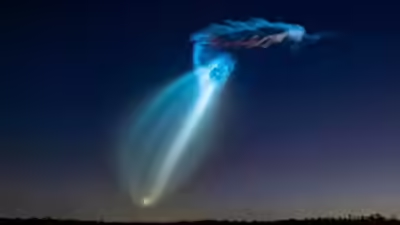
On a clear evening in March 2026, thousands of people along the coast watched a striking sight in the sky high above. A glowing plume spread out against dusk, changing from electric blue to soft violet. Many people call this the Airspace Nebula, but it is actually a result of modern rocket launches. The recent SpaceX launch created a jellyfish-shaped cloud, a beautiful sign of how often we now reach into space.
To those who know what to look for, this space jellyfish is not a natural mystery. Instead, it shows how rocket exhaust interacts with sunlight at high altitude above Earth.
The Autonomy of a Space Jellyfish
The jellyfish effect happens during a short window, about 30 to 60 minutes before sunrise or after sunset. While people on the ground are in darkness, the rocket, now more than 100 kilometers up, is still lit by the sun.
When the Falcon 9 or Starship’s second stage fires, it releases water vapor and carbon dioxide. In the thin upper atmosphere, these gases quickly disperse. With little air pressure, the plume spreads upward for hundreds of miles instead of fading like a jet trail.
The tentacles of the jellyfish shape come from the main engine’s exhaust, while the bell forms as the gases spread out and catch sunlight from behind the curve of the Earth. This effect, part of the “twilight phenomenon,” lights up tiny ice crystals that appear when the water vapor freezes instantly in space.
Atmospheric Physics and the Twilight Phenomenon
The large size of a jellyfish cloud is due to how the rocket’s nozzle works. Near the ground, air pressure keeps the exhaust narrow, but once the rocket passes the Kármán line, there is almost no air, so the exhaust spreads out very quickly.
The bright colors seen during the SpaceX event were caused by Mie scattering. This is different from Rayleigh scattering, which makes the sky blue. Mie scattering occurs when particles, such as ice crystals and leftover fuel, are about the same size as the wavelength of light. Depending on where you stand and where the sun is, the cloud can look orange or deep blue.
On this SpaceX mission, the rocket’s path kept the second stage in sunlight for almost 20 minutes, so the plume stayed visible for a long time. This usually means the rocket is using a lot of energy to reach a high orbit, while maintaining a certain angle to enter a geostationary transfer orbit.
Environmental Aspects and Reusable Rocketry
While the visible display is indisputable and these clouds are beautiful, scientists are now discussing how frequent launches might affect the upper atmosphere. As SpaceX aims to launch several times each week, groups like NOAA are watching. The build-up of water vapor and soot in the stratosphere is among the cleanest in the world, utilizing refined kerosene, RP-1, or liquid methane. These propellants produce significantly less particulate matter than the solid rocket boosters used on the space shuttle. However, the vast amount of water vapor injected into the ionosphere can cause temporary ionospheric holes localized thinnings of the plasma layer that can briefly affect GPS signals and shortwave radio propagation.
The Public Perception Of New-Age Aerospace
SpaceX launches now create jellyfish clouds so often that they have shifted public perceptions of spaceflight. Just a decade ago, rocket launches were rare events seen mostly on television. Today, they are local light displays that draw crowds and flood social media with photographs.
To many people, these clouds show progress and mark our steps into the solar system. Some regard them as a sign of the crowded sky problem, in which the splendor of launches comes with concerns about space junk and light pollution for astronomers. SpaceX has tried to help by adding dark-side coatings to Starlink satellites, but the bright exhaust from clones from rocket launches remains an unavoidable and beautiful part of chemical launches. For the remainder of 2026, the jellyfish will likely become a common fixture of the coastal skyline. With the Starship program reaching operational maturity at Starbase, Texas, and the continued expansion of the Florida launch complexes, the atmospheric canvas will be painted more frequently than ever before.
Upcoming advancements in propulsion, such as nuclear, thermal, or electric ionic drives, may eventually eliminate these violet displays as they do not rely on the massive chemical expansion of water and CO2. But for now, the SpaceX jellyfish remains the most spectacular bridge between our terrestrial home and the vacuum home of the void.
Final Thoughts: A Sky Reimagined
The SpaceX jellyfish cloud is more than a viral photo. It is a real-time physics experiment and a sign of the new space age. It makes us look up and realize that the line between Earth and Space is thinner and more active than we think. Whether you see it as a wonder of technology or a disruption in the sky, it is hard to deny the power of a machine that runs the air into a bright show of light and movement.
Source: Astronomy Picture of the Day








