






Austin, Texas.
If a robotic arm stops working in an automotive plant, it can cost over $20,000 for every minute of downtime. Still, many industrial robots rely on cloud-based systems, which can cause delays, network congestion, and communication failures when operators are busiest. Intel sees this as a chance to step in.
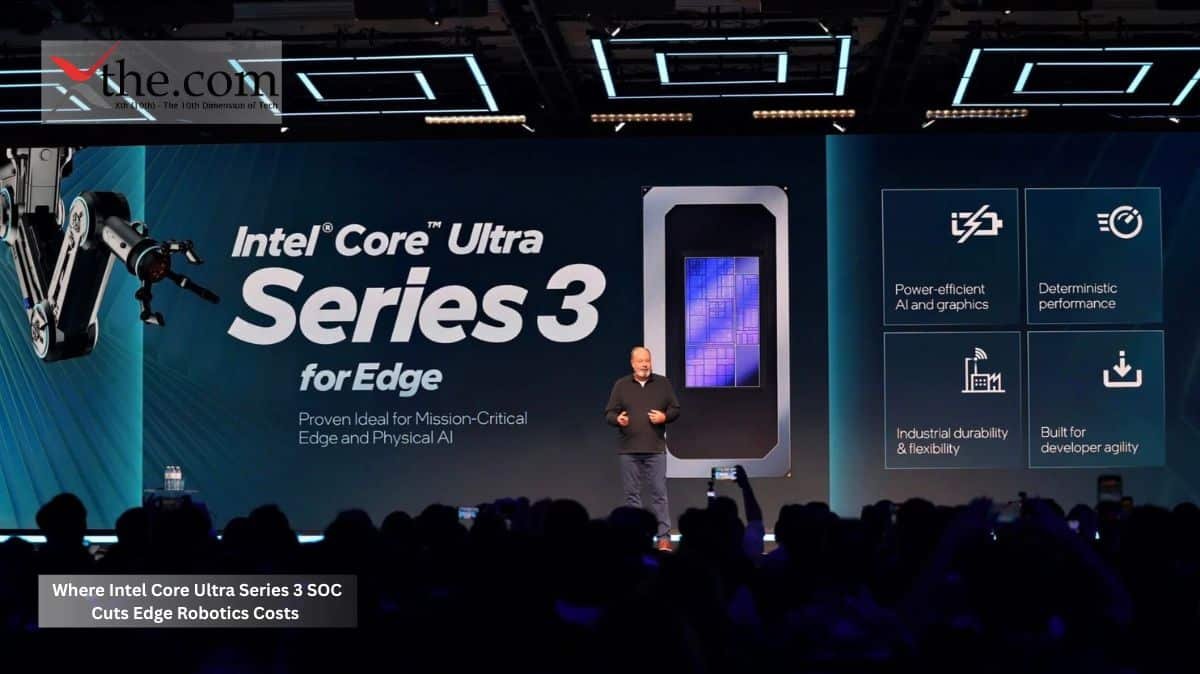
The company’s push behind Intel Core Ultra Series 3 processors represents more than another silicon refresh cycle. It is a direct challenge to the economics of discrete GPU‑heavy edge computing systems that dominate industrial automation today. Intel’s wager centers on a deceptively simple idea: if manufacturers can consolidate compute workloads into a unified system‑on‑chip architecture, they can reduce deployment costs, simplify thermal management, and execute real‑time AI inference directly on the factory floor without relying on constant cloud connectivity.
Why Intel Targets The Edge AI Robotics Market
For a long time, industrial robotics companies built systems with separate CPUs, GPUs, and accelerator cards. This setup worked, but it also made things more complicated. Using multiple chips made the boards more complex, increased power use, and required more cooling in already tight spaces.
This becomes a big issue when a manufacturer installs 5,000 autonomous inspection systems in different factories.
The new Intel Core Ultra Series 3 processors aim to combine all those computing tasks into one chip. This chip can handle AI graphics, machine vision, and robotics control simultaneously. Intel’s approach aligns with the trend toward edge AI robotics, where local processing determines whether robots react in milliseconds or seconds.
In modern semiconductor fabs and automotive plants, robots increasingly synchronize their tasks rather than operate independently. One robot vision system detects defects. Another adjusts tooling paths. In real time, a third reallocates workloads based on the conveyor throughput. This shift to multi‑agent physical compute requires real‑time communication and continuous inference cycles that cloud architectures frequently fail to deliver consistently.
A 200‑millisecond delay from the cloud might not matter in regular software, but in robotics, it can mean damaged products, bad welds, or stopped assembly lines.
The Financial Logic Behind Unified Silicon.
The main competition isn’t about performance numbers; it’s about the total cost of ownership.
Discrete GPU deployments remain expensive to scale because manufacturers must account for separate power delivery systems, thermal designs, maintenance schedules, and replacement inventories.
Intel’s integrated architecture aims to eliminate those overhead layers by integrating a CPU, GPU, NPU, and edge silicon for robotics deployments, consolidating processing into a unified SoC platform.
These cost savings become significant when used on a large scale.
A company installing ten thousand machine‑vision units could save millions each year by using less power. Having fewer separate parts also means fewer things can break. Maintenance teams don’t have to troubleshoot separate GPU connections, memory issues, or overheating across many boards.
Intel’s emphasis on integrated NPU tops scaling also addresses another industrial challenge: predictable AI performance under constrained power budgets.
Most robotics setups can’t use heavy cooling systems found in data centers. Robotic arms near welding stations already face high heat. Edge systems need to handle AI tasks while remaining small and energy-efficient. Intel’s neural processing unit moves AI work off the main CPU and graphics hardware, so manufacturers get reliable response times without using much more power.
Breaking The Legacy Of GPU Dependency.
Intel’s bigger goal is to cut down on what it sees as unnecessary extra hardware and infrastructure.
In the past, industrial AI companies used powerful graphics cards because CPUs weren’t fast enough for AI tasks. But today’s robotics work differs from training large language models. Most factories need local AI for tasks like object detection, mapping, and quick decision-making, not large-scale cloud-based training.
That distinction fuels Intel’s campaign against the legacy discrete GPU replacement market.
Rather than sending tasks to large GPU setups designed for large-scale AI training, Intel offers its SoC design for real-world robotics. For example, a warehouse robot moving between shelves doesn’t need a massive accelerator that consumes a lot of power. It needs dependable local AI, quick responses, and the ability to keep working without errors.
This is where integrated CPU, GPU, and NPU edge silicon for robotics becomes commercially attractive.
Use an automated quality control system to check the packaging of medicines. If the internet goes down for three seconds, cloud-based systems might stop working. But with a local SoC chip, the system keeps running because it performs AI processing on-site.
Keeping operations running smoothly is more important than just having the best benchmark scores.
The Manufacturing Shift Toward Localized Intelligence.
Intel’s bigger plan depends on how companies spend on industrial AI in the coming years.
Manufacturers now want autonomous systems that don’t rely on the cloud. Data privacy rules also support local processing. Often, sensitive factory data can’t leave the building because of intellectual property or security rules.
The expansion of edge AI robotics chipsets in INTC reflects Intel’s shift toward distributed intelligence. Complying companies now prioritize resilience alongside raw compute power.
Intel’s main challenge is putting its plan into action. NVIDIA is still the top choice for AI, especially for developers using CUDA for robotics. Intel needs to show manufacturers that easier and cheaper setups are worth switching from their current software.
Still, the momentum between multi‑agent physical compute suggests the market may reward integrated architectures faster than many analysts expect.
Factories don’t just want robots for the same tasks alone anymore. They want smart, connected systems that can make decisions together and react quickly. This approach works best with chips designed for local AI, energy efficiency, and easy scaling, not with big data‑center hardware.
Intel’s bet on its Core Ultra Series 3 processors comes down to one fact:
When robots work right next to production machines, even the fastest cloud can’t beat processing done directly on the factory floor.