






Seoul, South Korea | July 16, 2026
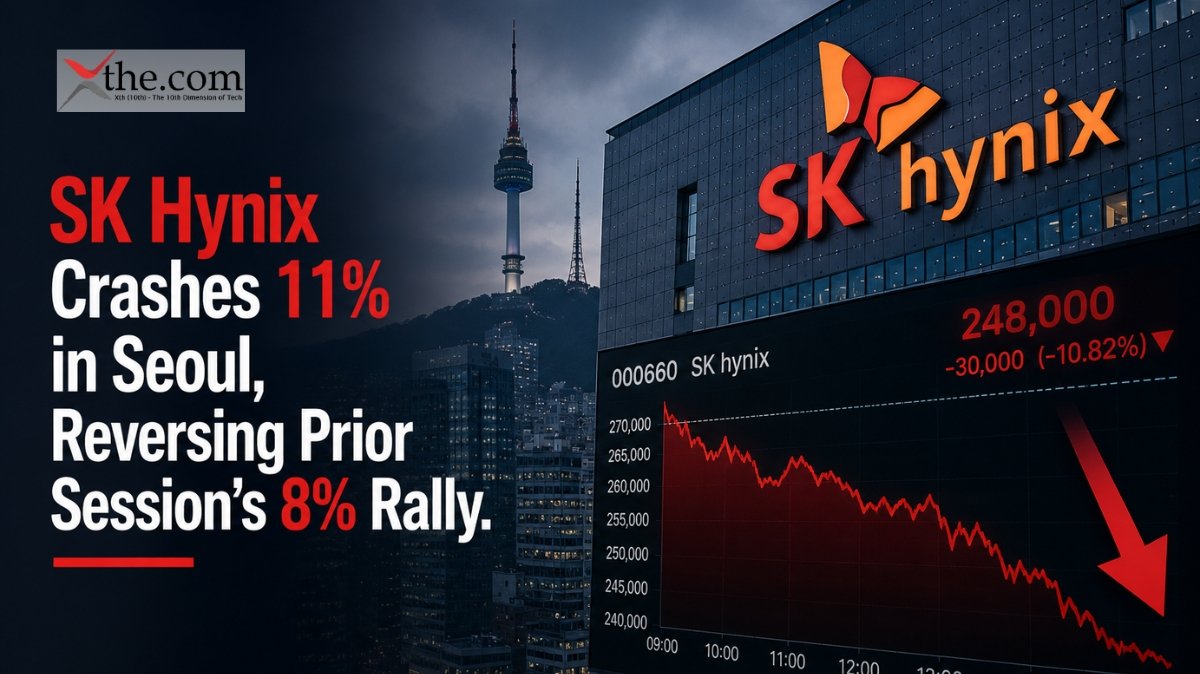
About eleven billion dollars disappeared from SK Hynix’s market value in just one trading session in Seoul on Thursday, July 16, 2026. This happened less than a week after the company completed the largest U.S. share sale ever by a foreign company. SK Hynix crashed 11 percent; headlines do not capture the whiplash traders actually lived through a stock that rocketed nearly 13% higher on Wednesday gave almost all those gains by Thursday’s close. This sharp reversal also pulled down the rest of Asia’s chip sector.
This is not a garden-variety pullback. It is SK Hynix post-IPO swings in their rawest form, a pattern that has defined the stock since its Nasdaq debut on July 10 turned it into a magnet for leveraged single-stock exchange-traded funds and short-dated options of traders. The mechanics of that new trading ecosystem, more than any single piece of fundamental news, explain why a company at the center of the artificial intelligence memory boom can lose an eighth of its value before lunch.
Why SK Hynix Crashed 11% in Seoul
The headline number tells only part of the story. SK Hynix crashes 11 percent; Seoul reverses 8 percent Wednesday rally describes the exact mechanism at work: Wednesday’s buy-side sidecar and near-13% surge set up a Thursday session primed for profit-taking the moment sentiment cracked. Korea Exchange data show the stock closing down roughly 11.5%, with intraday losses briefly touching 12.5%, at a price near 1.84 million won.
Institutional and foreign investors led the sell-off, together selling more than a trillion won in shares. Meanwhile, retail traders tried to buy as prices fell. That imbalance triggered a sell-side sidecar just minutes after the market opened. The Korea Exchange uses this tool to pause program trading when index futures move too quickly in one direction. This was the 37th time the sidecar was activated this year, showing how volatile 2026 has been, not just for SK Hynix but for the whole market.
The Monday-Wednesday-Thursday Pattern
Anyone tracking SKHYV volatility in Seoul this month has watched a genuine three-act structure play out. The stock logged its steepest one-day decline Monday, as investors who had ridden the AI memory trade for months decided to lock in gains amid growing worried that spending on data-center hardware might be cresting. Wednesday reversed that mood entirely, with buyers piling back in and driving a nearly 13% rally in Seoul. Thursday erased almost the entire move.
Such a quick reversal over three sessions is rare, even for a fast-growing stock. This suggests the problem is as much about how the market is set up as it is about company fundamentals. The new Nasdaq American Depositary Receipts, combined with SK Hynix shares traded in Seoul, create opportunities for arbitrage and hedging that make every change in mood more extreme. In New York, SK Hynix’s ADRs dropped nearly 9%, which was less than the fall in Seoul but still erased most of the previous day’s gains.
Samsung, Seoul Semiconductor, and the Sector-Wide Selloff
Samsung drops 7 percent Thursday was the second headline of the day, and it mattered because Samsung’s decline confirmed this was a sector event, not an SK Hynix-specific accident. Samsung Electronics finished the session down between 7% and nearly 9% depending on the exact print used, closing near 255,000 won. The country’s two largest chipmakers rarely move in lockstep by coincidence; when they do, it usually signals a repricing of the entire memory cycle rather than a stock-specific stumble.
The losses spread further down the supply chain. Seoul Semiconductor and LG Innotek fall headlines followed within hours, as Seoul Semiconductor fell more than 5%, and LG Innotek dropped between 1% and 3%, depending on the final numbers. Samsung SDI, which makes batteries and materials for the Samsung group, lost over 2%. None of these companies had released new guidance or warnings that morning. Their declines were driven by broad selling across the index and a broader rethink about how much longer the AI infrastructure trade can continue in the short term.
The Overnight Trigger from Wall Street
Korea was not the source of this sell-off. It followed a sharp drop in U.S. chip stocks the day before, which carried over into Asian trading. Micron Technology fell about 8% in New York, and Dell shares dropped nearly 10% because of worries that memory prices and server demand were weakening faster than analysts expected. This overnight decline made Seoul traders keen to sell quickly without waiting for more information.
Japan also saw similar losses. Advantest, which makes chip-testing equipment and is closely linked to Nvidia’s supply chain, fell by more than 6%. SoftBank Group, which is heavily invested in AI infrastructure, dropped nearly 7%. Tokyo Electron lost over 5%, and Renesas Electronics fell about 4%. The fact that three national markets fell together in a single session shows how closely connected the global semiconductor industry is and how quickly news from the United States can affect markets in Seoul, Tokyo, and beyond.
What the Selloff Signals About the AI Memory Cycle
Analysts are divided about what will happen next. Barclays started covering SK Hynix with an Overweight rating and a price target of 330,000 won, saying that high-bandwidth memory supply will remain tight well into 2027 despite short-term swings. Morgan Stanley disagrees, downgrading the stock and warning that the memory market is starting to weaken as the sector moves past its peak. Earlier in July, Citigroup and Goldman Sachs both raised their price targets, expecting demand for HBM chips used in Nvidia’s data-center GPUs to keep growing, even if the stock stays volatile.
SK Hynix will report its second-quarter earnings on July 22, and those results will be more important than any single day’s price move. Most analysts still expect revenue to continue growing, driven by HBM shipments to Nvidia and other AI accelerator companies. However, the past week has shown that, with leveraged ETFs, new ADR flows, and retail traders adjusting to the stock’s new liquidity, SK Hynix’s share price now responds as much to market mechanics as to actual chip demand.
Gazing Forward
The next big moment comes soon. Until the July 22 earnings report, expect more ups and downs as options expire; ADR arbitrage happens, and news from Washington and Beijing moves the stock in different directions. Investors who bought into the AI memory story for extended growth will need to handle bigger single-day drops than before. It will become clearer whether Thursday’s sell-off signals a real turning point in the memory cycle or just another round of volatility once SK Hynix releases its results next week.
Source: SK Hynix shares plunge over 11% as Asia sees tech rout, tracking U.S. chip losses