




NEW YORK —
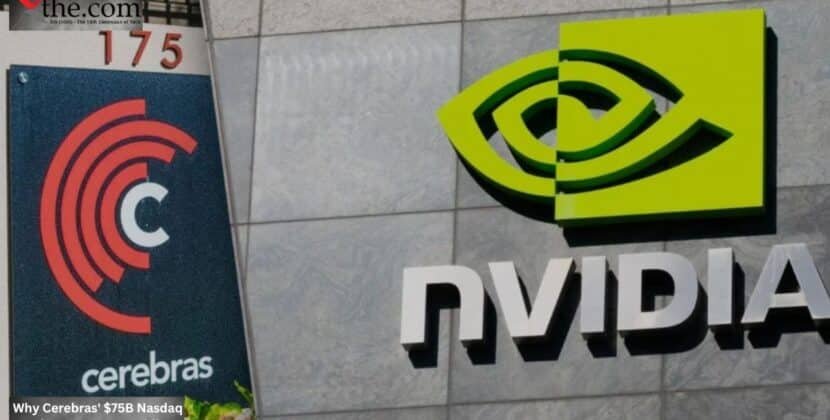
Atomic Answer: Cerebras Systems ($CBRS) surged 90% in its Nasdaq debut today, reaching a $75 billion valuation. This confirms institutional appetite for “Wafer-Scale” alternatives to Nvidia, specifically targeting massive LLM training clusters that require higher on-chip memory than traditional GPUs.
That Cerebras IPO landing near a $75 billion valuation is not really a capital markets story it’s an AI chip race inflection point. As institutional investors start to price a credible alternative to $NVDA at sovereign-fund scale, the buying conversation around AI infrastructure quietly moves away from “which Nvidia setup” to “do we even need Nvidia” for the particular workload profile where Wafer-Scale architecture has a structural edge, you know.
What the 90% Debut Surge Actually Signals
Markets don’t really reprice AI infrastructure alternatives just because there is a 90% debut premium on vibes or pure speculation. The Cerebras IPO valuation rather signals real institutional conviction that the Wafer-Scale Engine addresses a tangible architectural issue — specifically, chip memory density whereas $NVDA GPU clusters typically handle things via networking rather than through the silicon itself.
For LLM training work that needs sustained, very high-bandwidth memory access across gigantic parameter sets, the networking approach incurs extra latency, while the silicon approach essentially sidesteps it. So the AI chip race isn’t basically a matchup between GPU blueprints anymore; it’s more like a contest between two fundamentally different ways of dealing with the memory compute neighborhood problem, which frontier model training keeps pulling to the surface.
Wafer-Scale Engine vs Nvidia Blackwell: The Procurement Comparison
The decision between Cerbras and Nvidia’s Blackwell for AI factory procurement for 2026 is primarily based on the workload profile of how they will be utilized. NVIDIA’s Blackwell is optimized for distributed training on large multi-GPU clusters interconnected via the mature, well-established, and robust InfiniBand architecture, with a deep semiconductor vendor ecosystem to support it.
The Wafer-Scale Engine eliminates the need for the InfiniBand layer(s) by providing complete training compute on a single chip, eliminating the latency associated with the “networking hops” required to coordinate multiple GPUs.
When the performance impact of inter-GPU communication is included in the overhead, the Wafer-Scale Engine will show clear performance advantages in both latency and density. NVIDIA’s distributed architecture, i.e., Blackwell, will not deliver performance equivalent to or better than these two metrics.
Software Stack Risk and CUDA Dependency
The most significant friction in the AI chip race for enterprises looking at $CBRS is not exactly hardware performance, it’s mostly software. The AI infrastructure ecosystem has built up years of CUDA-optimized tooling, libraries, and deployment frameworks that quietly assume $NVDA silicon as the actual execution target.
Transitioning to a Wafer-Scale Engine will entail a comprehensive audit of the entire software stack to identify all CUDA dependencies that need to be removed, replaced, or recompiled. If an enterprise already has fully developed GPU-based training pipelines, the software audit will take longer than expected and require at least several weeks of additional engineering effort, which will then feed into the total cost of migration. The leading semiconductor companies that are attempting to compete with $NVDA have often underestimated the cost of switching to a WSE and, therefore, procurement evaluations of $CBRS should explicitly include these costs before making any commitments.
Thermal Architecture and Rack Setup Costs
Silicon wafers generate more thermal energy than standard rack cooling can dissipate, so we need a new cooling method that uses an internal liquid-cooling system connected to the wafers. Because of this, deploying AI infrastructure on $CBRS hardware requires higher upfront rack setup costs (compared to either air-cooled or traditional liquid-cooled racks).
Companies that evaluate Cerebras vs Nvidia Blackwell purchases for their AI factories in 2026 need to factor in the cost of preparing their racks for these wafers when calculating Total Cost of Ownership (TCO). Cooling the wafers with an internal liquid-coolant manifold will require a substantial initial capital investment; however, this requirement is often overlooked by procurement departments unfamiliar with wafer-scale thermal characteristics when comparing initial pricing with other types of computer chips.
Sovereign Cloud and Single-Node Security Applications
The valuation of Cerebras’s initial public offering (IPO) is influenced in part by the need for sovereign clouds. These would include government and regulated enterprises where having a single node for “training density” is required for security, rather than just wanting to perform better. For example, if multiple nodes are used with $NVDA InfiniBand clusters to distribute training data across hardware devices connected through a network, establishing boundaries around the data adds additional complexity when those systems are “air-gapped” or classified.
Using a single-chip wafer-scale engine for “training” allows for the entire model parameters and training data to reside on the same physical device. This is a property that many sovereign cloud providers and government/defense-adjacent providers purchasing AI infrastructure are assigning significant procurement value to, regardless of performance ratings or benchmark tests.
Conclusion
The Cerebras IPO at $75 billion confirms that the AI chip race has a credible second competitor at an institutional scale. $CBRS and its Wafer-Scale Engine apply direct pressure on $NVDA in these specific workload categorzies high-memory LLM training, sovereign cloud deployments, and single-node density needs where Blackwell’s distributed setup has structural disadvantages, by design.
So, AI infrastructure procurement teams looking at Cerebras vs Nvidia Blackwell for AI factories in 2026 should first assess the workload profile, then the software migration cost, and third, check whether the thermal infrastructure is ready. Only after that should they position the $CBRS hardware in their deployment roadmap. Overall, the AI chip race between the major semiconductor players now feels like a real architectural choice, not just marketing, and the Cerebras IPO liquidity gives the Wafer-Scale Engine roadmap enough capital to keep pace through the next hardware generation.
Enterprise Procurement Checklist
- Financial Consequence: Massive liquidity for Cerebras accelerates the roadmap for their third-generation Wafer-Scale Engine.
- Infrastructure Risk: Adopting non-Nvidia silicon requires a full software stack audit for CUDA-dependency.
- Deployment Impact: Single-chip training reduces “networking hop” latency inherent in $NVDA InfiniBand clusters.
- Thermal Scaling: Wafer-scale chips require specialized internal liquid manifolds, increasing initial rack setup costs.
- Operational Action: Evaluate Cerebras for “sovereign cloud” projects where single-node density is a security requirement.
Primary Source Link: Economic Times International