






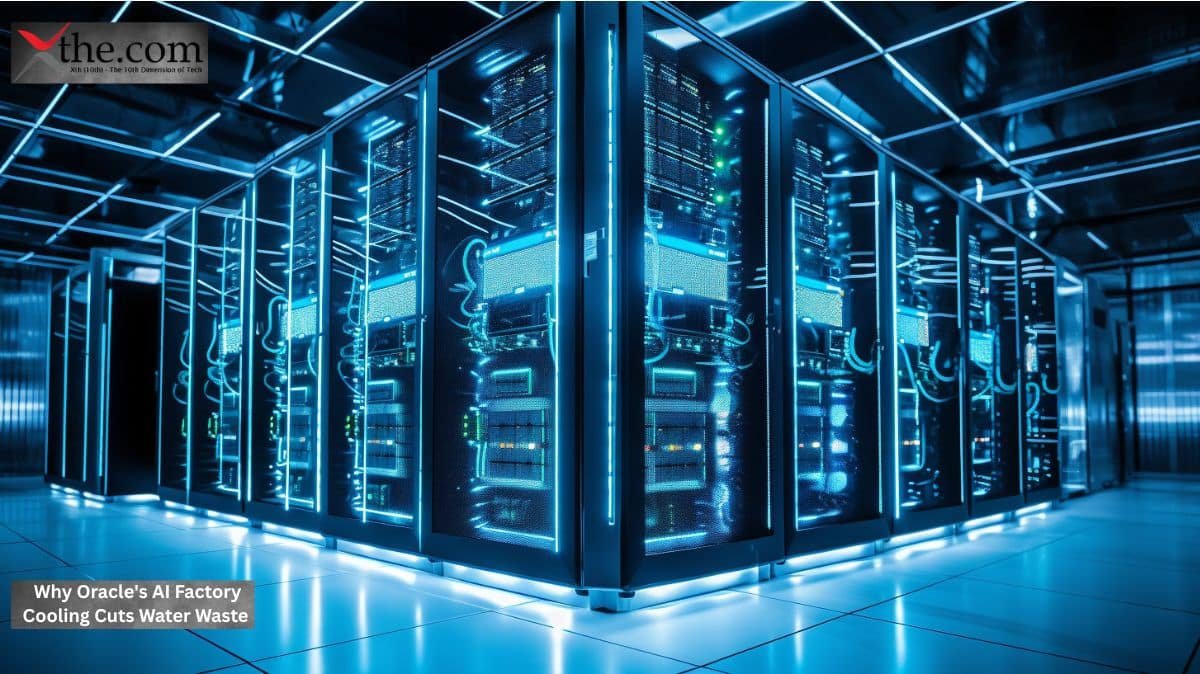
Austin, Texas, Oracle (ORCL) has pivoted its factory strategy to utilize exclusively closed-loop, non-evaporative cooling systems for its massive chip clusters. This technical shift eliminates the draw on local water resources, allowing for dense AI infrastructure deployments in water-stressed regions without sacrificing the kW per rack density required for LLM training.
A single hyperscale data center can consume millions of gallons of water each year just to keep servers from overheating. That number climbs even faster when operators deploy high-density GPUs for generative AI workloads. The surge in AI factory construction has exposed a problem executives can no longer ignore: traditional cooling systems cannot sustain the next decade of compute demand without inflating utility costs and increasing environmental pressures. That reality sits at the center of Oracle’s infrastructure strategy as the company pushes deeper into large-scale AI deployments.
The Cooling Problem Behind Every AI Factory
The economics of AI depend on the heat management. Every advanced GPU rack generates substantial thermal output, and older air-based systems struggle to dissipate it efficiently. The result often includes rising electricity bills, higher water consumption, and expensive retrofits tied to increasing thermal CapEx requirements.
A company building a 100-watt AI campus faces a tough challenge. Packing in more computing power can boost revenue, but it also puts more pressure on cooling systems. Traditionally, evaporative cooling uses a lot of water to keep things safe in dry areas like Arizona, Nevada, and parts of Texas. This creates long-term risks for operations.
Oracle Infrastructure stands out by making cooling a core part of its infrastructure design. Instead of seeing it as a side issue, Oracle builds thermal efficiency right into its modern AI factory setups.
Why Closed-Loop Cooling Changes the Economics
Oracle’s move to closed-loop cooling is part of a larger trend in big data centers, but it emphasizes water conservation and more predictable operations.
Traditional evaporative cooling systems use a lot of fresh water because they rely on evaporation to remove heat. Closed-loop cooling works differently by recirculating the coolant in a sealed system. The same fluid is reused repeatedly with very little loss, greatly reducing the need for city water.
For companies looking at long-term infrastructure deals, the financial side is just as important as sustainability. Water prices are going up in many US cities, and regulators are watching industrial water use more closely. Businesses running thousands of AI accelerators need to avoid unexpected utility costs.
Oracle’s engineers combine closed-loop cooling with denser rack designs so customers can add more computing power without using much more water. This is especially helpful for organizations building their own AI systems or regional cloud setups where local infrastructure limits their ability to expand.
How Liquid-to-Chip Technology Improves Efficiency
The real innovation is liquid-to-chip cooling. Instead of cooling the air around the equipment, this method sends coolant directly over the processors that create the heat. This experience might seem small, but it’s actually very important.
Air cooling uses more energy because it tries to cool the whole room. Direct liquid systems focus on the actual heat source. This makes heat transfer much more efficient, especially in AI clusters with many GPUs, where each rack can consume over 100 kilowatts.
Here’s an example. Suppose a financial services company is training fraud detection models on thousands of GPUs. With older cooling systems, they might need extra chillers, more airflow controls, and lots of backup to keep things cool during busy times. With liquid-to-chip cooling, they can keep temperatures lower and need less overall cooling equipment.
This has a big impact on data center power use. Cooling can make up 30% to 40% of a facility’s total energy bill. Making cooling more efficient reduces costs and improves power usage effectiveness, a key metric for both investors and regulators.
The Financial Impact of Reducing Thermal CapEx
Infrastructure leaders are now looking at AI projects with a focus on capital efficiency rather than just performance. Faster GPUs are important, but cooling is what makes these systems affordable to run over 10 years.
Rising thermal CapEx has become one of the hidden, highest hidden costs in hyperscale expansion. Companies frequently underestimate the costs associated with retrofitting facilities for advanced AI workloads. Upgrading chillers, reinforcing airflow systems, and expanding water treatment capacity can add hundreds of millions of dollars to large-scale projects.
Oracle’s choice to use non-evaporative cooling changes the cost picture. Since this method uses less water, operators can avoid many of the additional costs associated with traditional cooling towers and water systems. This is important for more than just sustainability reports. Investors are now looking closely at how resilient infrastructure is during their reviews. Cloud providers in areas with drought risks face big questions about long-term growth. Oracle’s cooling approach tackles this issue head-on.
The emphasis on Oracle AI infrastructure procurement for sustainable data centers also indicates a shift in enterprise buying behavior. Procurement teams now evaluate energy efficiency and water consumption, along with compute performance, when selecting cloud vendors or colocation partners.
Oracle Infrastructure and the Race for Sustainable AI
The AI industry is moving toward more powerful, compact computing systems. Newer models need bigger clusters, faster connections, and more electricity. But these advantages also make cooling even more challenging.
Oracle seems to understand that cooling efficiency is now a key way to stand out, not just a technical detail. By investing in non-evaporative cooling and direct liquid cooling, Oracle can attract companies facing ESG requirements, higher utility costs, and local water restrictions.
This strategy also fits with growing government pressure for sustainable infrastructure. Some US states have already discussed limits on water-heavy data centers. In Europe, some cities now require more stringent environmental reports before approving large facilities.
Against this backdrop, Oracle AI infrastructure procurement for sustainable data centers becomes more than a technical procurement phrase. It represents a growing shift in corporate priorities. CIOs and infrastructure executives increasingly want systems that can support aggressive AI growth without triggering unsustainable operating costs.
The future of the AI industry may rely less on just having more computing power and more on how efficiently companies can support it at scale. Oracle’s cooling design shows that water efficiency, energy savings, and strong infrastructure are now just as important as processor speed.
Checklist of Main Points
✔ Oracle adopted closed-loop, non-evaporative cooling systems
✔ AI factory cooling reduces water use in drought-prone regions
✔ Liquid-to-chip technology improves thermal efficiency
✔ Lower thermal CapEx reduces long-term infrastructure costs
✔ Sustainable AI infrastructure supports future hyperscale growth
Source: Oracle AI Infrastructure in 2026 and Our Commitment to Local Communities








