




Santa Clara, California
NVIDIA GeForce NOW stream games and the servers behind them just got a major upgrade. This is especially important for the millions of American households employing basic office laptops or budget desktops, even if most people don’t realize it yet.
NVIDIA’s new RTX 5080-class cloud servers, now available worldwide, let a $400 Chromebook or a four-year-old office laptop run games like Cyberpunk 2077 or Borderlands 4 at settings that once needed a $1,500 graphics card. This upgrade began rolling out in September 2025 and will continue to expand through 2026. The best part is, prices haven’t changed at all.
What the Blackwell Server Rollout Actually Did
The update that made this possible was announced at Gamescom 2025 and centers on NVIDIA’s Blackwell architecture, replacing the previous Ada Lovelace GPU generation across its remote server nodes. Each new SuperPOD unit runs a custom RTX 5080-class GPU with 48 GB of VRAM, paired with an 8-core AMD Ryzen Zen 5 processor clocked at 4.4 GHz — around 30% faster on CPU workloads than the older Zen 3 configuration.
The resulting compute figure lands at 62 teraflops for Ultimate tier members, a level of output that exceeds three times the processing power of a PlayStation 5 Pro and delivers up to 2.8 times the frame rate of the previous RTX 4080-based servers.
What this means at the consumer level: the graphics streaming quality achievable over a standard home broadband connection now approaches what a dedicated gaming rig produces locally. PC Gamer noted that titles felt indistinguishable from local play under optimal conditions following the Blackwell server introduction. That assessment holds for wired gigabit connections; wireless setups introduce their own variables, which we address below.
How Low-Latency Data Routing Works on a Home Network
This is where the engineering gets interesting, and it’s also where most coverage skips the details.
Low-latency data routing is a system built to reduce the delay between clicking your mouse and seeing the result on screen. In cloud gaming, the round-trip from your device to the data center and back has always been a challenge. NVIDIA’s Blackwell update tackles this with three main improvements.
First, each remote server node in the SuperPOD network uses ConnectX-7 smart networking cards alongside Rivermax packet-pacing technology. This allows direct data transfer to and from the GPU, smoothing latency even at high streaming bitrates without queuing delays at the rack level.
Second, NVIDIA introduced a dedicated Low Latency Streaming (LLS) mode that integrates NVIDIA Reflex — the same anti-lag technology embedded in local RTX graphics cards — directly into the cloud pipeline. The result is 30ms click-to-photon latency in titles like Overwatch 2, outperforming a PlayStation 5 Pro in 120Hz mode on the same network, which logs 49ms under identical conditions.
Third, NVIDIA worked with major internet service providers, including Comcast, Deutsche Telekom, and BT Group, to bring in L4S (Low Latency, Low Loss, Scalable Throughput) network technology. In areas where these cooperations are active, L4S greatly cuts the lag between the data center and your home router. For Comcast customers in the US, this uses the DOCSIS cable standard that’s already in most homes.
The aggregate effect of NVIDIA GeForce NOW stream games’ low-latency updates is measurable: the majority of GeForce NOW subscribers in supported regions now experience sub-30-millisecond network latency, a threshold at which most players cannot detect delay during competitive play.
What Budget Buyers Actually Pay
This is where the value becomes clear for people shopping for home computer hardware.
The Ultimate tier — which delivers RTX 5080-class graphics streaming at up to 4K resolution and 240 frames per second — remains priced at $19.99 per month, $99.99 for six months, or $199.99 annually. The Performance tier, offering 1440p at 60 frames per second with 6-hour sessions, stays at $9.99 per month or $99.99 per year. A free, ad-supported tier is available to anyone who wants to test the service without a credit card.
Now compare that to buying hardware. An RTX 5080 desktop graphics card costs over $1,000. A laptop that can run Call of Duty: Black Ops 7 at high settings usually starts at $1,200. The yearly price of a GeForce NOW Ultimate subscription is just one-fifth of that. Plus, you don’t have to worry about installing hardware, controlling heat, or your gear becoming outdated.
The NVIDIA GeForce NOW stream games library now exceeds 4,500 titles following the rollout of Install-to-Play, a feature that effectively doubled the accessible catalog by allowing users to install Steam titles directly to NVIDIA’s cloud storage, with 100GB of session cache available to Performance and Ultimate subscribers. The platform operates on a bring-your-own-games model, meaning any title already purchased on Steam, Epic, or GOG becomes instantly accessible without re-purchase.
Converting a Cheap Laptop Into a Capable Workstation
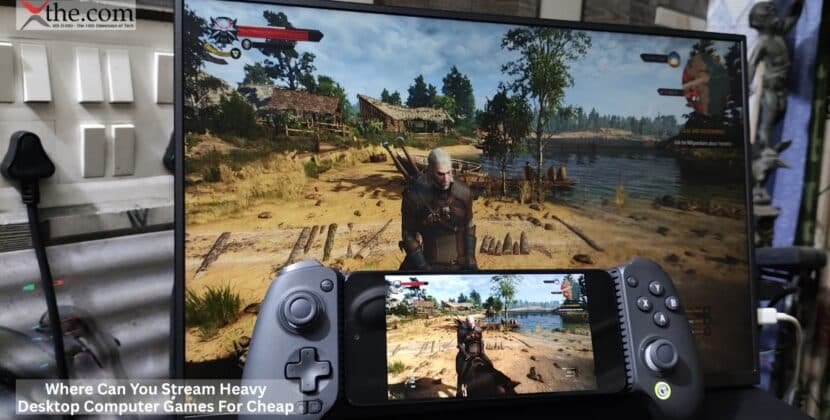
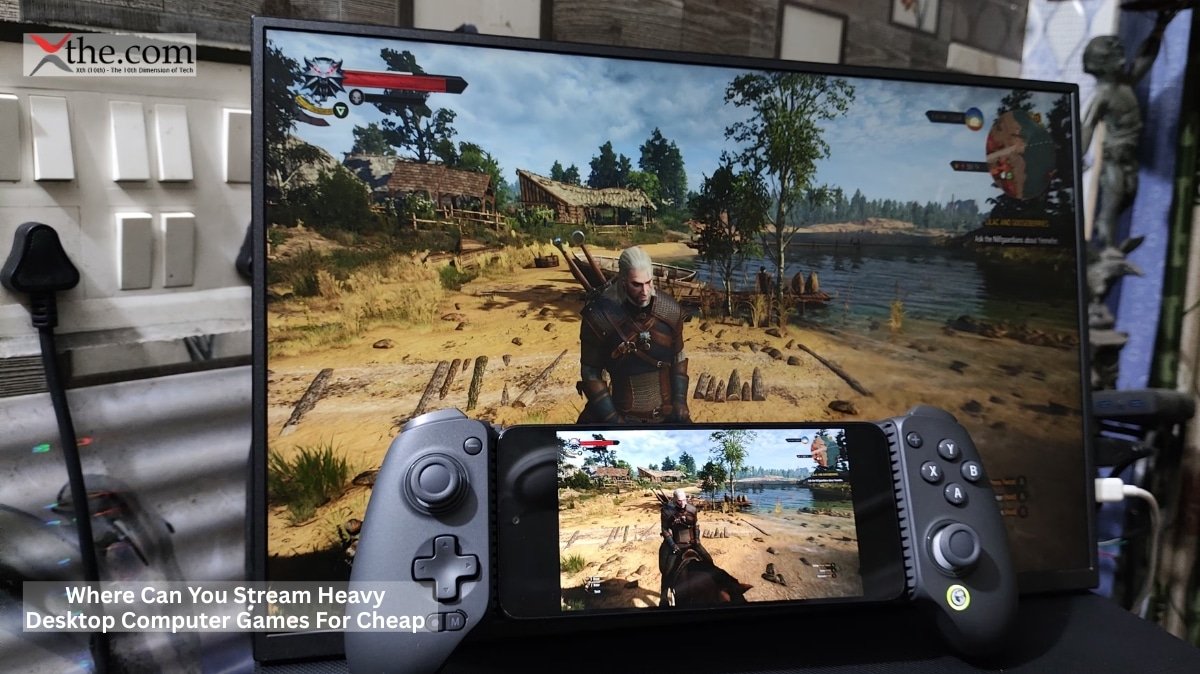
Because remote server nodes now handle all the graphics to work, your own device barely needs to do anything. Whether you have a $299 Chromebook, a MacBook Air with basic graphics, or a work laptop from 2020, they all work just as well as terminals.
GeForce NOW’s Cinematic Quality Streaming mode uses 4:4:4 chroma sampling, 10-bit HDR, and advanced AV1 encoding. Users say the results look like razor-sharp on high-resolution laptop screens, even in scenes with lots of detail, complex text, or fast movement that usually challenge streaming quality.
You can now use many devices beyond just a PC. The Steam Deck has a native app that supports up to 90 frames per second in handheld mode or 4K at 60 frames per second when docked. Samsung and LG TVs, Apple Vision Pro, Meta Quest headsets, and Amazon Fire TV devices are all supported. As long as your network is stable, your living room TV can be just as good for gaming as a desktop computer.
The Network Variable That Remains
Low-latency data routing from NVIDIA’s end does not fully compensate for a congested home router or an oversaturated Wi-Fi band. The recommended baseline for smooth graphics streaming at 1440p is a stable 25 Mbps connection; the Cinematic Quality Streaming mode at full fidelity asks for up to 100 Mbps. Wired Ethernet eliminates most of the variance introduced by 5 GHz Wi-Fi under household load.
With a wired connection, GeForce NOW’s Low Latency Streaming mode can reach 360 frames per second for competitive gaming. This level of responsiveness matches dedicated gaming monitors, something that was only possible with local RTX hardware until recently.
This is a big change in how gaming works. For years, gamers had to keep buying expensive new hardware. Now, for $9.99 a month, you can use a powerful data-center GPU that would cost more than most people’s entire desktop. The server network behind it is now much stronger, too. So, for budget buyers, the real question isn’t whether GeForce NOW can replace a gaming PC, but how soon do they want to switch?
Source: Nvidia Newsroom