





AMRAAM Production Japan Deal Adds a Second Allied Missile Factory
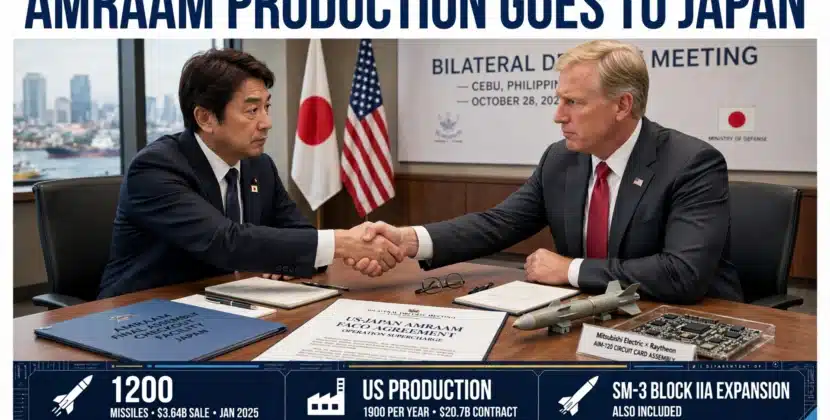
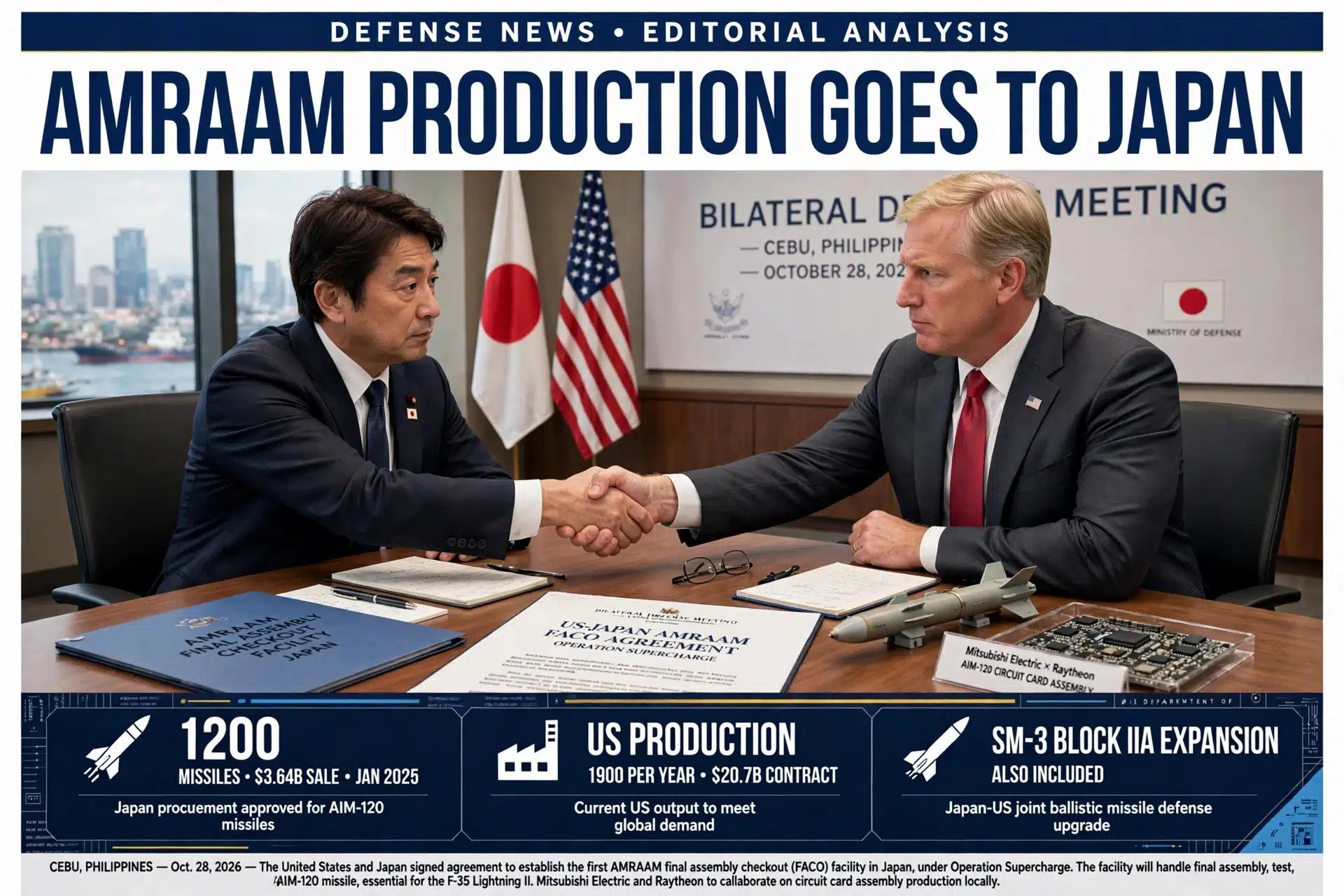
AMRAAM production is expanding to Japan, under an agreement Defense Secretary Pete Hegseth and Japanese Defense Minister Shinjiro Koizumi signed on October 28 in the Philippines, and the AMRAAM production Japan decision also opens the door to boosting SM-3 interceptor output. The allied factory move is the industrial-base side of a wider rearmament push, and it matters to US readers for one concrete reason: the air-to-air missile that guards every American F-35 and the sea-based interceptor that guards allied cities will no longer depend on a single country’s assembly lines. Final locations, output targets and timelines were not disclosed.
Key Takeaways:
- – Hegseth and Koizumi agreed on October 28, 2026, at an ASEAN-linked defense meeting in Cebu, to establish an AMRAAM final assembly and inspection facility in Japan.
- – The same readout records an agreement to share technical information enabling increased production of the SM-3 Block IIA interceptor.
- – Both items fall under Operation Supercharge, the bilateral push accelerating defense equipment and technology cooperation.
- – The step follows a September 2026 Raytheon award worth up to more than $20 billion over seven years that will nearly double AMRAAM production, contingent on congressional funding.
- – Japan already co-produces PAC-3 and approved selling those interceptors back to the US in 2024, so the AMRAAM line extends an existing pattern.
What was agreed at Cebu
The Japanese defense ministry’s official meeting summary, dated October 28, records the two core decisions plainly: the ministers agreed to share the necessary technical information to enable increased production of the SM-3 Block IIA, and they agreed to establish an AMRAAM FACO, final assembly and inspection, in Japan. The meeting itself ran about half an hour, and the readout groups the decisions under Koizumi’s Operation Supercharge initiative alongside cyber cooperation, missile-defense strengthening and Keen Sword 27, the large bilateral exercise that follows.
The inside-baseball detail is the functional form of the facility. A FACO, final assembly and inspection capability, means Japanese workers will build finished missiles from US-produced components under US quality oversight, rather than merely conducting repairs or setting up a licensed copy shop. That structural choice keeps the sensitive guidance software and control systems consolidated in US hands while distributing production throughput across allies, which is precisely the arrangement Washington has used for decades with formal partners such as Japan’s F-35 wing line.
Why the US wants missiles built outside the US
AMRAAM, the AIM-120 built by RTX’s Raytheon unit, is described in trade coverage as essential to the F-35 and fires from every fighter in the American inventory as well as many allied ones. Demand changed after the spring 2026 Middle East operation drained stockpiles, and in May 2026 the Pentagon placed AMRAAM and the SM-3 on its list of 14 critical weapons to accelerate. The September 2026 Raytheon contract, worth up to over $20 billion across a five-year base with two option years, nearly doubles planned production.
The binding constraint is factory capacity, not demand. A FACO abroad ends up functioning as overflow capacity that cannot be easily disrupted by a supplier fire, a single test stand malfunction, or a domestic labor dispute, and each such disruption in 2026 has the entire weapon family waiting behind it. Japan’s motivation is equally concrete: a factory in its own country means priority access, deep local skill development, and a stake for its own contractors.
What Operation Supercharge actually changes
Operation Supercharge is the umbrella under which the two countries are accelerating equipment and technology cooperation. Under the same banner the two sides have opened co-development lanes for munitions, tightened intelligence sharing, and pushed Japanese shipbuilding cadence, with the October 28 meeting extending that into assembly-line territory for air-domain weapons. Japanese Defense Minister Koizumi framed the agreement as a groundbreaking deal: it ensures both countries acquire the equipment they need while strengthening Japan’s defense industrial base, a sentence that captures the industrial logic in a single clause. He followed up at a press event by promising to elevate the Japan-US alliance to even greater heights, per Stars and Stripes.
The operational frame matters too. The Pentagon readout, as relayed in trade coverage, emphasizes strategic alignment to strengthen deterrence and implement an effective denial defense in the First Island Chain, the line of islands running through the Philippine Sea that anchors US allied strategy against regional coercion. That is the strategic register in which missile-line policy lives, and it explains why such agreements move at diplomatic speed instead of procurement deadlines.
What this means for US jobs and supply
Domestic skepticism about foreign missile assembly deserves a real answer. The Japanese assembly decision does not move US aerospace employment overseas, because final assembly of US-built components adds finished-missile throughput that otherwise would not exist, plus a second country’s investment in the same supply chains that employ US workers. More AMRAAM output also eases the queue for foreign military sales customers, keeping the existing US line focused on American inventory.
The finer point is insurance. On the American side the word is munitions, and the simple version is that tomorrow’s shortfall in a regular war scenario would not wait for a US line to ramp up, especially when allied commitments depend on one country’s export approval. Meanwhile, Tokyo’s expressed interest in co-production with Raytheon dates back years, and Mitsubishi Electric’s April announcement of joint AMRAAM production talks with the American maker fits directly into this week’s decision, though the Japanese industrial partner has not been publicly named.
What happens next
Three questions remain open. Where in Japan the facility sits, what cadence it adds, and how its cost is split are all undetermined, and Stars and Stripes reported that the Japanese side offered no numbers. A formal implementing agreement, the legal instrument that authorizes a FACO, typically follows within months of a leader-level commitment, so watch the bilateral schedule through early 2027. Congressional funding is the other gate, because the September Raytheon award nearly doubles production only if lawmakers appropriate the option years, and the Japan line magnifies the effect of whatever the US funds at home. The official US record is thinner here, since publicly available DoD readouts do not name AMRAAM or SM-3, so the authoritative framing for now is the Japanese summary.
For US readers watching defense stocks and the defense industrial debate, the pattern to track is the second: every factory the alliance adds is a hedge against the bottleneck economics that slowed ammunition in recent years, and this agreement moves the highest-demand air-to-air missile into the same category Japan already handles for Patriot interceptors.
Frequently Asked Questions
Why is AMRAAM production moving to Japan?
It is not relocating; a new final assembly facility is being added in Japan to expand total output. The October 28 agreement responds to surging demand after missile stockpiles drained in 2026 and to the Pentagon’s push to accelerate 14 critical weapons, including the AMRAAM and SM-3.
What is Operation Supercharge?
Operation Supercharge is the Japan-US bilateral initiative, championed by Defense Minister Koizumi, that accelerates defense equipment and technology cooperation, including munitions co-production, and the October 28 agreements on AMRAAM FACO and SM-3 technical information sharing fall under it.
Will SM-3 interceptor production increase?
Both governments agreed to share technical information to enable increased SM-3 Block IIA production, which is the prerequisite step toward higher output. Actual rates jump only after production decisions, facility arrangements and funding follow, and no timeline or numbers have been published.
Sources:
- https://www.mod.go.jp/en/article/2026/10/8dbc5c2ef47ef3843a13f3bb48dc6b00fff7ba03.html
- https://breakingdefense.com/2026/10/us-japan-ink-agreements-for-amraam-production-sm-3-production-boost-japanese-mod/
- https://www.stripes.com/theaters/asia_pacific/2026-10-30/hegseth-japan-missile-production-23306398.html
- https://apnews.com/article/association-of-southeast-asian-nations-defense-ministers-pete-hegseth-shinjiro-koizumi-3351555ce9c46b41a3e31d91b81894eb