





Apple iMac M6: Release Date, Upgrades, and Who Should Buy
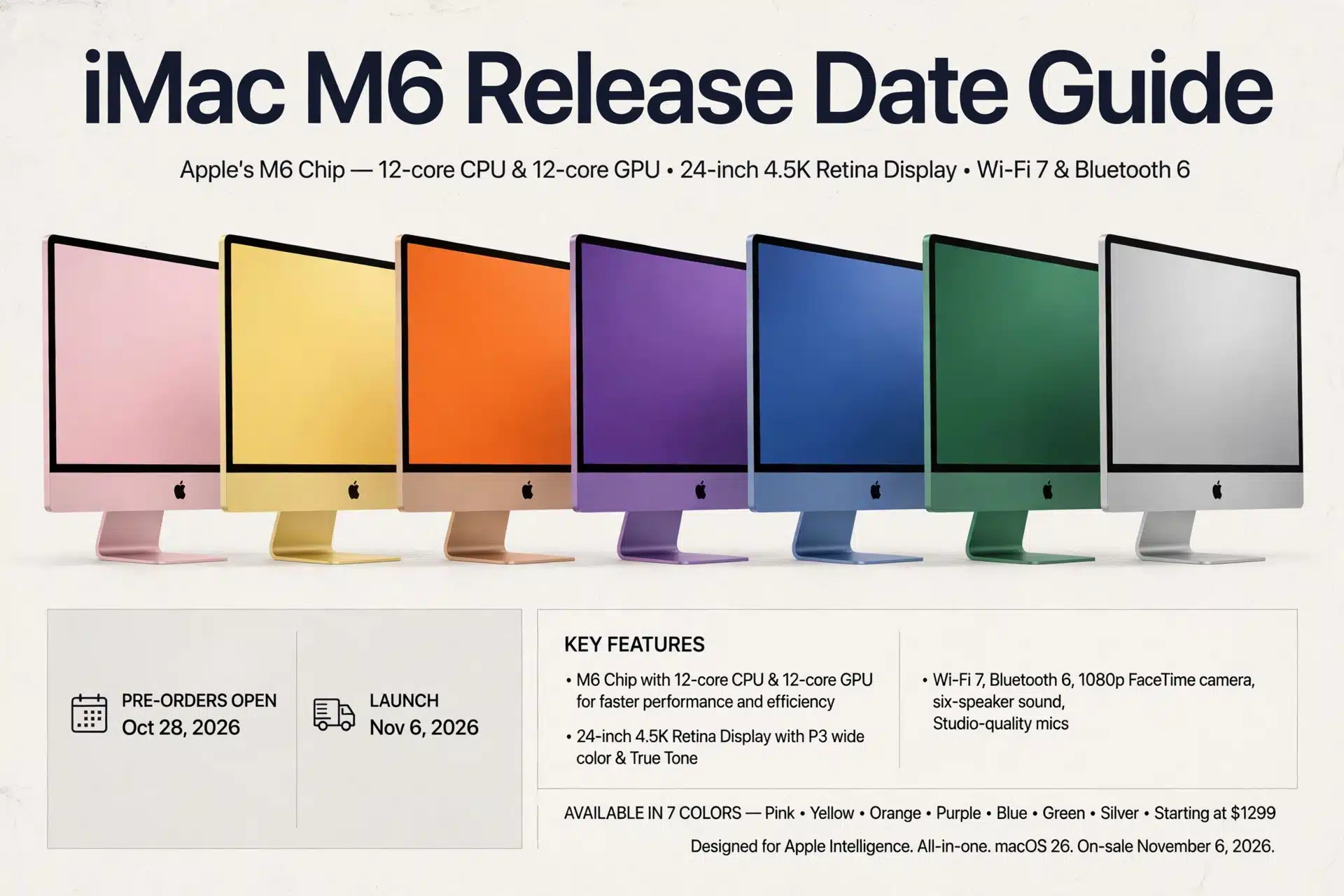
Apple unveiled the refreshed 24-inch iMac with the M6 chip on Tuesday, October 27, 2026, with pre-orders opening October 28 and in-store availability starting Friday, November 6. Here is exactly what the iMac M6 upgrade delivers, how its performance compares with older models, and whether the new all-in-one makes sense for your desk this holiday season.
Key Takeaways:
- – The iMac M6 was announced October 27, 2026; pre-orders opened October 28 and it ships November 6.
- – Up to 5x faster on-device AI performance than M4 and up to 18x faster than the most popular Intel iMac for upgraders.
- – New 12-core CPU and GPU with Neural Accelerators in every GPU core, plus a Dual 16-core Neural Engine.
- – Connectivity adds Wi-Fi 7, Bluetooth 6, optional 2.5 Gigabit Ethernet, and up to 2x faster storage.
- – Same design language: 24-inch 4.5K Retina display, seven colors, macOS 27 with next-generation Apple Intelligence and Siri AI.
What Apple announced on October 27
The press release keeps the iMac template Apple has refined since 2021: a strikingly thin all-in-one with the 24-inch 4.5K Retina display, color-matched accessories, and up to four Thunderbolt 4 ports, now in seven colors including blue, green, pink, yellow, purple, orange, and silver. What is genuinely new sits underneath. The M6 raises the core counts, with up to a 12-core CPU and 12-core GPU, two cores more than the M4 generation, and every GPU core carries a Neural Accelerator, the hardware path Apple uses to accelerate AI workloads. Memory bandwidth climbs to 170 GB/s, which is the spec that matters most when running local large language models.
Shelly Goldberg, Apple’s vice president of Hardware Engineering, called iMac the world’s best all-in-one and framed the refresh as performance and AI capabilities supercharging every workflow, alongside macOS 27 and the next generation of Apple Intelligence with Siri AI.
The iMac M6 upgrade numbers that matter
Apple’s published comparisons give a concrete map for two very different buyers. For users replacing an aging machine, the leaps are large: up to 2.5x faster performance in Microsoft Excel versus the iMac with M1, and for anyone still on Intel, up to 18x faster than the most popular Intel-based iMac. For owners of the M4 iMac from two years ago, the deltas are smaller but real: up to 1.5x faster productivity performance, up to 2x faster graphics, up to 2x higher gaming performance with ray tracing, and the standout, up to 5x faster on-device AI performance for prompt processing in LM Studio versus M4, which is up to 12x versus M1.
That AI figure is the one Apple is leading with, and for good reason. The iMac now runs local AI models, meaning models operating entirely on the device, fast enough to be practical for tasks like writing assistance, transcription, and image analysis without sending data to a server. For privacy-conscious US households and small businesses in regulated fields, the pitch is simple: M6-class speed plus local processing means capable AI features with data that never leaves the desk.
Connectivity: Wi-Fi 7 and faster wired options
The connectivity upgrades sound incremental but change what the machine can anchor in a home or office. Wi-Fi 7 support future-proofs the iMac for the newest generation of routers spreading through the US market, with higher throughput and lower latency in dense wireless environments. Bluetooth 6 refreshes the radio for a new wave of accessories, including hearing-aid-class audio devices that lean on the updated standard. On the wired side, an available 2.5 Gigabit Ethernet option serves households and small offices on multi-gig fiber plans, and storage is up to 2x faster, so large photo libraries, video projects, and local model files launch without the wait. The display remains the 24-inch 4.5K Retina panel with an industry-leading camera, speaker, and microphone array.
Siri AI and macOS 27 on the iMac M6
Software is half the announcement. With macOS 27, the next generation of Apple Intelligence powers Siri AI, a rebuilt, conversational Siri that can find information across messages, email, and photos and take action across apps. Apple positioned three desktop-specific touches. Siri AI is built directly into Spotlight, so searching becomes asking. Visual Intelligence is a keyboard shortcut away: point it at anything on the 4.5K display, from a spreadsheet chart to a browser photo, and ask about it, a workflow that plays naturally to the iMac’s role as the household’s shared screen. And Siri can write and edit in place, matching the user’s tone in Mail and Messages.
For creative and productivity buyers, Apple also highlighted the AI-enhanced app ecosystem, calling out Pixelmator Pro and Claude as examples of apps that take advantage of the Neural Accelerators for photo enhancement, object removal, and writing tasks.
Who should buy the iMac M6, and when
The strongest cases are three audiences. Intel iMac owners still limping along on 2020-or-older hardware get the largest jump Apple has advertised on any Mac tier this cycle, up to 18x, and the November 6 availability makes a clean holiday upgrade. M1 iMac owners, now five years into the Apple silicon era, get a meaningful but optional step up, strongest if local AI and gaming feature in their week. M4 owners should wait; the gains there are real but incremental, since Apple itself framed M6 as 1.5x to 2x in most consumer workloads.
Families get the story Apple emphasizes in its collateral: managing calendars and finances, helping with homework, and running small businesses on apps like Bigin by Zoho, with students editing and sharing video between classes. Creators get faster Blender modeling, Final Cut Pro editing of high-resolution footage, and Affinity photo retouching. The unifying theme is that every workflow Apple named gets AI acceleration rather than only the professionals’ tools.
What happens next
Pre-orders have been open since October 28, and the practical planning questions are price configuration and timing. Historically, Apple’s all-in-ones hold their refresh cadence for roughly a year, so buying at launch means maximum longevity in this generation. Watch two developments after launch: independent benchmarks confirming the LM Studio prompt-processing numbers on retail units, which will settle whether the 5x AI claim survives real-world memory-bound workloads, and any bundle promotions as the holiday season gets underway, since the iMac competes for families’ big-ticket tech gift along with laptops and tablets.
For US readers deciding this week, the calculation is straightforward: the iMac M6 upgrade is a genuine generational jump for Intel and M1 owners, a solid refresh for M4 skeptics who want Wi-Fi 7 and the AI headroom, and a wait-and-see for M4 owners planning to skip a generation.
Frequently Asked Questions
When can I pre-order the iMac M6?
Pre-orders began October 28, 2026, the day after Apple’s announcement, and the iMac M6 becomes available November 6, per Apple’s press release.
How much faster is the iMac M6 than M4?
Apple claims up to 1.5x faster productivity performance, up to 2x faster graphics, up to 2x faster gaming with ray tracing, and up to 5x faster on-device AI performance in LM Studio compared with the M4 iMac.
Is the iMac M6 worth it for running local AI models?
It is the strongest case in the refresh: Neural Accelerators in every GPU core, 170 GB/s memory bandwidth, and a Dual 16-core Neural Engine deliver Apple’s claimed up to 5x AI prompt-processing speed over M4, enough to run capable models locally with data staying on the device.
Sources: