




A Cyberattack on Defense Contractor BAE Systems Has Halted Notices From Every U.S. Federal Bankruptcy Court
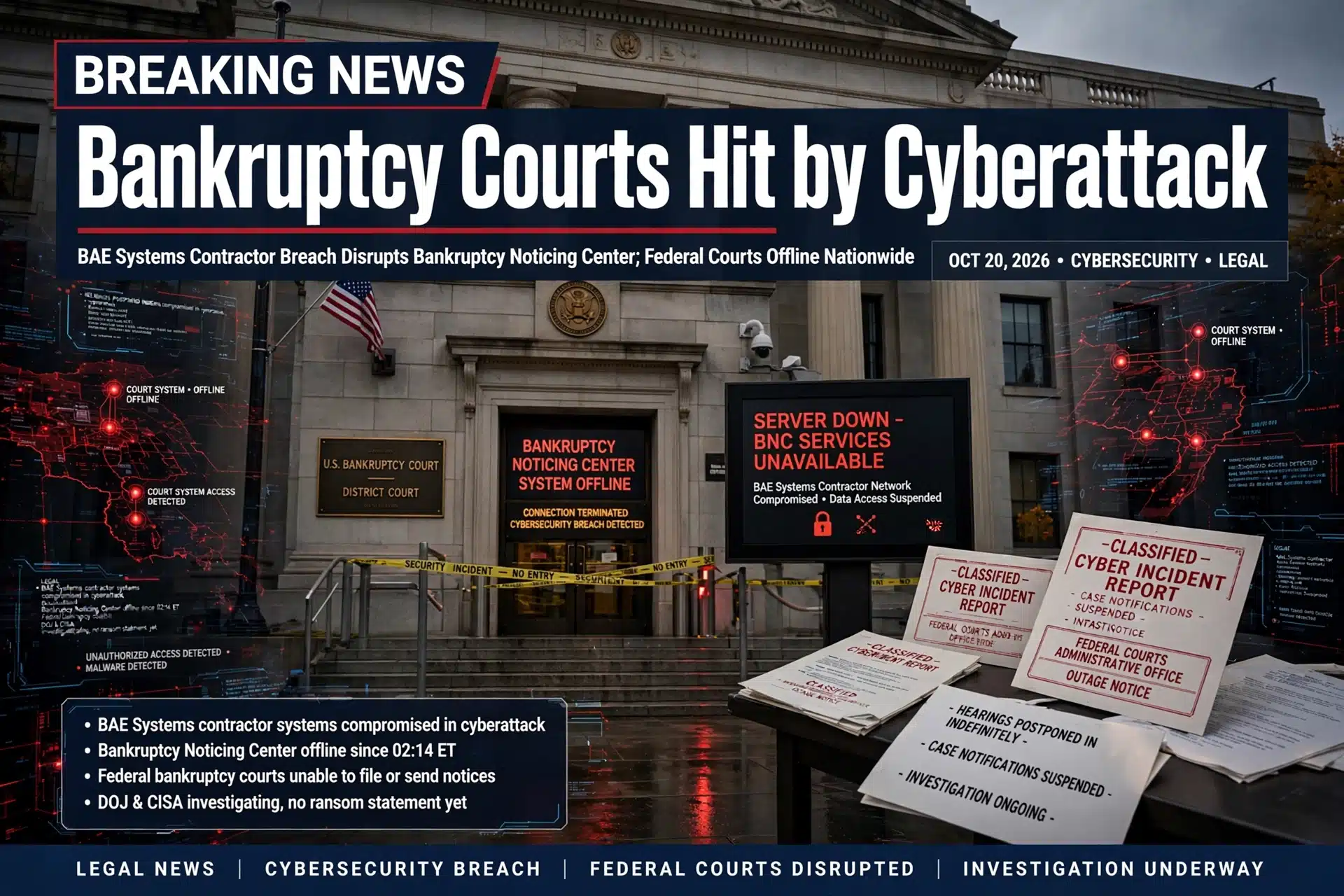
A cybersecurity incident at BAE Systems has knocked out the Bankruptcy Noticing Center, the system that produces and transmits bankruptcy notices for all federal bankruptcy courts nationwide, in the most disruptive bankruptcy court cyberattack yet recorded on the U.S. judiciary’s vendor stack. The Administrative Office of the U.S. Courts disclosed the incident on October 15, and as of this writing every BNC system and website it operates remains unavailable. If you have a bankruptcy case pending, your case is still open and filings are still accepted, but the paper trail that notifies creditors is stuck.
Key Takeaways:
- – The Bankruptcy Noticing Center, run by BAE Systems for the Federal Judiciary, produces and transmits notices for every federal bankruptcy court in the country.
- – All access to the BNC systems and websites is currently unavailable, including the National Creditor Registration Service, and notice production has halted.
- – Courts continue accepting filings; the disruption affects the noticing pipeline, not case handling itself.
- – Neither BAE nor the judiciary has confirmed the cause, whether data was compromised, or when service will be restored.
What Exactly Went Dark
The BNC is obscure plumbing with an outsized role. It generates the official notices that tell creditors, landlords, employers and other parties about bankruptcy filings, automatic stays and plan confirmations, and it runs the National Creditor Registration Service that lets creditors receive electronic case updates. All of it went offline together. The affected addresses include bnc.uscourts.gov, bankruptcynotices.uscourts.gov and notices.uscourts.gov, and the Administrative Office confirmed that the BNC’s production and distribution of notices has stopped entirely.
Courts were told the same day to keep accepting filings, and some electronic filing notifications continue through separate channels. The practical consequence is a growing backlog of undelivered notices rather than closed courthouses, with the delay compounding by the day the outage persists.
Who BAE Systems Is and Where the Incident Began
BAE Systems is one of the largest defense contractors in the world, and a major U.S. government vendor across aerospace, weapons and information security, which makes an incident in the bankruptcy data pipeline a convenient reminder that a contractor’s attack surface includes its administrative businesses, not just its weapons programs. Reporting indicates the affected entity is a BAE Systems IT operation based in Virginia that runs the BNC under contract for the Administrative Office of the U.S. Courts.
The timeline is longer than the disclosure date. Court notices tied to the incident indicate the service disruption began around October 9, six days before the judiciary publicly attributed the outage to a cybersecurity incident at BAE. That gap matters for creditors tracking notices; the outage is measured in the second week, not the second day. A BAE spokesperson said the company is aware of a security incident that is isolated to the BNC system and has taken immediate steps to address it, while declining to describe the incident’s nature.
What Is Not Yet Known
The public record contains more open questions than answers. Neither the judiciary nor BAE has said whether the incident was ransomware, whether data was stolen, whether creditor lists or case information in the BNC system were accessed, or when restoration is expected. CISA, the agency that typically handles federal cyberattacks, redirected reporters to the U.S. Courts, and the FBI did not respond to media requests for comment. The Administrative Office said only that it is in communication with impacted courts and coordinating with BAE, and that the company is actively investigating and working to restore operations.
For creditors and filers concerned about exposure, the honest answer is that nothing is confirmed either way. Companies handling notice distribution for courts necessarily hold large volumes of personal and case data, which is why the data-theft question will matter as much as the outage question when details emerge.
The Pattern: Courts and Contractors Under Fire
This is not an isolated month for U.S. court system cybersecurity. Weeks earlier, Arizona’s state court system was breached and the information of more than 1.3 million people was leaked. Federal judicial systems were previously hit by a major hack of the case filing system that raised fears of exposure of confidential informants, and the federal courts docketing system was attacked by hackers in early 2020. On Wednesday of the same week, the Department of Transportation confirmed that a contractor cyberattack temporarily took a safety-agency contact center offline.
The common thread is contractor dependence. Government operations increasingly run through commercial vendors that hold process-critical systems, and the BNC shows how a single contractor’s incident can stop a nationwide judicial function even though no judicial agency itself was breached. Oversight bodies and procurement officials will read this event as a case study in third-party risk, an area where U.S. agencies have been adding requirements since the federal government’s own wave of supply-chain compromises.
What Happens Next
The near-term watch items are restoration speed and attribution. Courts are showing no published estimate for restoration of the BNC, and creditors should expect noticing delays to extend into next week; updated cabinet notices will likely be batched once service returns. If BAE confirms data was compromised, the judicial branch will face the same notification obligations as any data holder, and Congress will take particular interest given the judiciary’s confidential-case precedents. Longer term, the Administrative Office has said it was working to bolster security for sensitive case files even before this incident, and the BNC outage adds a fresh argument for separating judicial noticing from single-vendor dependence.
What This Means for Filers and Creditors
If you filed bankruptcy recently, deadlines tied to notice service may effectively be tolled by the outage, and attorneys should document that noticing was impaired by the incident rather than by party delay, with proof of service disputes likely once backlogs clear. Creditors relying on the National Creditor Registration Service cannot register or receive updates while it is offline, so claim and bar-date awareness for pending cases requires manual attention for now. Neither BAE nor the judiciary has advised of data compromise, so no one should panic, but everyone in the system should plan for a noticing delay measured in weeks, not days.
Frequently Asked Questions
Are bankruptcy courts still open?
Yes. Courts continue accepting filings; the outage affects the Bankruptcy Noticing Center that produces and transmits notices, not the ability to file cases.
Is the Bankruptcy Noticing Center down right now?
All access to the BNC systems and websites operated by BAE Systems for the judiciary remains unavailable as of the latest official statement, including the National Creditor Registration Service.
Was bankruptcy data stolen?
Unknown. Neither the judiciary nor BAE has confirmed the nature of the incident or whether data was compromised, and the investigation is ongoing.
How long will notices be delayed?
No restoration timeline has been published; disruptions of this type have so far run over a week, so filers and creditors should plan for noticing delays into next week.
Sources: