





New York, New York | July 13, 2026
Wall Street rarely rewards companies that raise prices during a soft consumer spending cycle. Yet Apple continues to challenge that assumption. As inflation pressures, component shortages, and prudent consumer demand weigh the wider electronics market, analysts increasingly believe Apple’s premium positioning gives it an advantage that few competitors can match. That belief sits at the center of Citi’s Apple price target of $365, a new bullish outlook that argues Apple’s pricing strategy remains one of its strongest competitive assets.
Citi’s latest research notes also upgraded AAPL stock upgrade Monday, reinforcing growing confidence that Apple’s pricing power in 2026 remains intact despite macroeconomic uncertainty and higher production costs.
Citi Apple price target $365 Exhibits Confidence in Apple’s Premium Strategy
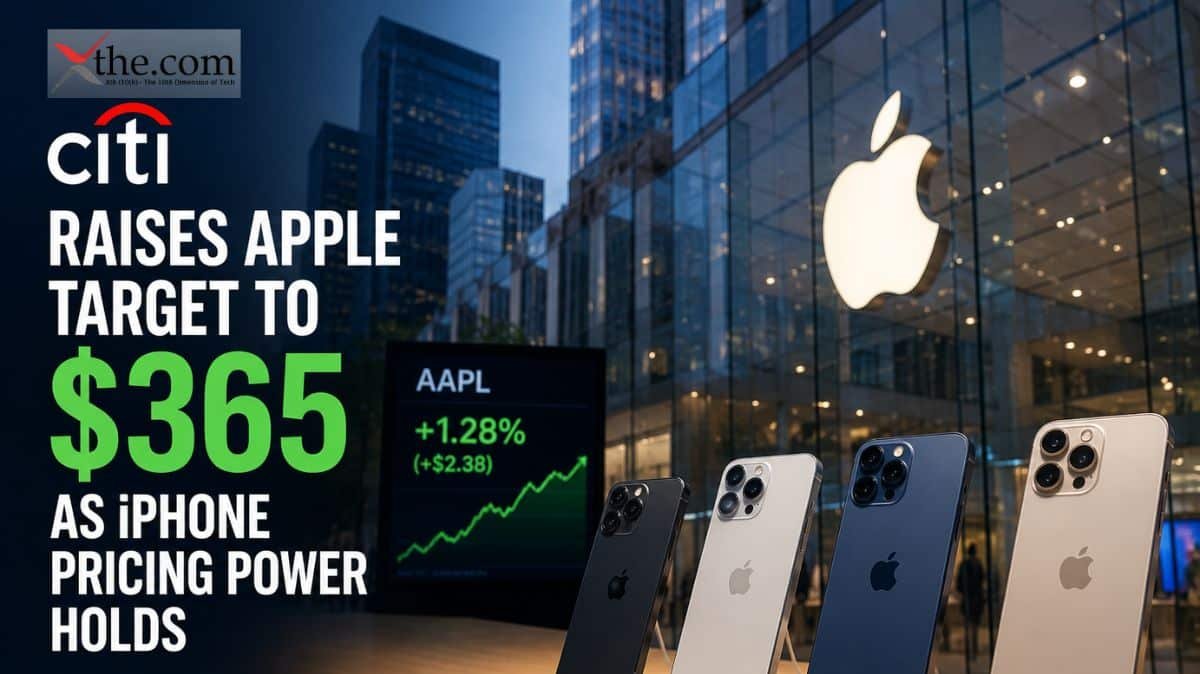
Citi raised its Apple price target from $315 to $365 per share, which is about 16% higher than Friday’s closing price. Citi is now the second big Wall Street firm this week to raise its outlook for Apple, following JPMorgan’s increase to $345.
The latest projection, described as Citi AAPL $365 from $315, with 16 percent upside, reflects a broader investment thesis rather than an expectation of a single product launch. Analysts increasingly believe Apple’s ecosystem, customer loyalty, and expanding Services businesses allow the company to handle economic slowdowns more effectively than rivals.
Citi analyst Asiya Merchant said Apple stands out because it can raise prices without losing much demand. While other electronics companies often cut profits to keep sales up, Apple has kept its margins strong thanks to careful pricing and a strong brand.
Merchant also pointed out that Apple’s customers care more about how well their devices work together, software support, and long-term value than about short-term price changes.
Apple’s Pricing Power Continues to Surprise Wall Street
The clearest sign of Apple’s pricing power in 2026 came in late June, when the company raised prices on several Mac and iPad models.
These price hikes ranged from about 15% to over 50%, depending on the model. Instead of worrying about lower demand, most investors saw the increases as a necessary response to higher memory costs driven by increased spending on artificial intelligence infrastructure.
This trend supports the investment case for Apple’s market share memory price hike. Industry-wide DRAM shortages have significantly increased component costs, yet Apple appears positioned to pass much of those expenses directly to consumers.
When component prices go up, most hardware makers have to choose between taking a hit to profits and raising prices, which could cost them customers. Apple, though, has shown that many of its customers are still willing to pay higher prices.
This advantage is especially important when supply chains are disrupted.
AAPL stock upgrade Monday Highlights Analyst Consensus
The recent AAPL stock upgrade on Monday shows that more analysts are agreeing, not just one firm.
In the past few weeks, several investment banks have pointed out the same trends.
Analysts identify several structural advantages:
- Apple’s unmatched brand loyalty.
- A growing installed device base.
- High-margin Services revenue.
- Premium product positioning.
- Strong cash generation.
All these factors help make Apple’s earnings more stable than those of many other tech companies.
With Citi’s new target and JPMorgan’s earlier upgrade, it looks like big investors expect Apple to do better than other hardware makers in the coming months.
Why Apple loyal customer pricing analyst Monday Matters
Apple’s brand loyalty is one of its biggest strengths, even if it doesn’t show up on the balance sheet.
The latest research surrounding Apple loyal customer pricing analyst Monday argues that customer retention allows Apple to maintain pricing discipline during difficult economic circumstances.
Consider a hypothetical example.
Someone who uses an iPhone, Apple Watch, AirPods, MacBook, iCloud, Apple Music, and Apple Pay faces real challenges if they switch brands. Changing one device can cause problems with how everything works together.
This ecosystem gives Apple more flexibility in determining prices.
People might postpone buying gadgets from other brands, but many still upgrade their Apple devices to keep their digital experience smooth.
This loyalty helps Apple keep its prices steady, while other companies often have to offer discounts.
Services Revenue Strengthens the Investment Case
Most Apple’s revenue still comes from hardware, but its Services business is changing the company’s finances.
Services revenue has grown by about 15% each year, giving Apple a steadier income that doesn’t depend on iPhone upgrades.
Services like Apple Music, iCloud+, Apple TV+, AppleCare, Apple Pay, App Store fees, and financial products bring in steady income with much higher profit margins than hardware.
Having a mix of services and products makes Apple’s earnings less likely to swing wildly.
For investors looking at Apple’s pricing power in 2026, Services are just as important, since subscriptions bring steady income even if hardware sales change.
Wall Street now sees Apple as more than just a smartphone maker. It’s viewed as a company with a whole ecosystem and several steady sources of income.
AI Features Could Become Apple’s Next Growth Driver
Another reason for Citi’s positive outlook is Apple’s plan for artificial intelligence.
After its announcements at WWDC, Apple is adding AI features to the iPhone, iPad, Mac, and Vision platforms.
Instead of just focusing on AI chatbots, Apple is putting more effort into on-device intelligence, privacy, and making sure AI works smoothly with its operating systems.
Investors will watch upcoming software updates to see if these AI features lead people to upgrade their devices more often.
If Apple’s AI features make users more productive without hurting privacy, analysts think more people will want to upgrade during the next hardware cycle.
This could boost Apple’s long-term earnings, not just its current pricing outlook.
Comprehending the Long-Term Bullish Thesis
The case for investing in Apple is about more than just higher device prices.
Supporters think Apple’s strengths build on each other.
Higher prices support margins.
Healthy margins, finance research, and development.
Innovation builds customer loyalty.
Customer loyalty supports future pricing flexibility.
Recurring Services revenue provides steadiness throughout the cycle.
All these factors come together to make Apple’s business model especially strong, even when the economy changes.
This thinking appears throughout Citi: raises Apple price target to $365 from $315 pricing power memory hike, where pricing flexibility offsets higher component costs while preserving profitability.
Likewise, the research notes titled Citi Apple AAPL upgrade Monday July 11, 2026, Asiya Merchant analyst note emphasizes that Apple’s premium positioning allows selective price increases without materially weakening demand.
Risks Investors Should Monitor
Even with all optimism, Apple still faces some real risks.
If the economy gets worse, people might cut back on spending even more than expected.
Continuing supply chain problems could keep raising production costs.
Regulators are still monitoring Apple’s App Store and online marketplace practices in several countries, which remains a concern.
Competition from Android makers is also getting tougher, especially in countries where people are more price sensitive.
Artificial intelligence is another factor. Apple needs to show that its AI investments actually drive increased customer demand, not just minor software upgrades.
Still, many analysts think these risks are manageable because Apple’s strong finances, global brands, and ecosystems provide significant protection.
Outlook for Apple Shares
Now, investors are focusing on Apple’s impending earnings, new AI software releases, and the holiday shopping season.
If Services revenue continues to grow in the double digits and Apple maintains its premium pricing, Wall Street may raise its profit forecasts again.
Strong profit margins, steady subscription income, growing AI features, and loyal customers all help keep Apple’s stock price high. Citi’s new target shows that Apple has a rare ability in tech: it can charge more and still keep demand strong. If the next earnings report supports this, Apple’s pricing strategy could be as valuable to investors as its newest products.
Source: Veteran Bank Tweaks Apple Stock Price Target Ahead of Phone 18 Launch