





New York, NY | July 15, 2026
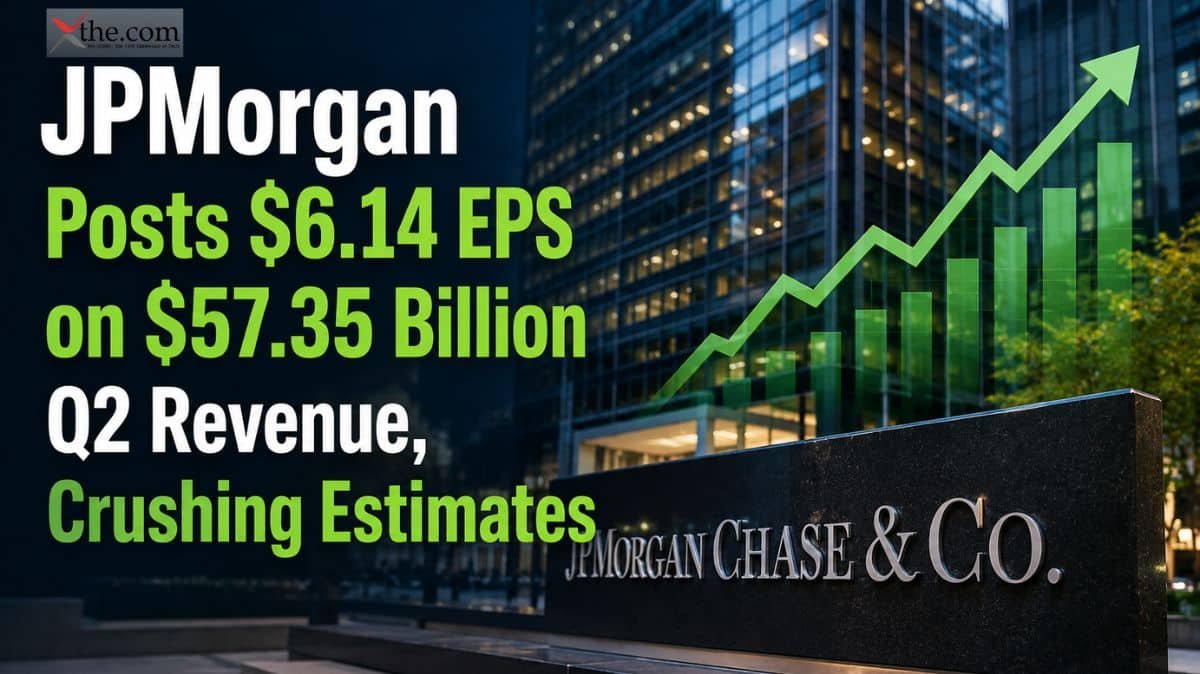
Wall Street had priced in a solid quarter from the country’s largest bank. It got something closer to the rout of the consensus. The JPMorgan Q2 earnings beat landed at $6.14 per share against a Zacks Consensus Estimate of $5.59, wide enough to reset how analysts model the next two quarters. JPM EPS $6.14 on JPMorgan revenue $57.35 billion— up sharply from the $49.14 billion Wall Street had penciled in — turned Tuesday’s earnings session into the opening argument for an entire banking sector that had spent the spring bracing for margin compression instead of a windfall.
The size of this surprise is just as important as the headline numbers. Usually, a bank as large as JPMorgan only moves markets when its results change the overall story, not just by beating estimates. That’s what happened this time.
JPMorgan Q2 Earnings Beat by the Numbers
Every segment inside JPMorgan’s second quarter told a version of the same story: record activity meeting a bank built to capture it. The JPM Q2 9.8% earnings beat was driven primarily by markets revenue, which JPMorgan reported was up sharply year over year, and by the corporate and investment bank division, which posted revenue of $24.9 billion, up 27% from last year. Consumer and community banking added $20.3 billion, an 8% increase, while asset and wealth management contributed $6.9 billion, up 19%, with assets under management nearing record highs.
Reported revenue, which includes a $4.6 billion gain tied to JPMorgan’s long-held Visa stake and roughly $1 billion in gains on certain equity investments, rose 27.7% year over year. Strip out those one-time items, and revenue still grew a healthy clip in the mid-teens. Evidence that the underlying franchise, not accounting for windfalls, is doing heavy lifting. Executives were careful to separate the two in their disclosures, and analysts on the earnings call pressed for clarity on which growth rate should anchor forward models. The JPMorgan 27.7% revenue growth Q2 2026 captures the headline reported number; the adjusted growth rate, closer to 15%, is the one likely to matter more once the one-time Visa gain rolls off the year-over-year comparison.
JPMorgan’s return on tangible common equity reached 23% on an adjusted basis, and its CET1 ratio stayed at 14.1%, well above regulatory requirements, even as risk-weighted assets increased. The bank also raised its quarterly payout to $1.65 per share, marking the 15th consecutive year of increases. This move shows management’s confidence that strong results are not merely a one-time event.
Investment Banking Fuels the Upside
The biggest surprise came from dealmaking. JPMorgan’s investment banking M&A activity picked up speed during the quarter. Before earnings, KBW analyst Chris McGratty predicted investment banking revenue could rise 26%, and trading revenue could increase 14% from last year. The actual results were even better, as strong equity underwriting and a busy M&A pipeline boosted fee income across the industry, not just at JPMorgan.
A major driver of fee growth was the SpaceX initial public offering in late June. Goldman Sachs led the deal and earned about $100 million in underwriting fees from this single transaction, which was enough to impact the entire quarter’s investment banking results. JPMorgan’s corporate and investment bank also benefited, as clients who had postponed offerings in 2025 moved quickly to capitalize on the healthy market.
How the Rest of the Big Banks Measured Up
JPMorgan led the way, but other big banks also reported strong results. Citigroup beat estimates by 15.8%, with EPS of $3.15 compared to the expected $2.74, and revenue of $24.77 billion—its best quarter in ten years and a key moment in Jane Fraser’s turnaround plan. Bank of America reported EPS of $1.21, beating the $1.13 forecast and up 34% from last year, driven by steady consumer banking and stronger trading results. Wells Fargo beat estimates by 13.3% with EPS of $1.96, although its net interest margins were under pressure even as lending businesses grew.
Goldman Sachs delivered the most dramatic beat of the five, with adjusted earnings crushing consensus by more than 45% on the strength of a record-setting equities trading desk that generated $7.42 billion in revenue, up 72% year over year. Yet the market’s reaction undercuts the scale of the number. Goldman GS 1% stock gain earnings was the actual outcome — shares moved only modestly higher in premarket trading despite the blowout quarter, as investors considered whether trading-driven results of this magnitude are repeatable once the current cycle of dealmaking and market turbulence normalizes. This serves as a reminder that headline earnings strength and stock-price reaction do not always move in lockstep, particularly when a beat this large elicits questions about sustainability rather than answering them.
What Ties the Big Five Together
All five major banks beat both EPS and revenue estimates this week, which is unusual and suggests broader market trends rather than just individual performance. Higher stock market volatility boosted trading revenue for everyone. The reopening of capital markets, highlighted by the SpaceX IPO, also increased investment banking fees. Loan demand was mixed but stayed strong enough to support net interest income, even as some banks warned that margin pressure could become an issue later in the year.
Jamie Dimon described the current environment on JPMorgan’s earnings call as one of the high market activities, driven by AI-related spending and ongoing government stimulus, resulting in increased business investment. This helps explain why five banks with very different business models—from Wells Fargo’s focus on regional lending to Goldman’s emphasis on capital markets—all reported results much better than analysts expected three months ago.
What Comes Next for Bank Earnings
This stronger-than-expected quarter sets a higher standard for the future, which may not be easy for banks to meet. JPMorgan’s guidance points to higher expenses in 2026, with projected costs rising to about $107.5 billion from the previous $106 billion estimate, even as net interest income is expected to improve to around $105.5 billion. Investors will be watching to see whether the strong investment banking and trading momentum that defined this quarter can persist once the SpaceX-driven wave of capital markets activity fades, or whether the sector reverts to the more modest growth rates analysts had originally penciled in before this week’s results reset expectations. For now, the JPMorgan Q2 EPS $6.14 revenue $57.35B beats 9.8 percent July 15 story functions as the clearest signal yet that the biggest U.S. banks are taking advantage of favorable conditions to produce results that surpass even optimistic forecasts, and the JPMorgan Chase Q2 results record revenue investment banking July 2026 headline is likely to set the standard for the rest of the sector for the rest of the year.
Source: JPMorgan Chase & Co. (JPM) Q2 earnings: Taking a look at key metrics versus estimates