






Shanghai, China | Tuesday, July 28, 2026
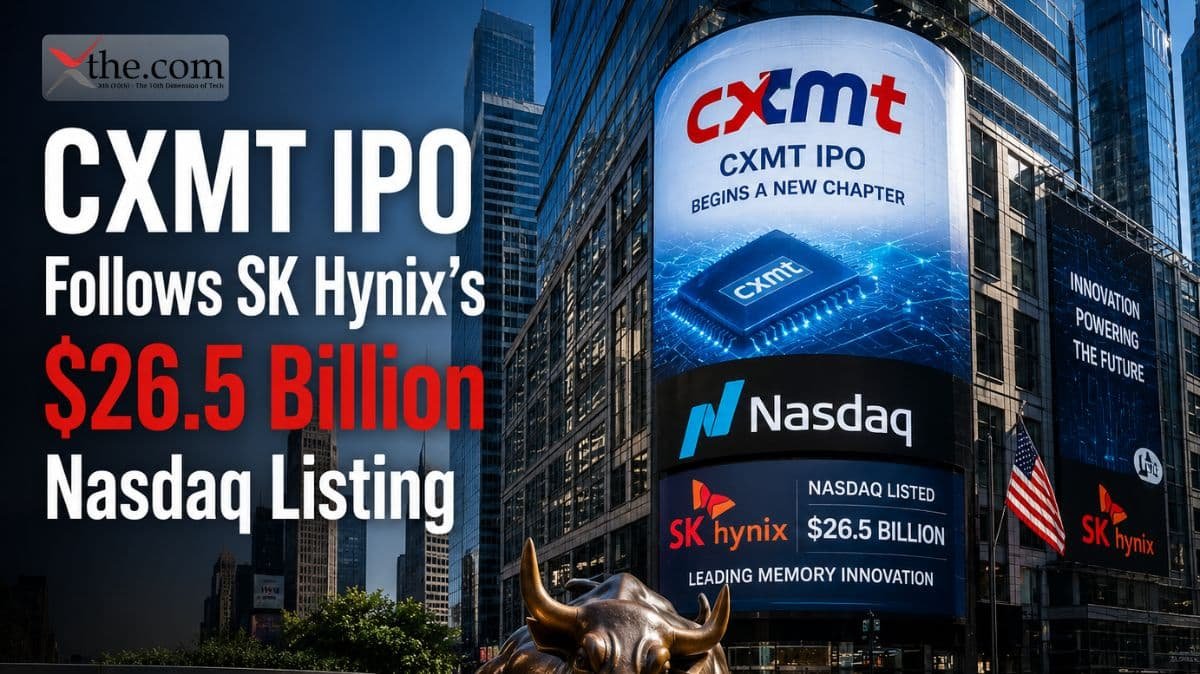
The focus in building the next generation of artificial intelligence has moved from software to hardware. In just a few weeks, two major memory industry public offerings have illustrated that reality. CXMT IPO follows SK Hynix, denoting a key moment for the semiconductor industry as investors put money into companies set to benefit from the rising need for high-performance memory chips. SK Hynix’s $26.5 billion Nasdaq debut earlier this month and CXMT’s major Shanghai listing have started what analysts are calling the memory chip listing wave of 2026. Even with ongoing global disputes and technology restrictions, investors stay eager as AI changes the global semiconductor market.
CXMT IPO Follows SK Hynix as Memory Companies Attract Record Capital
The CXMT IPO follows SK Hynix’s Nasdaq listing, making this one of the busiest months ever for memory chip companies going public. ChangXin Memory Technologies (CXMT), China’s top DRAM maker, had a strong debut on Shanghai’s STAR Market, raising about $8.6 billion and seeing its shares jump on the first day. For a short time, this made CXMT one of China’s biggest listed tech companies, showing that investors are confident in local semiconductor manufacturing even with growing international trade restrictions.
Earlier this month, SK Hynix completed its landmark U.S. listing valued at approximately SK Hynix $26.5 billion Nasdaq, increasing access to global investors while strengthening its position as one of the world’s dominant suppliers of advanced DRAM and High Bandwidth Memory (HBM) products for AI servers. Together, these transactions demonstrate how capital markets are rewarding companies supplying the memory required for increasingly complex AI workloads.
Memory Chip Listing Wave 2026 Reflects AI Investment Boom
The memory chip listing wave of 2026 continues as semiconductor companies seek more funding than ever before. AI training clusters now need much more DRAM and HBM than older computing systems. Each new generation of AI models uses more memory bandwidth, which keeps investment flowing through the supply chain.
The memory chip listing wave of 2026 is about more than just raising money. Manufacturers need billions of dollars to grow their factories, buy advanced equipment, improve packaging, and get raw materials. Public markets offer long-term financing that private investors often cannot provide.
Industry analysts still expect strong demand as large cloud providers invest more in AI infrastructure. Big tech companies have put tens of billions of dollars into new data centers, which is driving up memory use. This demand has reduced inventories in several categories, causing a global memory chip shortage in advanced AI-oriented products.
AI Demand Continues to Tighten Global Supply
The current global memory chip shortage is different from past chip shortages. Instead of being caused mainly by consumer electronics, today’s shortage comes from the rise of enterprise AI projects.
Large language models, suggestion engines, self-driving platforms, and business AI applications all need huge amounts of memory to handle big datasets quickly. High Bandwidth Memory is especially important because it greatly boosts the performance of AI accelerators.
Samsung Electronics, SK Hynix, and Micron still lead in high-end memory production, but CXMT has been growing its share in standard DRAM markets. Research firms say the Chinese company already makes up a larger part of global DRAM shipments and plans to keep increasing its share in the coming years.
CXMT Chip Equipment Restrictions Remain the Company’s Biggest Challenge
Although investor enthusiasm surrounding the IPO remains strong, CXMT chip equipment restrictions continue to represent the company’s most significant strategic obstacle.
The United States has expanded export controls limiting Chinese companies’ access to advanced semiconductor manufacturing equipment. These restrictions affect cutting-edge lithography systems, deposition tools, etching equipment, and inspection technologies needed for leading-edge memory production.
As a result, CXMT chip equipment restrictions may slow the company’s ability to compete with global leaders within next-generation memory, especially High Bandwidth Memory for AI accelerators.
Chinese Equipment Makers Dependency Shapes Manufacturing Strategy
Since CXMT cannot get many of the world’s most advanced fabrication tools, it has had to depend more on Chinese equipment makers dependency to expand production capacity.
Local suppliers have sped up work on etching, cleaning, measurement, and deposition systems to replace imports when they can. The Chinese government has invested a lot to build a more self-sufficient semiconductor industry and encourages equipment makers and chipmakers to work together.
Nevertheless, Chinese equipment makers’ dependency presents technical and operational problems. Many locally produced tools continue to lag the precision, throughput, and reliability offered by established international suppliers. That gap affects manufacturing efficiency, yields, and the speed at which advanced process technologies can be commercialized.
Investors See Opportunity Despite Rising Risks
Despite these challenges, capital markets seem ready to overlook them.
Investors know that China’s need for semiconductors is huge. The country imports chips worth hundreds of billions of dollars each year, so making more chips locally is a top national goal.
For portfolio managers, CXMT gives access to one of the fastest-growing parts of the semiconductor industry. At the same time, SK Hynix still benefits from high prices for AI memory products and stays a global leader in HBM technology.
However, there are still big risks. Growing geopolitical competition, changing export controls, limits on technology licenses, and possible oversupply could all quickly change the market. After the CXMT listing, several memory stocks became more volatile as investors reconsidered future competition.
What the Dual Listings Mean for the Semiconductor Industry
The fact that the CXMT IPO follows SK Hynix within the same month reflects more than coincidence. Both offerings demonstrate that memory has become one of the most strategically valuable segments of the global semiconductor market.
SK Hynix’s $26.5 billion Nasdaq listing showed that international investors want to back leading AI infrastructure companies. At the same time, CXMT’s IPO right after SK Hynix’s signals China’s strong push to build up its own semiconductor industry, even with ongoing trade restrictions.
As AI adoption accelerates across cloud computing, healthcare, automotive technology, manufacturing, and enterprise software, the requirement for advanced memory is expected to remain strong. That outlook explains why the Memory chip listing wave 2026 continues despite geopolitical uncertainty.
For investors, policymakers, and tech companies, these IPOs are about more than just raising money. They show that memory chips are now a key strategic asset in the AI era. Companies that can grow production and handle supply chain and export challenges will likely lead the next phase of global semiconductor competition.
Source: China memory chipmaker CXMT’s shares soar in blockbuster listing








