






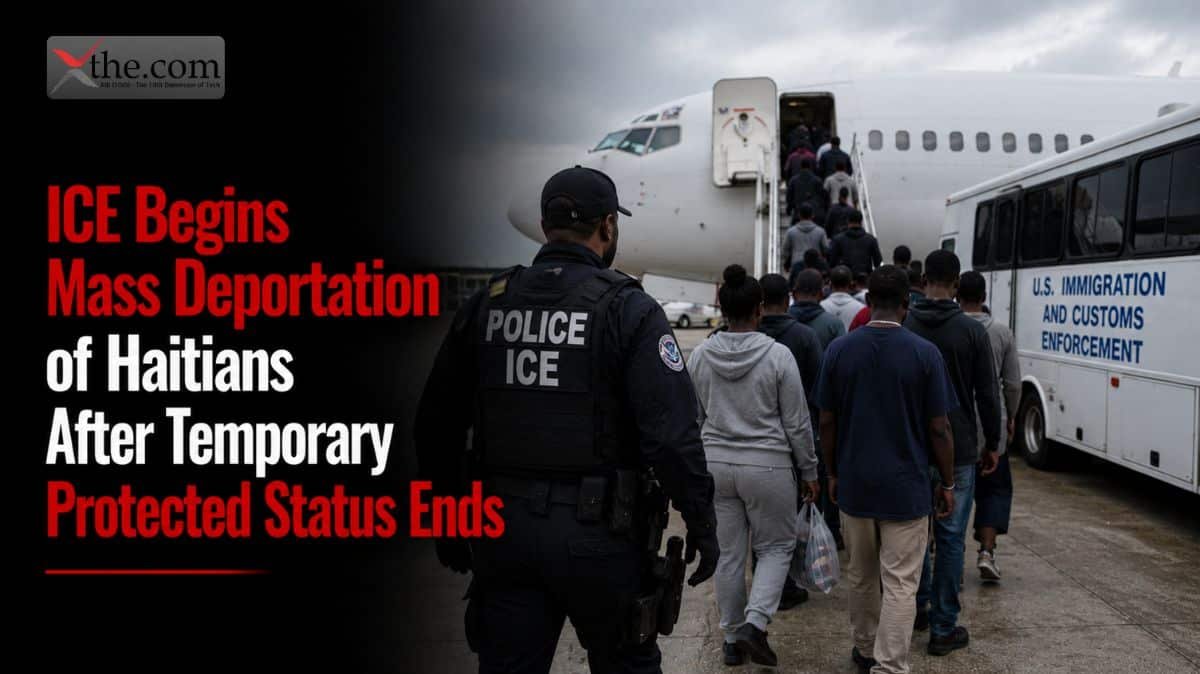
Community leaders say Thursday’s removal flight was one of the largest they had seen, sending shockwaves through Haitian communities across America.
Immigration and Customs Enforcement has begun deporting Haitians who lost Temporary Protected Status, with removal flights ramping up this week in what community leaders describe as one of the largest enforcement operations targeting a single nationality in recent years. The deportations, which began in earnest on August 20, 2026, mark the end of a humanitarian program that had allowed roughly 160,000 Haitians to live and work legally in the United States.
TPS for Haiti was terminated by the Trump administration earlier this year, part of a broader effort to wind down the program for multiple countries. The designation, which had been renewed repeatedly since the devastating 2010 earthquake, was deemed no longer necessary by officials who argued that conditions in Haiti had stabilized. Critics called that assessment absurd, pointing to the ongoing gang violence, political instability, and humanitarian crisis that has made Haiti one of the most dangerous countries in the Western Hemisphere.
“They Are Sending Us Back to Die”
At a deportation processing center in Miami, families clung to each other in tearful goodbyes as buses loaded with detainees prepared to depart for the airport. Community organizers who had been monitoring the operation said the scale of Thursday’s removal flight was unprecedented.
“This is not immigration enforcement — this is a death sentence,” said Marleine Bastien, executive director of the Family Action Network Movement, a Haitian-American advocacy group. “These people have lived here for years. They have jobs, homes, children who are U.S. citizens. And now ICE is putting them on planes to a country where gangs control the streets and the government has collapsed.”
Among those facing deportation are parents of American-born children, business owners, and healthcare workers who had been on the front lines during the COVID-19 pandemic. Many have no remaining family in Haiti and no clear plan for where they will live or how they will survive upon arrival.
A Controversial Policy
The Trump administration has defended the deportations as a necessary step to restore order to the immigration system. “Temporary Protected Status was never meant to be permanent,” said a Department of Homeland Security spokesperson. “It is called temporary for a reason. We have given these individuals years to adjust their status, and the time has come to enforce the law.”
But immigration attorneys say the administration’s timeline has made legal adjustment nearly impossible. The backlog for asylum hearings stretches years, and the cost of private immigration attorneys — often $5,000 to $15,000 per case — is prohibitive for working-class families.
In Maryland, where a large Haitian community has settled, churches and community centers have transformed into emergency legal clinics. Volunteer attorneys are working around the clock to file last-minute motions, but the sheer volume of cases is overwhelming.
“I have been here for 12 years,” said Jean-Pierre L., a construction worker facing deportation who asked that his full name be withheld. “My daughter is 10. She was born here. She has never been to Haiti. What do I tell her? That Daddy has to go to a place where people get kidnapped on the street?”








