






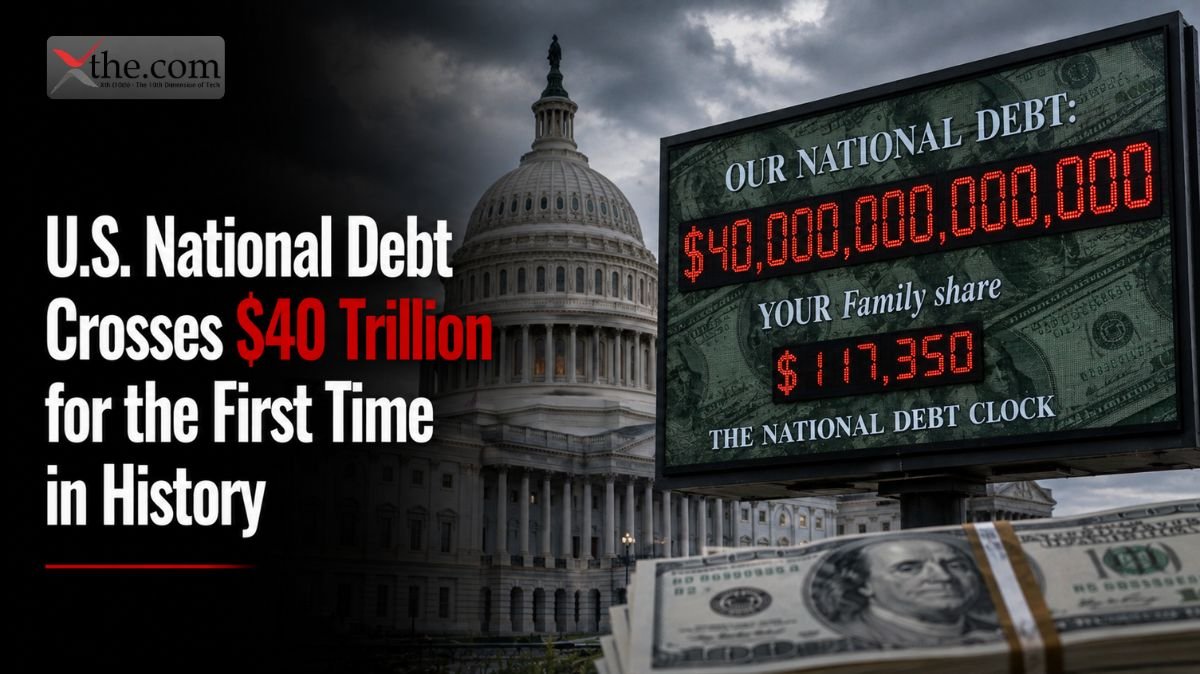
The milestone, reached with little fanfare in Washington, means every American now owes roughly $118,000 — and the bill keeps growing.
The United States national debt has crossed a threshold that once seemed unimaginable: $40 trillion. The milestone, quietly reached in mid-August 2026, has sent shockwaves through financial markets and reignited a long-dormant debate about whether Washington’s spending habits have become a threat to the nation’s economic future.
The debt clock, that ever-ticking monument to fiscal excess on a New York City sidewalk, rolled over into the forty-trillion range with little ceremony from lawmakers who have grown numb to numbers that would have triggered panic just two decades ago. But outside the Beltway, the figure is landing with force.
“How Did We Let This Happen?”
Treasury Secretary Scott Bessent addressed the milestone during a press briefing, acknowledging the gravity of the figure while defending the administration’s economic agenda.
“This is a serious number, and we take it seriously,” Bessent said. “But we are also growing the economy, cutting waste, and putting America first. The debt is a challenge, not a crisis — and we have a plan to address it.”
Critics were not buying it. The Committee for a Responsible Federal Budget, a nonpartisan watchdog, called the $40 trillion mark “a fiscal wake-up call that Washington keeps hitting snooze on.” The group noted that interest payments on the debt alone will exceed $1.2 trillion this year — more than the entire defense budget.
“How did we let this happen?” asked Maya MacGuineas, the committee’s president. “We spent $6 trillion on COVID relief, trillions more on tax cuts, and now we are funding a war in the Middle East with borrowed money. At some point, the bill comes due. And that point is getting closer.”
What It Means for You
For the average American, the $40 trillion debt is not an abstract number. It translates into higher interest rates on mortgages, car loans, and credit cards. It means less money for infrastructure, education, and healthcare. And it raises the specter of inflation, currency devaluation, and reduced Social Security benefits for future retirees.
Financial markets have so far shrugged off the milestone, with investors continuing to treat U.S. Treasury bonds as the world’s safest asset. But some economists warn that confidence is fragile. If foreign buyers — particularly China and Japan, which together hold roughly $2 trillion in U.S. debt — begin to diversify away from Treasuries, interest rates could spike and trigger a fiscal crisis.
“The world has been willing to lend us money because they believe we will pay it back,” said former Federal Reserve Chair Janet Yellen. “But at $40 trillion, that faith is being tested. We are running out of runway.”
No Appetite for Austerity
Despite the grim numbers, there is little political appetite for the spending cuts or tax increases that would be needed to stabilize the debt. Republicans have ruled out tax hikes, while Democrats have resisted cuts to social programs. The result is a bipartisan agreement to kick the can down a road that grows shorter by the day.
For now, the debt clock keeps ticking. And at $40 trillion, every second costs America roughly $126,000 in new borrowing. The question is no longer whether the debt is too high. It is whether anyone in Washington is brave enough to do something about it.








