




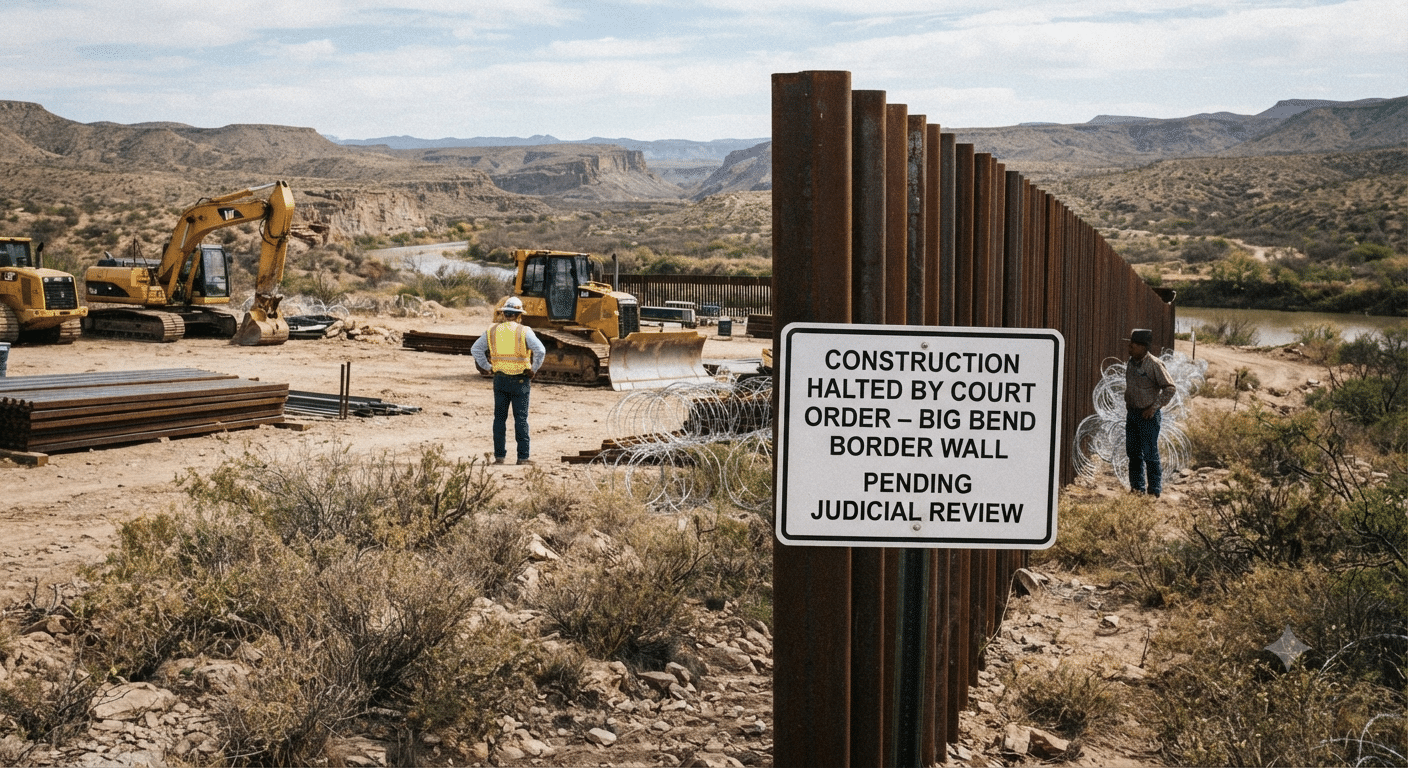
Judge Halts Border Wall Construction Across Big Bend in Landmark Environmental Ruling
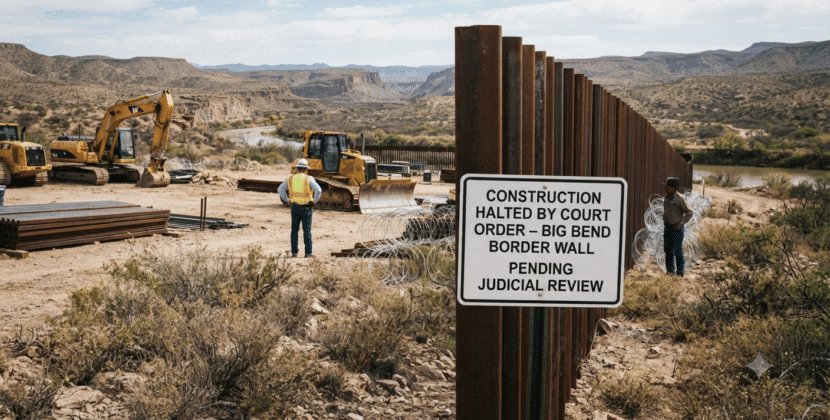
A federal judge on Friday ordered an immediate stop to all border barrier construction in the Big Bend region of West Texas, handing a preliminary injunction to an environmental coalition that argued the Trump administration’s wall plans for one of the most remote and storied landscapes in the state are unconstitutional. The ruling by U.S. District Judge Kathleen Cardone in El Paso suspends ground-disturbing activities while the underlying lawsuit plays out, halting bulldozers that had been carving new roads in and around Big Bend National Park.
Cardone read her order aloud from the bench at the close of a hearing that ran late into the afternoon, first asking the courtroom to remain calm. She found that the plaintiffs’ constitutional claims were likely to succeed on the merits, the standard a court must meet before freezing government action mid-case. The decision arrives after months of escalating conflict over five contracted wall projects that together form part of more than $7.5 billion in border infrastructure contracts covering walls, roads, fences, lights and sensors along the southwest border.
What the Judge Decided
The injunction targets what the order calls ground-disturbing activities, which means clearing, grading and construction work rather than planning or contract signing. Since news of the government’s plans broke in January 2026, contractors had been bulldozing new roads in the park area after DHS waived the Endangered Species Act and the National Environmental Protection Act to speed the expeditious construction of barriers and roads. Those waivers are precisely what the plaintiffs say the government had no power to grant.
The lawsuit was filed in April by the Center for Biological Diversity on behalf of two plaintiffs: the Friends of the Ruidosa Church, a nonprofit preserving a historic church in Presidio County, and Danny William Miller, a Rio Grande river guide and landowner in Redford whose property sits in the path of the wall. Their legal team argues the five contracted projects are unconstitutional for several reasons, including violations of the constitutional separation of powers and the taking of citizens’ land without fair process. Six lawsuits have now been filed over the Big Bend wall in total, and a different judge rejected a temporary restraining order request in a parallel case just one day earlier.
Testimony From the Communities in the Path
The hearing carried an emotional weight unusual for procurement litigation. Miller compared the government building a wall across his property and cutting his access to the river to a bullet to the head, testifying that once the desert landscape is altered it can never be replaced, and that his work as a river guide would become a tour of the military industrial complex rather than a tour of the wilderness. Bill Guerra-Addington, a Hudspeth County rancher, told the court that a barrier along the river would be a death sentence for his ranch.
Zeynep Graves, an attorney with the Center for Biological Diversity, argued in closing that the harm reaches far beyond the landscape itself, touching communities whose identity and livelihoods are bound up with the river and the park. The Big Bend sector, which includes Big Bend National Park and Big Bend Ranch State Park, covers about a quarter of the length of the Texas-Mexico border, yet it accounts for just 1 to 3 percent of migrant apprehensions by Customs and Border Protection each year, a disparity that has fueled a grassroots, bipartisan backlash across the region since January.
The Government’s Case for Building
The administration’s position rests on a broad reading of border security authority. DHS argues that physical infrastructure is necessary even in remote and lightly trafficked areas like Big Bend to achieve what it calls operational control of the border, defined as zero unauthorized crossings. Former DHS Secretary Kristi Noem wrote in the series of waivers that eased contracting laws across the entire southwest border that since the president took office the department had delivered the most secure border in history, while adding that more can be done.
CBP Commissioner Rodney Scott has said the agency’s goal is protecting the national park from future cartel activity, and officials have floated scenarios in which migrant traffic shifts toward Big Bend if walls go up elsewhere. Opponents call those hypotheticals a pretext for building through a landscape that sees almost no crossings, and note that the government waived the very environmental laws Congress wrote to force agencies to study what they are about to destroy. The waivers, they argue, are the constitutional problem at the center of the case.
Why Big Bend Is Different From Other Border Fights
Along most of the southern border, wall construction is a story about steel bollards and property owners’ fences. Big Bend is different because the wall runs through a national park, a state park and some of the darkest skies and most intact desert wilderness left in North America, where the Rio Grande cuts canyons that have drawn tourists and river guides for generations. The regional opposition that formed after January has included county commissions, ranchers and business owners who do not otherwise oppose border enforcement, an alignment that surprised even its organizers.
The scale mismatch matters too. Deploying heavy construction crews and barriers to a sector with 1 to 3 percent of apprehensions is a hard sell politically, and the plaintiffs put that arithmetic in front of the judge alongside testimony about churches, burial sites and river access. When the harm is a historic church in Presidio County or a family ranch in Redford, the cost is measured in places that cannot be rebuilt, which is why the constitutional claims found a receptive audience in Cardone’s courtroom.
What Happens Next
The injunction remains in effect while the lawsuit proceeds, so construction crews cannot resume ground-disturbing work in the Big Bend region under the ruling. The government is expected to fight the order and may seek relief in higher courts, though the unusual posture of cases that challenge DHS waiver authority makes the appeal path less predictable than ordinary litigation. Meanwhile, the five contracted projects hang in limbo, and the other Big Bend cases continue on parallel tracks with their own hearings.
For residents, the ruling buys time rather than certainty. A preliminary injunction lasts only as long as the case takes, and a final judgment could still permit construction if the courts ultimately side with DHS. But for a region that spent the spring and summer watching bulldozers appear on land it considered safe, Friday’s order is the first time a federal court has drawn a line and said the Constitution still applies out here.
Frequently Asked Questions
What did the judge rule in the Big Bend border wall case?
U.S. District Judge Kathleen Cardone issued a preliminary injunction on October 2, 2026, halting all ground-disturbing border wall construction in the Big Bend region while the lawsuit continues, finding the plaintiffs’ constitutional claims likely to succeed.
Who sued to stop the border wall in Big Bend?
The Center for Biological Diversity filed the suit in April on behalf of the Friends of the Ruidosa Church, a nonprofit preserving a historic Presidio County church, and river guide and landowner Danny William Miller of Redford.
How much border wall construction is planned in Texas?
The Big Bend lawsuits target five contracted projects that are part of more than $7.5 billion in border infrastructure contracts covering walls, roads, fences, lights and sensors across the southwest border.
Why is the Big Bend border wall controversial?
The sector covers about a quarter of the border but sees only 1 to 3 percent of apprehensions, and the planned routes run through a national park, a state park and private land that plaintiffs say cannot be replaced once bulldozed.