






Washington, D.C. | July 8, 2026
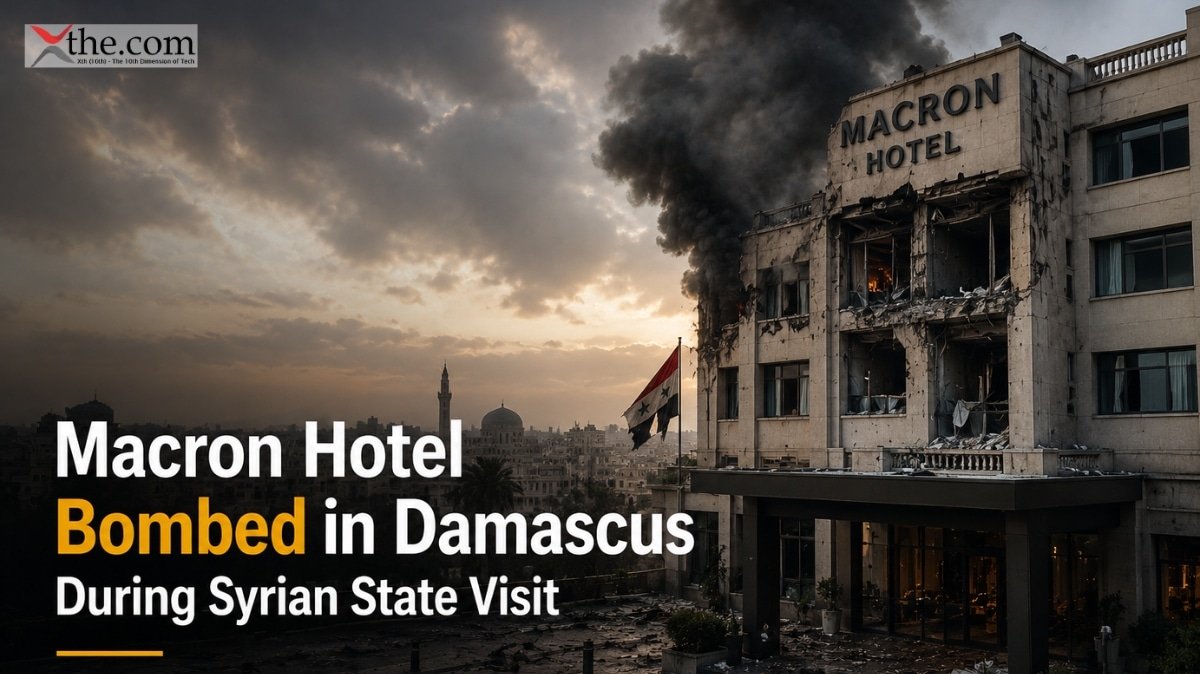
Two bombs went off, eight minutes apart. The French president did not hear either explosion. The Macron Damascus hotel bombing on July 7 did more than break windows near the Four Seasons; it showed how fragile safety persists in a country trying to prove it has moved beyond four decades of dictatorship. The Syria state visit bomb attack wounded 18 people, including four police officers, and turned what was meant to be a diplomatic showcase into an example of how delicate post-war reconstruction can be.
The Four Seasons Damascus explosion in 2026 did not directly harm Emmanuel Macron. His motorcade had already left for the presidential palace when the bombs went off. Still, being nearby does not mean it is unimportant. A bomb exploding where a head of state slept the night before sends a message, even if no one claims responsibility.
What Happened Near the Four Seasons
Syria’s Interior Ministry said security forces found the explosives before they went off. One was hidden in a parked car, and the other was in a garbage can near the Ministry of Tourism, right across from the hotel. Officials reported that both devices exploded while a bomb disposal team was trying to make them safe, which leaves many questions. Even though the bombs had been found and were being handled, the explosions still injured 18 civilians and police officers on a busy downtown street.
The Damascus car bomb and garbage can explosion happened in a busy commercial area between the Tourism Ministry and the Damascus National Museum. This is the type of crowded, public space that security teams usually secure first when a foreign leader visits. The fact that it was not cleared, or not cleared well enough, is something Syrian authorities will have to explain.
Video circulating within hours showed a vehicle engulfed in flame, a motorcycle burning nearby, and blood on the pavement. The Emmanuel Macron Syria visit attack marked the second bombing in Damascus within a week — an explosive device killed at least ten people and wounded twenty more at a café near the Justice Palace. Two attacks in one week, while the capital hosts its first major Western leader since Bashar al-Assad’s fall, is not a coincidence. This is a pattern, and patterns require explanations that governments have not yet provided.
The Sequence of Events
Macron arrived in Damascus on Monday night with a delegation that included the chief executives of TotalEnergies and CMA CGM, as well as French officials working on reconstruction agreements. On Tuesday morning, he met with representatives of Syrian civil society before leaving for the presidential palace to meet President Ahmed al-Sharaa. The explosions happened after his motorcade had left the area. Such timing likely prevented a much worse outcome, whether by chance or design.
An Elysee official, who spoke anonymously due to the sensitive nature of presidential security, confirmed that Macron was unharmed and that his meeting with al-Sharaa went ahead as planned. Macron did not mention the bombing directly in his public comments. On X, a few hours after the explosions, he wrote that nothing could stop Syrians’ desire to live in a sovereign, pluralistic, and united country, and simply stated: “My visit continues.”
A Visit Freighted With Geopolitical Weight
This was never going to be a routine diplomatic trip. Macron’s security in Syria in 2026 had to account for the reality that this was the first visit to Damascus by a major Western leader since al-Sharaa, a former insurgent commander, took power after overthrowing Assad in late 2024. Before Macron, only the emir of Qatar and Ukrainian President Volodymyr Zelensky had visited. Macron’s visit, along with more than a dozen agreements signed, showed that Paris is willing to invest political capital in Syria’s future after Assad.
The stakes of that bet are not abstract. Macron’s delegation finalized a partnership deal for French shipping group CMA CGM to handle air freight at Damascus International Airport, building on an earlier agreement to operate two dry ports in the country. France and Syria also began the process of returning 51 million euros — roughly $58.3 million — in assets confiscated from Rifaat al-Assad, the deposed former president’s late uncle, convicted in France of money laundering. Additional commitments touched infrastructure rebuilding in Homs and technical support for Syria’s central bank as it undertakes financial reform.
Al-Sharaa, for his part, described France as a potential “primary partner” for Damascus, proposing a role for Syria in global shipping amid ongoing disruptions in the Strait of Hormuz. This is the language of a government trying to signal investability. A France-Syria diplomatic visit attacked by explosives, twice in a single week, undercuts that signal in a way no amount of press-conference optimism could fully repair.
Who Might Be Responsible
No group has claimed responsibility for the July 7 blasts, and Syrian authorities say the investigation is ongoing. But context narrows the field of suspects. ISIS has claimed a string of attacks against al-Sharaa’s government since February, when the group announced what it called a new operational phase against Damascus. Analysts including Aron Lund of the Century International think tank caution against overreading the incident as evidence the group has meaningfully reconstituted, noting that Islamic State has not re-emerged at the scale many feared in the eighteen months since Assad’s fall. Still, the timing — directly beside a French delegation, during the country’s most consequential diplomatic moment in years — points toward an attempt to disrupt Macron’s visit specifically, whether by jihadist remnants, Assad loyalists, or another faction opposed to normalization.
The Security Failure Question
The line Syrian officials have repeated — that the blast site sat outside Macron’s “designated security perimeter” — is technically true and politically insufficient. Explosive devices reached a location close enough to a hotel housing a sitting French president, his cabinet-level delegation, and corporate executives to draw international headlines regardless of perimeter boundaries drawn on paper. Security experts inside Syria, including researcher Kamal Abdeo of the University of Idlib, have called it plainly what it is: a major breach that al-Sharaa’s government must address before it can credibly host the next foreign delegation.
For Western governments weighing closer engagement with Damascus, the calculus now includes a harder question than economics or reconstruction financing. It is whether Syria’s security services, still rebuilding institutional capacity after fourteen years of civil war, can protect the very diplomats and investors the country is courting. Macron pressed forward Tuesday and even floated the possibility of French special forces support against ISIS. That commitment, made in the same news cycle as an attack near his own hotel, will be the real test of whether Western capitals treat post-Assad Syria as a partner worth the risk — or a gamble that just showed its downside.








