






New York, New York | Friday, July 31, 2026
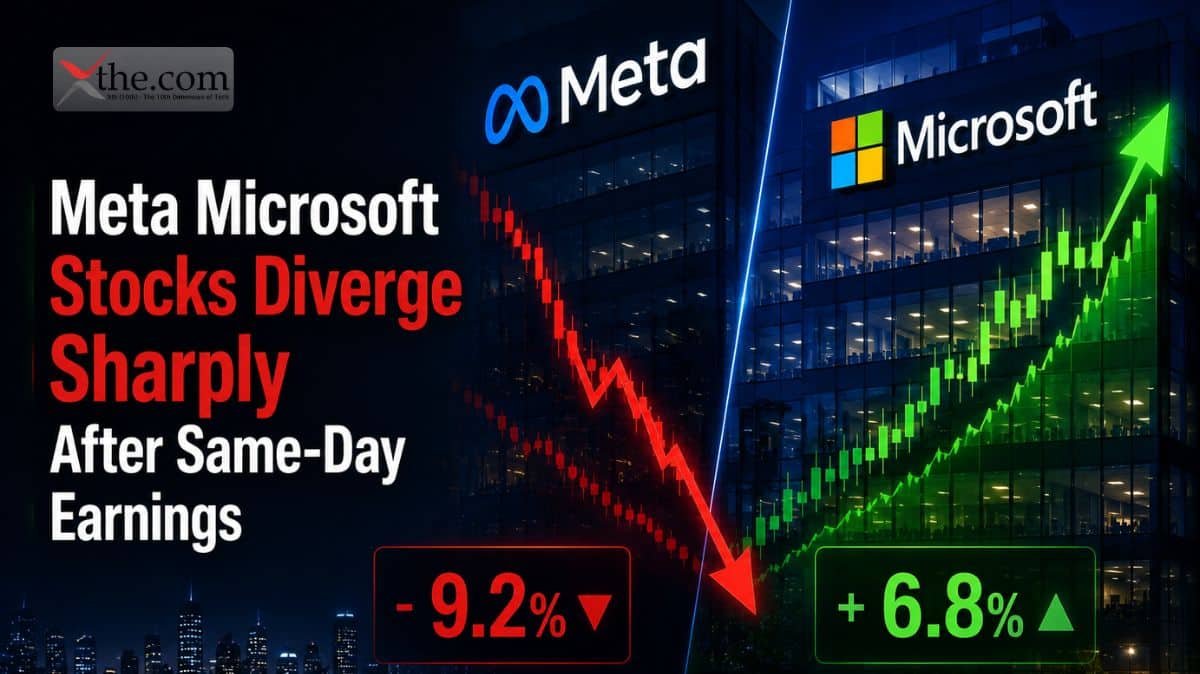
One earnings evening produced two completely different verdicts from Wall Street. Meta Microsoft stocks diverge became the defining market story on Thursday after the two technology giants reported quarterly results within hours of each other, yet investors replied with dramatically opposite reactions. Meta shares fell about 9%, extending what many traders described as Meta’s historic losing streak, while Microsoft surged and powered a wider technology rally.
This contrast could be a clear sign that the AI investment boom is changing. Investors now want to see strong execution, clear guidance, and proof that major infrastructure spending yields real returns, not just spending for its own sake.
For executives, investors, and tech strategists, the Magnificent Seven earnings split offers an important lesson: capital expenditure is no longer the story. Profitability and credibility matter most.
Why Meta Microsoft Stocks Diverge Matters
Meta and Microsoft both continue to spend tens of billions on AI infrastructure, data centers, chips, and cloud capacity. Still, the market viewed these investments very differently for each company.
Microsoft’s results boosted confidence in enterprise AI demand. Strong Azure cloud growth, better commercial momentum, and management’s positive outlook convinced investors that Microsoft’s spending is causing faster revenue and earnings growth.
Meta faced a harsher assessment. Investors focused on expanding capital expenditure commitments, pressure on free cash flow, and uncertainty surrounding the schedule for monetizing AI investments across its advertising, messaging, and metaverse businesses. The result was same-day earnings opposite outcomes that few analysts expected to be so extreme.
This wasn’t merely about the numbers for the quarter. It was really about market confidence.
Microsoft Tech Gains Led Rally
Microsoft tech gains led the rally across the Nasdaq and the wider tech sector after the company reported better-than-expected cloud and AI results. Azure was the main reason for investor excitement, as demand for AI cloud services kept beating expectations.
Microsoft’s strong stock performance added hundreds of billions in market value and boosted semiconductor, networking, and AI infrastructure companies. Investors saw Microsoft’s results as proof that enterprise customers are spending more on AI, even with higher interest rates.
The rally also confirmed Microsoft as a main winner from generative AI adoption. Rather than doubting its spending, investors saw these investments as necessary to keep up with growing customer demand.
This difference became especially important when compared to how investors behaved toward Meta.
Meta Historic Losing Streak Extends
For Meta, the earnings release triggered a very different conversation. Meta’s historic losing streak extends became a dominant market theme as investors questioned whether rising AI infrastructure spending would produce sufficient returns in the near term.
Meta’s big spending plans raised worries about profit margins and cash flow. Even though the company continues to invest heavily in AI and technology, investors seem less willing to accept higher costs without clearer signs of faster profits.
Meta’s about 9% stock drop indicated more than just a bad quarter. It showed that investors worry AI spending could hurt the company’s value if management doesn’t give enough reassurance.
This marks a clear shift from earlier in the AI boom, when news of additional AI investment typically led to positive stock moves, regardless of near-term financial results.
Magnificent Seven Earnings Split Reveals a New AI Trade
The split in earnings among the Magnificent Seven is far more than a one-time event. It may indicate the start of a more selective approach to AI investing.
Over the past two years, investors mostly saw AI infrastructure spending as a good sign. Companies that invested more in data centers, advanced chips, and AI often received higher valuations because the market focused on prolonged growth.
But that way of thinking is changing now.
Investors are now looking for companies that can show real profits from AI, not just those asking for more investment without quick results. Microsoft’s earnings showed that its AI spending is boosting cloud demand and revenue. Meta’s results made investors less sure about when and how much it will earn from AI.
The tech giants’ opposite reactions therefore demonstrate a broader repricing of execution risk.
Same-Day Earnings Opposite Outcomes Reshape Investor Priorities
The same-day earnings opposite outcomes between Meta and Microsoft highlight how quickly market expectations have evolved. Analysts are now evaluating AI investments through several increasingly important questions.
Can the company turn AI spending into real revenue growth? Are profits improving even with higher infrastructure costs? Does management give believable guidance on AI returns? Are customers already paying for AI services, or are the benefits still mostly just potential?
Microsoft gave positive answers to many of these questions. Meta, on the other hand, faced more doubt.
This split also affected the wider tech market. Microsoft’s rally helped AI infrastructure and cloud stocks, while Meta’s drop put pressure on digital advertising and social media companies.
What the Divergence Means for Investors
The Meta-Microsoft stocks diverge-same-day narrative could become one of the most important earnings-season case studies of 2026 because it demonstrates that AI enthusiasm has become increasingly discriminating.
Big investors seem willing to back huge AI spending if it comes with faster revenue, better margins, and strong guidance. They are much less likely to support open-ended investments in the absence of clear signs of future returns.
This is a big deal for tech leaders. Just having an AI strategy may not be enough to keep high valuations. Companies need to show they can execute well, spend wisely, and actually make money from their investments.
For portfolio managers, this split highlights why picking the right tech stocks matters. The AI trend isn’t going away, but investors are being more selective.
The Next Phase of the AI Investment Cycle
The Magnificent Seven earnings-split reactions suggest that Wall Street has entered a new phase of AI investing, one defined less by ambition and more by accountability. Investors continue to believe in the long-term value of artificial intelligence, but they increasingly demand evidence that extraordinary spending will yield extraordinary returns.
Microsoft’s earnings showed that AI infrastructure can quickly bring business benefits through cloud computing, enterprise software, and productivity tools. Meta’s results reminded investors that big AI investments also come with risks, cash flow concerns, and valuation challenges.
The market’s verdict was unmistakable. Tech giants’ opposite reactions to similar AI investment themes revealed that execution now matters more than aspiration. As the next wave of Magnificent Seven earnings split reports come in, investors will likely care less about how much companies spend on AI and more about how well they turn that spending into long-term value for shareholders.
Source: Microsoft and Meta results send stocks in opposite directions








