






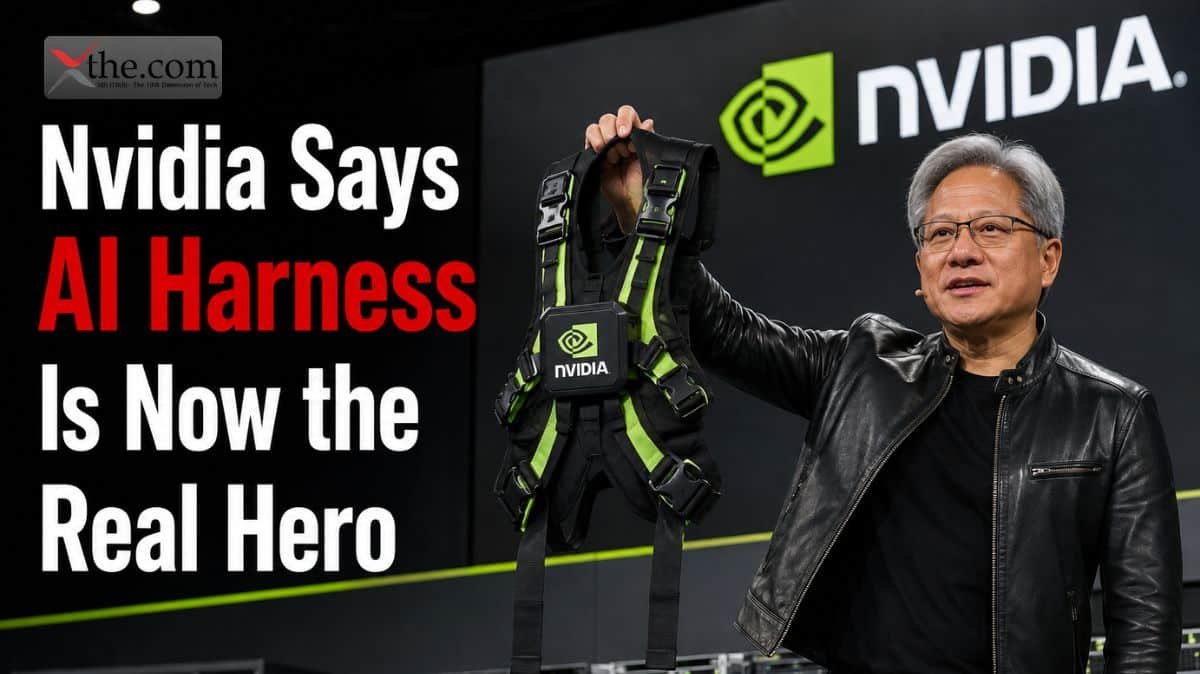
Nvidia, the world’s most valuable semiconductor company, has revealed a surprising shift in the artificial intelligence industry: the training harness — the infrastructure and tooling that surrounds AI models — is now more important than the AI model itself. The revelation, reported on August 21, 2026, has significant implications for how companies develop, deploy, and compete in the AI era.
For years, the AI industry has been obsessed with model size and capability. Bigger models meant better performance, and companies raced to train ever-larger language models using massive datasets and enormous compute resources. But Nvidia’s latest analysis suggests that this focus on models is misplaced.
What Is an AI Harness?
To understand Nvidia’s claim, you need to understand what an AI harness actually is. In simple terms, the harness is everything that surrounds an AI model — the data pipeline that feeds it training data, the evaluation framework that measures its performance, the deployment infrastructure that runs it in production, and the monitoring systems that track its behavior over time.
Think of it like a race car. The engine — the AI model — is important, but the car is much more than an engine. It needs a chassis, suspension, brakes, fuel system, cooling system, and a driver who knows how to use it all. Without these supporting systems, even the most powerful engine is useless.
Nvidia’s argument is that the industry has been pouring resources into building bigger engines while neglecting the rest of the car. And the result is that many AI models, despite their impressive capabilities on paper, fail to deliver real value in production.
Nvidia’s Evidence
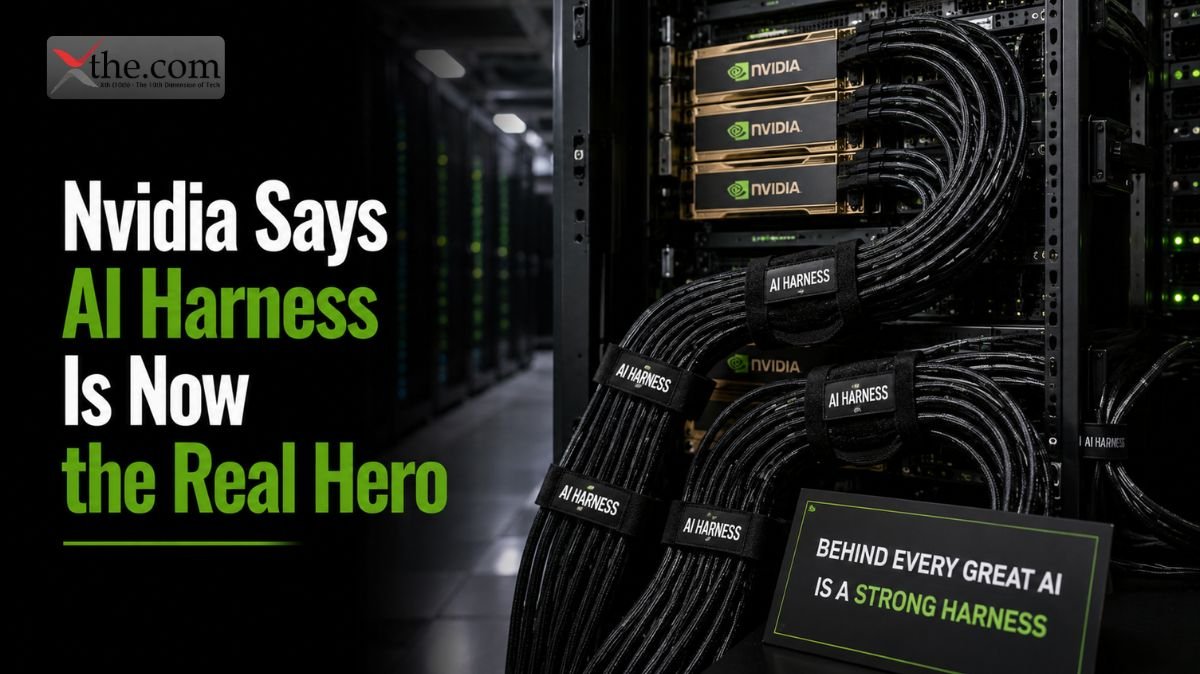
Nvidia presented its analysis at a technology conference on August 21, using data from hundreds of enterprise AI deployments across multiple industries. The findings were striking.
According to Nvidia, companies that invested in high-quality training harnesses — including data pipelines, evaluation frameworks, and deployment infrastructure — saw 3 to 5 times better results from their AI models compared to companies that focused primarily on model size.
The data showed that the quality of training data was the single most important factor in AI model performance. A smaller model trained on high-quality, well-curated data consistently outperformed a larger model trained on noisy, unfiltered data.
Evaluation frameworks were the second most important factor. Companies that had robust testing and evaluation systems could identify and fix problems before they reached production, resulting in more reliable and trustworthy AI systems.
Deployment infrastructure was third. The ability to serve AI models efficiently at scale — with low latency, high throughput, and automatic scaling — determined whether users actually experienced the benefits of the AI system.
Why This Changes Everything
Nvidia’s analysis has profound implications for the AI industry. If the harness matters more than the model, then the competitive landscape shifts dramatically.
First, it means that companies with strong data engineering teams have an advantage over companies with strong AI research teams. The ability to collect, clean, curate, and manage high-quality training data is now the most valuable skill in AI.
Second, it means that open-source models can compete with proprietary models. If the harness is what matters, then a well-tuned open-source model with a great harness can outperform a proprietary model with a poor harness. This levels the playing field for smaller companies and startups.
Third, it means that Nvidia’s own business is well-positioned. Nvidia doesn’t just sell GPUs — it sells the entire AI infrastructure stack, including data processing tools, training frameworks, deployment platforms, and monitoring systems. If the harness is what matters, Nvidia’s full-stack approach gives it a significant competitive advantage.
The Enterprise Impact
For enterprise companies deploying AI, Nvidia’s findings are both encouraging and challenging. The encouraging news is that you don’t need the biggest, most expensive AI model to get great results. A smaller, more efficient model with excellent data and infrastructure can deliver superior outcomes.
The challenging news is that building a great harness requires significant investment in data engineering, infrastructure, and operational capabilities. Many enterprises have focused on purchasing AI models or APIs from vendors like OpenAI, Google, or Anthropic, without investing in the supporting infrastructure needed to make those models work effectively.
Nvidia recommends that enterprises take the following steps. First, audit your data pipeline and ensure that training data is high-quality, well-labeled, and representative of the problems you are trying to solve. Second, invest in evaluation frameworks that can measure AI model performance against real-world metrics, not just academic benchmarks. Third, build deployment infrastructure that can serve models efficiently at scale, with proper monitoring and fallback systems.
The Startup Opportunity
Nvidia’s analysis also creates opportunities for startups. Several new companies are emerging to provide AI harness infrastructure as a service. These companies offer managed data pipelines, automated evaluation frameworks, and one-click deployment platforms that allow companies to focus on their AI models while outsourcing the harness.
Notable examples include Weights & Biases, which provides experiment tracking and model evaluation tools; Scale AI, which offers data labeling and curation services; and Modal, which provides serverless infrastructure for deploying AI models.
The market for AI harness infrastructure is expected to reach $50 billion by 2028, according to analyst estimates. This represents a massive opportunity for companies that can provide reliable, scalable, and cost-effective harness solutions.
What This Means for AI Development
Nvidia’s analysis suggests that the AI industry is entering a new phase. The initial phase, which lasted from roughly 2020 to 2024, was focused on building bigger and more capable models. The current phase, which is just beginning, is focused on making those models work effectively in the real world.
This shift has implications for how AI research is conducted. Rather than focusing primarily on novel architectures and training techniques, researchers are increasingly focused on data curation, evaluation methodology, and deployment optimization.
It also has implications for AI policy. If the harness matters more than the model, then regulations that focus solely on model capabilities may miss the mark. Effective AI governance needs to address the entire AI lifecycle, from data collection to deployment to monitoring.
The Bottom Line
Nvidia’s revelation that the AI harness is now more important than the model itself is a wake-up call for the entire industry. Companies that invest in high-quality data, evaluation, and deployment infrastructure will outperform those that simply chase bigger models.
For Nvidia, the finding reinforces its position as the infrastructure backbone of the AI industry. For enterprises, it means that AI success depends less on which model you choose and more on how well you build and operate the systems around it.
The race to build the best AI model is not over — but the race to build the best AI harness has officially begun.
Sources:








