






Why Nvidia Is Cutting Prices Now
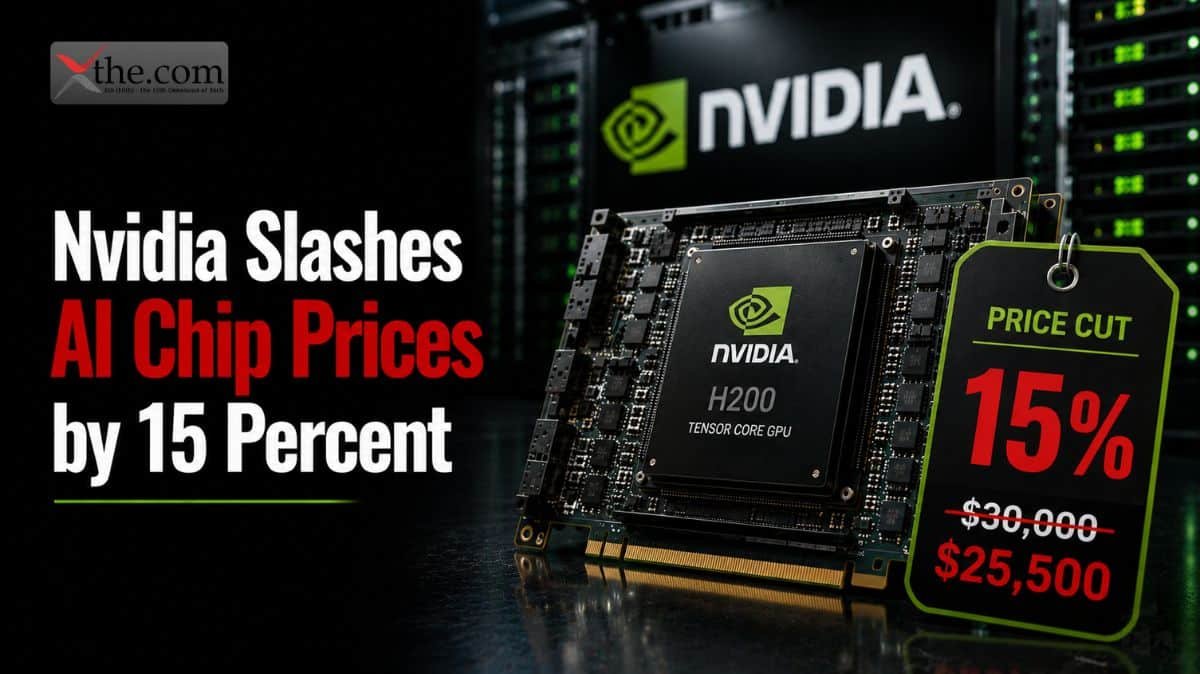
Nvidia, the world most valuable semiconductor company, has reportedly notified its largest customers that it will reduce prices on its flagship AI chips by at least 15 percent. The price cut, first reported by Bloomberg and confirmed by Reuters on August 22, 2026, represents a dramatic shift in the AI hardware market that could reshape how American companies invest in artificial intelligence infrastructure.
The announcement comes as Nvidia faces growing pressure from competitors including AMD, Intel, and a wave of custom AI chip makers backed by major tech companies like Google, Amazon, and Microsoft. For months, industry analysts have predicted that the AI chip market would eventually see price competition as supply catches up with the explosive demand that defined 2024 and 2025.
According to people familiar with the matter, Nvidia informed customers that the price reductions would take effect on servers shipped from 2027 onward. The cuts apply to Nvidia most advanced GPU configurations used in data centers for training and running large language models and other AI applications.
The decision appears to be driven by several converging factors. First, AMD has gained significant market share with its Instinct MI400 series. Second, custom silicon programs from hyperscale cloud providers have reduced their reliance on Nvidia hardware. Third, the global chip supply chain has largely recovered from the shortages that plagued the industry during 2023 and 2024.
Impact on American AI Companies
For US-based AI companies, the price reduction could have immediate and significant effects. Startups building large language models have long complained that compute costs represent their single largest expense. A 15 percent reduction in chip prices could translate to billions of dollars in savings across the industry.
OpenAI, Anthropic, Google DeepMind, and Meta AI research division are all major Nvidia customers. The price cuts could allow these companies to train larger models, run more inference operations, or simply improve their profit margins at a time when AI services face increasing pressure to become profitable.
For smaller AI startups and research labs, the impact could be even more transformative. Many early-stage companies have been priced out of training their own models due to the prohibitive cost of Nvidia hardware. Lower chip prices could democratize AI development and lead to a new wave of innovation.
Consumer GPU Prices Tell a Different Story
Interestingly, the data center AI chip price cuts come at a time when consumer GPU prices have been moving in the opposite direction. Nvidia GeForce RTX 5090 graphics card, launched earlier in 2026, saw prices climb to approximately ,500, well above its original suggested retail price of ,999. The divergence reflects different market dynamics.
The Broader AI Hardware Landscape
Nvidia price cuts signal a maturation of the AI hardware market. During the early days of the AI boom in 2023 and 2024, Nvidia held a near-monopoly on high-performance AI chips. As the market has grown, competition has intensified, and customers now have viable alternatives including AMD Instinct MI400 series, Intel Gaudi 3 accelerator, and Google TPU v6.
Industry analysts expect the trend toward lower AI chip prices to continue through 2027 and 2028. Morgan Stanley predicts that the average selling price of AI accelerators will decline by 25 to 30 percent over the next two years as competition intensifies and manufacturing efficiency improves.
Expert Reactions and Market Impact
Analysts have offered mixed reactions to Nvidia announcement. Some view it as a sign of strength, while others see it as an acknowledgment that the company pricing power has peaked. Nvidia stock price dipped slightly following the news, falling 2.3 percent in after-hours trading. However, many Wall Street analysts maintained their buy ratings.
The broader semiconductor market reacted positively to the news, with the Philadelphia Semiconductor Index rising 1.8 percent on the day of the announcement. Investors interpreted the price cuts as a sign that the AI chip market is maturing and expanding.
Looking Ahead
As AI continues to transform industries across the United States, the cost of computing infrastructure remains a critical factor in determining which companies can participate in the AI revolution. Nvidia decision to cut prices is good news for anyone building AI applications. Lower hardware costs mean lower barriers to entry, more competition, and ultimately more innovation. The full details of Nvidia pricing changes are expected at the company upcoming GPU Technology Conference.
The price reduction applies specifically to Nvidias H200 and next-generation B200 GPU configurations, which are the workhorses of the modern AI data center. These chips, which can cost individual customers upwards of 0,000 per unit, are used by virtually every major AI company in the world to train and run large-scale machine learning models.
Nvidias decision to lower prices also reflects the companys confidence in its next-generation products. By reducing prices on current-generation hardware, Nvidia can clear inventory ahead of the launch of its Blackwell Ultra architecture, which promises significant performance improvements over existing products. This is a common strategy in the semiconductor industry, where new product launches often trigger price reductions on older models.
The reaction from the broader tech industry has been largely positive. Cloud providers like Amazon Web Services, Microsoft Azure, and Google Cloud have all indicated that they plan to pass some of the savings on to their customers in the form of lower cloud computing rates. This could have a cascading effect throughout the AI ecosystem, making it cheaper for companies of all sizes to access cutting-edge AI capabilities.
For the average American consumer, the impact of Nvidias price cuts may not be immediately apparent. But over time, lower AI chip prices could translate into more affordable AI-powered products and services, from smarter virtual assistants to more capable autonomous vehicles. The ripple effects of this pricing decision will likely be felt across the technology industry for years to come.
The semiconductor industry has undergone a remarkable transformation over the past three years. What began as a shortage-driven sellers market has evolved into a highly competitive landscape where multiple companies are vying for market share. Nvidias dominance, while still substantial, is no longer unchallenged. The company market share in AI accelerators, which peaked at over 90 percent in 2024, has declined to approximately 75 percent in 2026.
Investors and analysts will be watching closely to see whether the price cuts translate into higher sales volumes and whether they can sustain Nvidias profit margins. The company gross margin, which has historically exceeded 70 percent, may face pressure as lower prices take effect. However, Nvidias management has expressed confidence that volume growth will more than offset the margin compression.
External Sources:








