






Santa Clara, California | Wednesday, July 22, 2026
A server chip that uses as much power as a household oven and has enough memory to run 375 iPhones at once might not seem efficient. But that’s exactly how Nvidia is presenting Vera, its first in-house CPU in almost ten years. This move has chip analysts now saying Intel and AMD are on the defensive.
On Tuesday, Nvidia published the Nvidia Vera CPU details that engineers and cloud buyers have been waiting for since its announcement in May. The company confirmed Vera CPU 250-450 watts of configurable power draw and, more strikingly, Vera CPU 1.5 terabytes memory capacity per chip. These numbers, along with a technical white paper and independent benchmarks, show Nvidia making its boldest move yet into a server processor market long dominated by Intel and AMD.
Why Nvidia Built Its Own CPU
For years, Nvidia has sold graphics processors to data centers, usually pairing them with CPUs from Intel, AMD, or Arm-based partners to handle other tasks. Vera changes this setup. It’s Nvidia’s own chip, built around a custom core called Olympus, and designed specifically for the AI agents that now answer customer questions, write code, and oversee complex tasks across data centers.
This difference is more important than it seems. Traditional server CPUs were made to run many virtual machines at a low cost, focusing on having lots of cores instead of fast single threads. Agentic AI needs the opposite: a processor that can quickly handle one task after another, since a slow CPU can leave a costly GPU waiting. Ian Buck, Nvidia’s vice president of hyperscale computing, said at a recent briefing that the rise of AI agents has made the CPU “much more integral” to how quickly a system can answer a single question.
The Memory Bet
The notable number 1.5 terabytes of memory on a single chip—comes from an unusual choice. Vera uses low-power DDR5X memory, the same type found in laptops and smartphones, instead of the more power-hungry DDR5 modules that typically fill out server racks. Nvidia says the resulting low-power memory AI chip design draws under 30 watts for its entire memory subsystem, compared to over 100 watts for DDR5. With a data fabric that moves information at 3.4 terabytes per second, the chip can supply thousands of AI agents with data at once without using too much power.
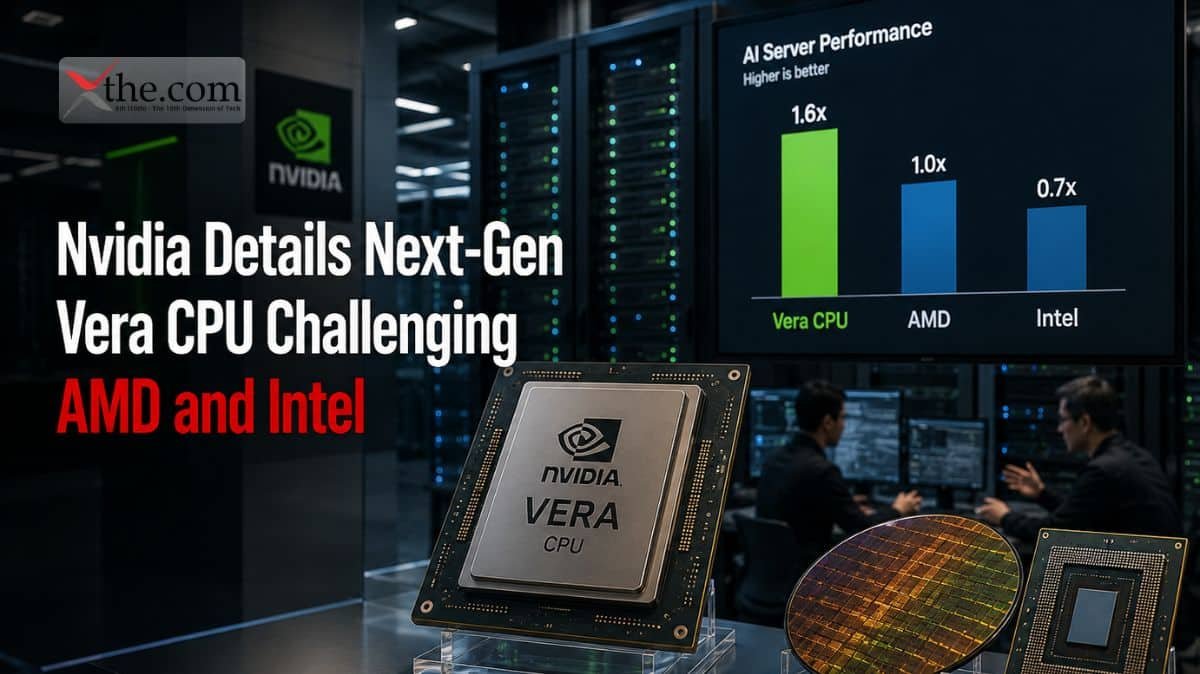
Nvidia is clear about what this means. The company frames Vera as Nvidia’s new CPU class territory — a processor built around agent throughput rather than the raw core density that has defined server chips since the cloud-computing boom of the 2010s. Independent tests from the cloud platform DeepInfra support this, showing that Vera can run up to 1.6 times more AI agents at the same time compared to other processors in early trials.
Nvidia Challenges AMD Intel on Their Own Turf
The stakes are not small. AMD currently holds roughly a third of the server’s CPU market. At the same time, Intel controls close to two-thirds, and both companies have spent years cultivating relationships with the hyperscale cloud providers that buy chips by the tens of thousands. Karl Freund, founder of Cambrian AI Research, has argued that Nvidia’s move is less about winning general-purpose server workloads and more about cutting dependency. “The CPU is something they’ve done to kind of unhook their customers from using Intel or AMD CPUs, and they covet that revenue,” Freund said.
That framing captures why Nvidia challenges AMD Intel so directly with this launch. Vera is not meant for running basic websites or databases. Instead, Nvidia is selling it together with its Rubin graphics processors as the Vera Rubin platform, as well as offering standalone chips, dual-chip servers, and liquid-cooled racks that can hold 256 Vera chips at once. Each setup encourages customers to buy both the CPU and GPU from Nvidia, rather than mixing Nvidia graphics with a competitor processor. It leans heavily on companies it already supplies with GPUs — OpenAI has said it plans to deploy Vera chips in large quantities this quarter. Anthropic and SpaceX have also received early units. Analyst Remy Cout has described the rollout as still in its “early innings,” and Nvidia has not yet locked in a major public cloud provider beyond Oracle. Getting Amazon, Microsoft, or Google to redesign server fleets around a new CPU architecture is a slower, more political process than shipping graphics cards, and both rivals have institutional relationships that won’t unwind overnight.
What Intel and AMD Can Still Do
Neither competitor is standing still. AMD’s latest Epyc processors are still the benchmark Nvidia used for its own SPEC CPU 2026 results, which shows where the real competition is. Intel still has the largest presence in data centers worldwide, a scale that Nvidia has not matched outside its GPU customers. Both AMD and Intel have something Nvidia does not: decades of experience selling CPUs to buyers who care about price per core, not just AI performance.
The Wider Signal for AI Infrastructure
Tuesday’s announcement shows that the debate over AI hardware is not simply about graphics processors. For the last three years, GPU supply has limited how quickly companies could train and use AI models. With Vera, Nvidia now sees the CPU and its memory as the next important factor to control. A white paper about the Nvidia Vera CPU and its challenge to AMD and Intel argues that CPU design, not just GPU power, will determine which companies can run AI agents at scale and at a reasonable cost.
For enterprise buyers planning their infrastructure spending over the next year and a half, the main question is not about benchmarks but about vendor lock-in. A Vera CPU with 1.5 terabytes of memory, paired with a Rubin GPU, looks impressive on paper. Whether it becomes the standard for AI operations or just another high-end choice alongside Intel and AMD will depend on how quickly the big cloud providers testing it decide to adopt it. Nvidia has built the chip, but the market—not the white paper—will determine if it truly creates a new category.
Source: Nvidia details its next-generation Vera CPU for AI, setting up challenge to AMD and Intel








