






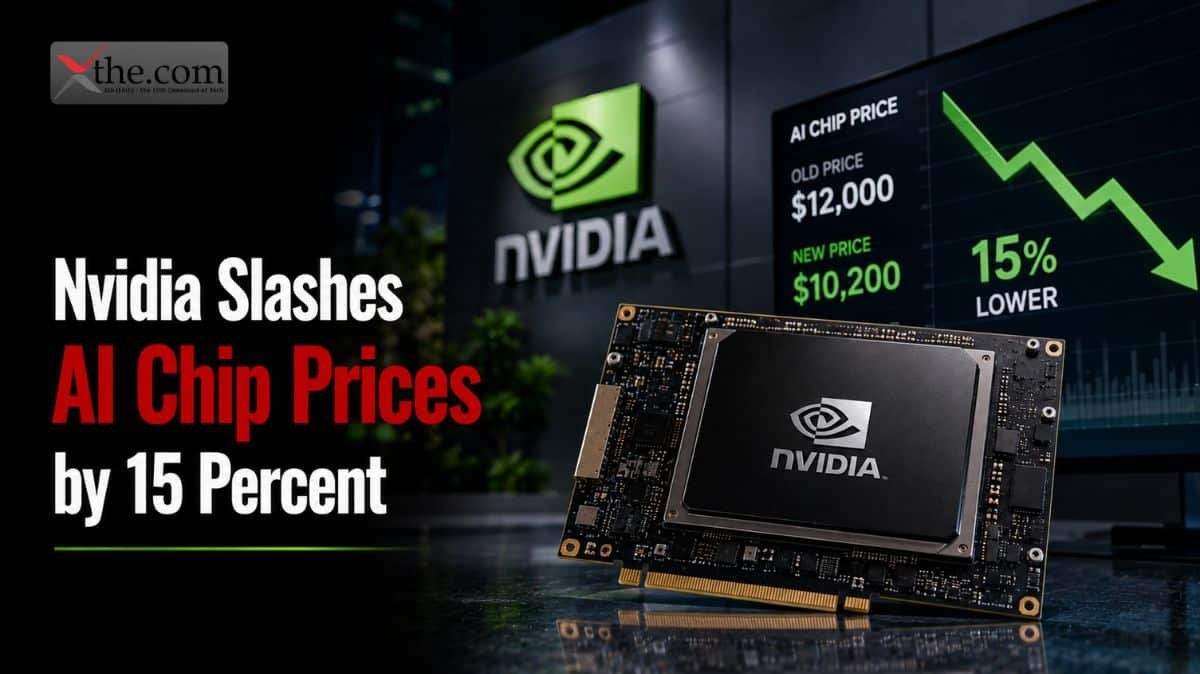
Nvidia, the world most valuable semiconductor company, has reportedly slashed the prices of servers containing its AI chips by up to 15 percent for some of its largest customers. The move, first reported by Bloomberg on August 22, 2026, marks a dramatic shift in the AI hardware market that has been characterized by sky-high prices and extraordinary demand since the ChatGPT revolution began in late 2022.
The price reductions apply to systems containing Nvidia latest generation of AI accelerators, including the flagship Vera Rubin chips and the Grace Blackwell platforms. According to sources familiar with the matter, the discounts were offered to major cloud providers and data center operators who commit to large-volume purchases.
Why Nvidia Is Cutting Prices Now
The decision to lower prices comes at a critical juncture for Nvidia and the broader AI industry. Competition in the AI chip market has intensified dramatically. AMD has gained significant market share with its MI300X accelerators, while custom chips from Google (TPUs), Amazon (Trainium), and Microsoft (Maia) are increasingly viable alternatives.
Second, the AI industry is entering a phase where efficiency matters more than raw computing power. Companies are demanding better performance-per-dollar ratios, and Nvidia premium pricing strategy has become harder to justify as alternatives improve.
Third, Nvidia is preparing for its next-generation chip rollout. By clearing inventory of current-generation systems at competitive prices, the company can make room for its upcoming Vera Rubin Ultra chips, which are expected to deliver two to three times the performance of current models.
What This Means for the AI Industry
For cloud providers like Amazon Web Services, Microsoft Azure, and Google Cloud, lower chip costs mean they can either improve their profit margins or pass the savings on to customers. This could accelerate AI adoption by making it more affordable for startups and mid-sized companies to train and deploy AI models.
For AI startups, the price cuts are welcome news. The astronomical cost of GPU compute has been one of the biggest barriers to entry in the AI space.
Nvidia Dominance Under Pressure
Despite the price cuts, Nvidia still commands an estimated 80 to 90 percent market share in AI accelerators.
Impact on Nvidia Upcoming Earnings
The price cut news comes just days before Nvidia highly anticipated Q2 fiscal 2027 earnings report, scheduled for August 26, 2026.
What Consumers Can Expect
For everyday consumers, Nvidia AI chip price cuts could eventually translate to more affordable AI services.
Looking Ahead
Nvidia decision to cut AI chip prices by 15 percent represents a strategic inflection point for the AI hardware market.
The competitive dynamics in the AI chip market have shifted dramatically over the past 18 months. When ChatGPT first launched, Nvidia enjoyed a near-monopoly on AI training hardware.
AMD MI300X accelerators have proven that Nvidia does not have a monopoly on high-performance AI computing.
Google fourth-generation Tensor Processing Units deliver exceptional performance for specific AI workloads at a fraction of the cost.
For the average consumer, the ripple effects could be felt in unexpected ways. AI-powered features in smartphones and smart home devices rely on the same chip technology.
The gaming community has watched with growing frustration as the company prioritized data center customers over consumer graphics cards.
Industry analysts predict that the price reductions could lead to a 20 to 30 percent reduction in the cost of training large language models.
Smaller AI startups and research institutions could finally gain access to the computing power they need to compete.
The geopolitical implications are also significant. The US government has restricted exports of advanced AI chips to China.
For Wall Street, the price cuts represent a calculated risk. By sacrificing some near-term margin, Nvidia is betting on a larger total addressable market.
The coming quarters will reveal whether this strategy succeeds. Nvidia next earnings report on August 26 will provide the first quantitative evidence.
The semiconductor supply chain is also being affected by Nvidias pricing decisions. Memory manufacturers, cooling system providers, and circuit board suppliers all face uncertainty about future demand.
Academic researchers who depend on GPU compute for scientific simulations have welcomed the price reductions. Many university labs have been unable to afford the computing resources needed for cutting-edge research.
The cloud computing market is being reshaped by the combination of Nvidias price cuts and increasing competition among cloud providers.
Environmental advocates have pointed out that cheaper AI chips could accelerate deployment of AI systems that consume enormous amounts of electricity.
The long-term implications extend to the fundamental question of who controls the AI revolution. By making chips more affordable, Nvidia is democratizing access to the most powerful technology of our time.
For consumers, the most immediate impact may be felt in the smartphone market. Mobile chip makers like Qualcomm and MediaTek may need to adjust their pricing to remain competitive as AI capabilities become cheaper.
The enterprise software market will also be transformed. Companies that develop AI-powered business tools can now offer their products at lower price points, potentially expanding the market for enterprise AI from Fortune 500 companies to small and medium businesses.
Venture capital firms have already begun adjusting their investment thesis in light of the price cuts. Several top-tier VCs have indicated that they plan to increase their allocation to AI startups, viewing the lower compute costs as a catalyst for new company formation.
The gaming community, which was Nvidias original core market, has watched with growing frustration as the company prioritized data center customers. With data center market now facing pricing pressure, there is renewed hope for more competitively priced consumer GPUs.
The price reductions also have implications for emerging markets in Asia, Africa, and Latin America where the high cost of AI computing has been a significant barrier to technology adoption. Lower chip prices could help bridge the digital divide by making AI services more accessible in developing economies.
Industry consolidation may accelerate as a result of the pricing pressure. Smaller chip companies that lack the scale to compete on price may find themselves acquired by larger players or forced out of the market entirely.
SOURCES:
- Reuters: https://www.reuters.com/technology/








