






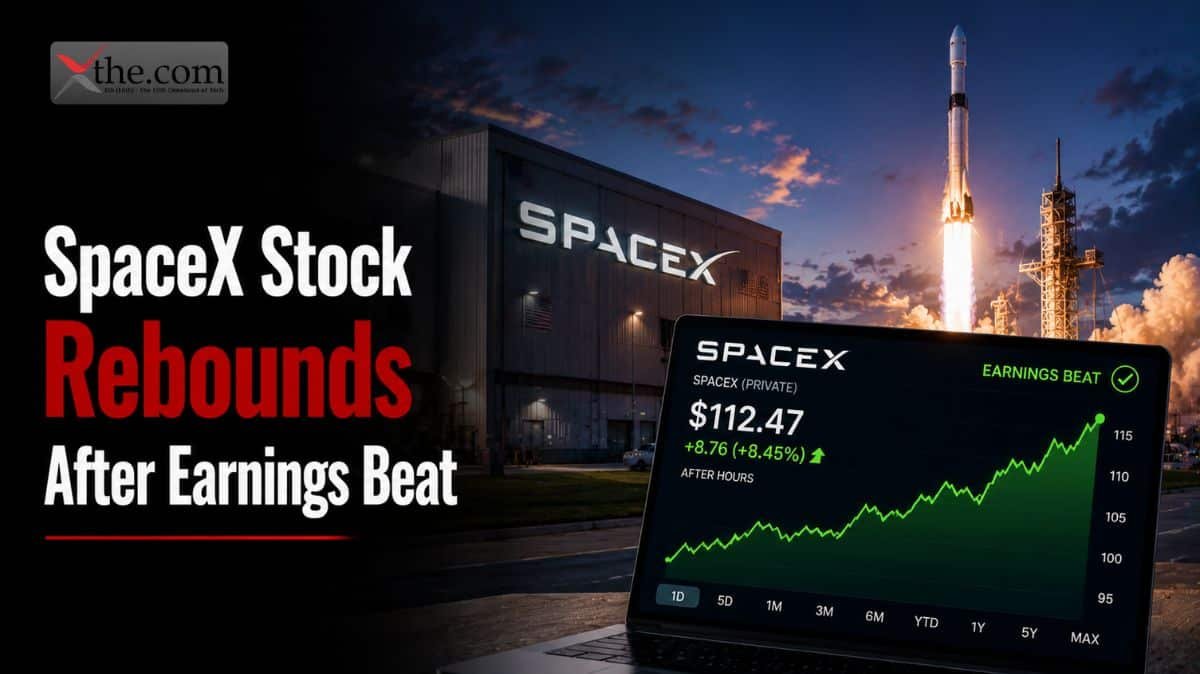
SpaceX, the rocket and satellite company founded by Elon Musk, saw its stock price climb above its initial public offering price for the first time on August 10, 2026. The stock, trading under the ticker SPCX on the Nasdaq, closed at 138.74 dollars per share, surpassing the 135 dollar IPO price.
The recovery comes after a turbulent period following the company historic IPO, which raised approximately 75 billion dollars and stands as the largest initial public offering in stock market history. After initially surging to an intraday high of 225.64 dollars on June 16, the stock experienced a prolonged decline before stabilizing.
Strong Earnings Report Drives Recovery
The primary catalyst for SpaceX stock recovery was its first-ever earnings report as a public company, released on August 4, 2026. Revenue came in at 7.81 billion dollars, representing a 92 percent increase compared to the same period last year and significantly beating the consensus estimate of 6.8 billion dollars.
The earnings report highlighted the continued explosive growth of Starlink, SpaceX satellite internet constellation. Starlink revenue now accounts for the majority of the company total income, driven by rapid subscriber growth across both consumer and enterprise markets.
Despite the strong revenue performance, SpaceX reported a net loss for the quarter, which is not unusual for the capital-intensive space industry. The company continues to invest heavily in its Starship rocket program, which aims to enable missions to Mars.
The IPO Journey
SpaceX path to the public markets was one of the most anticipated in financial history. The company had remained private for over two decades, during which time it revolutionized the space industry with reusable rockets and disrupted the satellite communications market with Starlink.
The IPO process was closely watched not only for its size but also for its political implications. Several members of the Trump administration were reported to hold significant positions in SpaceX stock, raising questions about potential conflicts of interest.
Starlink Growing Dominance
At the heart of SpaceX valuation story is Starlink, which has grown from an ambitious project to a major telecommunications provider. The satellite constellation now includes thousands of satellites providing internet coverage across much of the globe.
The service has also found traction in the enterprise market, providing connectivity for maritime operations, aviation, and emergency response. Government contracts for Starlink service have added another revenue stream.
The competitive landscape for satellite internet is intensifying, with Amazon Project Kuiper preparing to launch its own constellation. However, SpaceX significant head start gives it a substantial advantage.
What Analysts Are Saying
Wall Street analysts have expressed mixed views on SpaceX stock. Bulls point to the company dominant position in both launch services and satellite internet, arguing that the growth potential justifies a premium valuation.
Bears caution that the stock remains expensive relative to its current earnings. Even at reduced price levels, SpaceX trades at a significant premium to comparable companies.
The consensus among analysts is that SpaceX represents a high-risk, high-reward investment. The company technology leadership and market position are undeniable, but the valuation leaves little room for execution missteps.
Looking Ahead
SpaceX stock recovery above its IPO price marks an important milestone, but the company faces several key challenges in the coming months. The Starship program needs to demonstrate consistent operational success to justify the massive capital investment.
The key metric to watch will be SpaceX path to profitability. The company revenue growth is impressive, but sustained profitability will be necessary to justify its valuation over the long term.
The space economy is projected to grow significantly in the coming decades, and SpaceX is positioned to be a central player. Whether the stock can sustain its recovery and reach new highs will depend on the company ability to execute on its ambitious plans.
The significance of SpaceX recovery above its IPO price cannot be overstated. The rebound represents a vote of confidence from the market.
Starlink constellation of more than 6,000 satellites now provides internet service to customers in over 70 countries.
The revenue breakdown revealed that Starlink subscriber revenue has grown to represent more than 60 percent of total company revenue.
The Starship program represents the most ambitious rocket development program in history.
SpaceX government contracts provide a stable revenue base that complements the more volatile commercial launch market.
The competitive landscape in the launch industry is intensifying with Blue Origin, Rocket Lab, and United Launch Alliance.
For investors, the key question is whether the company can translate technological leadership into sustained financial performance.
The regulatory environment for commercial space operations is evolving rapidly, with SpaceX at the center of many important policy debates.
SpaceX workforce of more than 13,000 employees spans multiple states and encompasses rocket engineers, satellite technicians, and software developers.
The environmental impact of SpaceX operations has drawn scrutiny from conservation groups regarding rocket launch effects on local ecosystems.
For retail investors who bought SpaceX stock during the IPO, the journey above the IPO price represents a moment of vindication after months of paper losses.
The broader space industry is watching SpaceX performance as a bellwether for the commercial space economy. A successful transition to sustained profitability would validate the thesis that space can be a viable commercial enterprise.
The financial performance of SpaceX in the coming quarters will be closely watched by analysts and investors who are trying to determine whether the company can achieve sustained profitability while continuing to invest in ambitious programs like Starship and Starlink expansion.
For the broader technology sector, SpaceX success as a public company could encourage other major private technology companies to pursue IPOs, potentially unlocking significant value for employees and early investors who have been waiting for liquidity events.
The competitive landscape in the satellite internet market is expected to intensify further in the coming years, with Amazon Project Kuiper, OneWeb, and several Chinese companies all planning to deploy their own constellations. SpaceX first-mover advantage, however, remains substantial, as the company has already deployed thousands of satellites and built a global customer base.
Looking at the broader picture, SpaceX journey from a scrappy startup to one of the most valuable companies in the world is a testament to the power of visionary leadership and relentless execution. Elon Musk bet his fortune on the premise that reusable rockets and global satellite internet could transform both the space industry and the telecommunications market, and that bet is now paying off in spectacular fashion.
For the technology industry as a whole, SpaceX success story serves as both inspiration and warning. Inspiration because it demonstrates that truly transformative businesses can be built even in the most capital-intensive industries. Warning because it shows that the path to success is paved with enormous financial risks, technical challenges, and competitive threats that only the most determined and well-funded companies can survive.








