






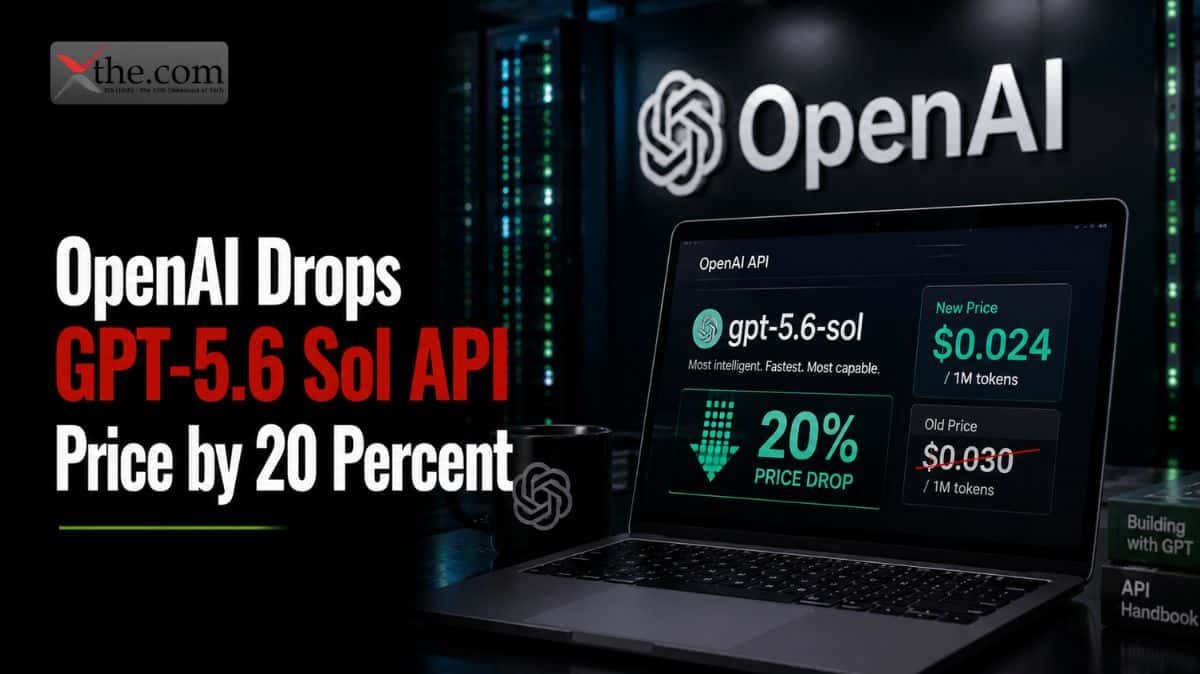
A Major Price Cut for Frontier AI
OpenAI has announced a significant price reduction for its most powerful AI model, GPT-5.6 Sol, cutting API costs by more than 20 percent for at least three months. The promotional pricing, which took effect on August 22, 2026, makes OpenAI frontier intelligence model significantly more affordable for developers, startups, and enterprises across the United States.
Under the new pricing structure, GPT-5.6 Sol now costs per million input tokens, down from , and 0 per million output tokens, a substantial 33 percent reduction from the previous 0 rate. The promotional window extends through November 21, 2026, giving developers a full three months to build and scale applications at the reduced rates.
The price cut applies to API access, Codex credits, and ChatGPT Pro subscriptions that use GPT-5.6 Sol. It represents OpenAI most aggressive pricing move since the launch of the GPT-5.6 family of models in July 2026.
Why OpenAI Is Cutting Prices Now
Several factors are driving OpenAI aggressive pricing strategy. The AI API market has become increasingly competitive in 2026, with multiple companies offering high-quality language models at lower price points. Anthropic Claude Opus 4.5, Google Gemini 2.5 Pro, and Meta open-source LLaMA 4 models all offer compelling alternatives.
Additionally, OpenAI is under pressure to demonstrate that its massive infrastructure investments can generate sustainable returns. The company reportedly spent over 5 billion on compute infrastructure in 2025, and investors are eager to see a path to profitability.
There is also a strategic dimension to the pricing cuts. By making GPT-5.6 Sol more affordable, OpenAI aims to lock in developers and businesses before they build applications on competing platforms. Once developers integrate a specific AI model into their products, switching costs are high.
Impact on the American AI Ecosystem
The price reduction is welcome news for US-based AI developers and businesses. AI API costs have been one of the biggest barriers to building AI-powered products, particularly for startups and small businesses. The new pricing makes it economically viable to build applications that would have been too expensive just months ago.
For example, a startup processing 100 million tokens per month on GPT-5.6 Sol would previously have paid approximately 00,000 monthly for input tokens alone. At the new rate, that same workload costs 00,000, a savings of 00,000 per month, or .2 million per year.
The impact extends beyond pure cost savings. Lower prices enable new categories of AI applications that were not economically feasible before. Real-time AI translation, continuous code review, automated customer service, and AI-powered content creation all become more viable.
What Developers Should Know
Developers looking to take advantage of the new pricing should note that the promotional rate is guaranteed through November 21, 2026, but OpenAI has indicated it may extend or make the pricing permanent depending on market conditions. The price reduction applies automatically to existing API keys.
GPT-5.6 Sol represents OpenAI most capable model, excelling at complex reasoning, code generation, creative writing, and analysis tasks. For cost-sensitive applications, the 80 percent reduction on GPT-5.6 Luna makes it an excellent option.
The AI Price War Heats Up
OpenAI pricing moves are part of a broader trend in the AI industry. As models become more capable and competition intensifies, prices are falling rapidly. Just two years ago, GPT-4 cost 0 per million input tokens, nearly eight times the new GPT-5.6 Sol price.
Lower costs mean more experimentation, more innovation, and ultimately more AI-powered products and services reaching American consumers. The competitive advantage enjoyed by large tech companies with massive compute budgets is eroding, opening the door for smaller players to compete.
The timing of the price cut is particularly significant. It comes just weeks after Alibaba released its latest AI model, which offered comparable performance to GPT-5.6 Sol at a fraction of the cost. The Chinese AI company aggressive pricing had threatened to undercut OpenAI in key markets, particularly in Asia and among cost-conscious developers worldwide.
OpenAI CEO Sam Altman addressed the pricing changes in a company blog post, writing that the goal is to make the most powerful AI tools accessible to everyone, not just the largest companies. He noted that the promotional pricing could become permanent if it drives sufficient adoption and usage growth.
The pricing reduction also affects ChatGPT Pro subscribers, who will see their monthly costs decrease as OpenAI passes along some of the API savings. This could help OpenAI retain subscribers who have been attracted by free or low-cost alternatives from competitors like Google and Anthropic.
Industry analysts at Gartner predict that AI API pricing will continue to fall throughout 2027 and beyond, potentially reaching levels where even small businesses and individual developers can afford to build sophisticated AI applications. This democratization of AI access could spark a new wave of innovation similar to what happened when cloud computing made server infrastructure affordable for startups.
The competitive dynamics in the AI model market have shifted dramatically in recent months. Meta continued release of increasingly capable open-source models has put pressure on all commercial AI providers, including OpenAI. Google Gemini 2.5 Pro has gained traction among developers who value its multimodal capabilities. And Anthropic Claude has carved out a niche among users who prioritize safety and alignment.
For the broader AI industry, falling model prices represent a double-edged sword. On one hand, lower costs make AI more accessible and could drive a surge in new applications and use cases. On the other hand, the race to the bottom on pricing could make it difficult for AI companies to achieve the sustainable profitability that investors are demanding.
The implications for American businesses are significant. As AI model costs continue to fall, companies that were previously unable to justify the expense of AI integration can now begin exploring these technologies. This could lead to a new wave of AI adoption across industries including healthcare, education, retail, and manufacturing, potentially boosting productivity and economic growth across the United States.
One notable aspect of OpenAI pricing strategy is its tiered approach. By offering three distinct models at different price points, Luna, Terra, and Sol, the company is able to serve a wider range of customers than a single one-size-fits-all offering would allow. This approach mirrors the pricing strategies used by cloud providers, who offer everything from basic to premium tiers of computing resources.
External Sources:
- OpenAI Blog: https://openai.com/index/gpt-5-6/








