






Seattle, Washington.
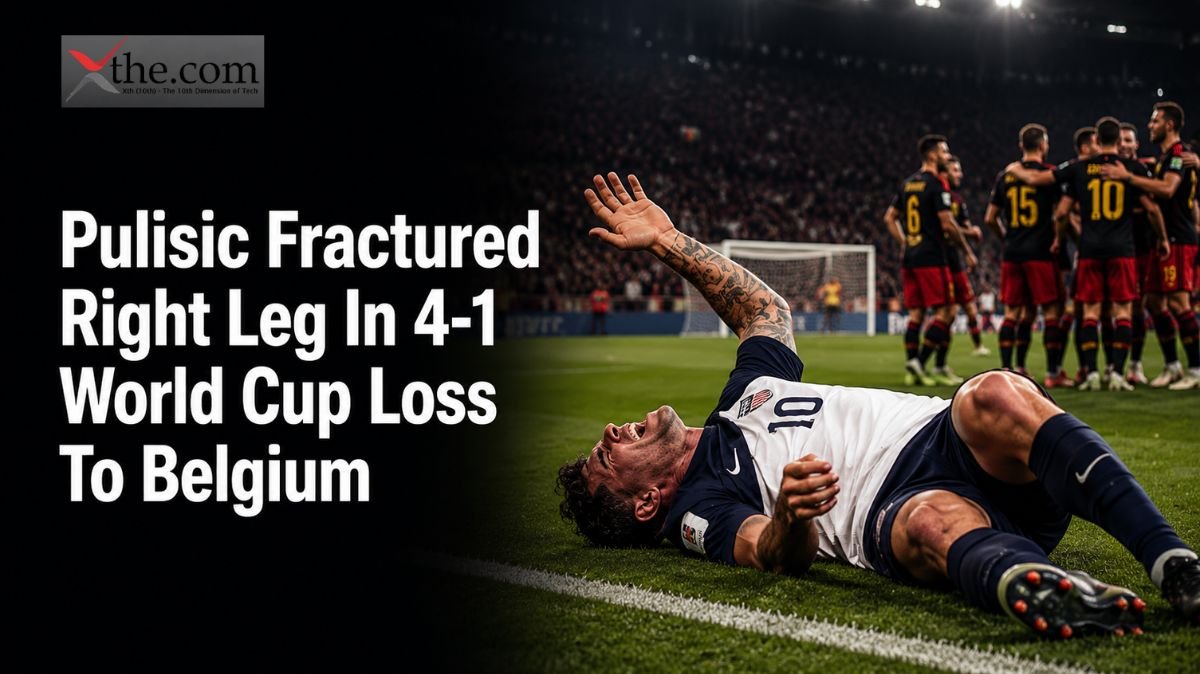
Thirty-three career goals, zero at the tournament that mattered most. That is the cruel arithmetic Christian Pulisic carries out of Seattle this week, and it is now a footnote to a far more serious story: Pulisic fractured leg in the USA 4-1 Belgium Round of 16 collapse, and the recovery clock is already running against AC Milan’s Serie A calendar.
On Thursday, the U.S. Soccer Federation confirmed what television replays had already hinted at three days earlier. Pulisic’s microfracture tibia-fibula damage in his right leg occurred during the second half of Monday’s match. The injury is serious enough to end his tournament and will require weeks of structured rehab before he can return to full training. As the team tries to understand how such a talented and well-funded roster exited the knockout stage so decisively, this injury turns a football failure into a business and health issue. It has real consequences for a European club, a domestic broadcaster, and a national federation now preparing for its next cycle lacking its most famous player.
What Happened in the 52nd Minute
The play happened quickly. Pulisic moved toward the box and took a shot, but his leg hit Belgium captain Youri Tielemans as he kicked the ball. He stayed on his feet and kept playing but was clearly limping until U.S. head coach Mauricio Pochettino decided to take him out. Sebastian Berhalter came on in the 59th minute, and the match continued with the U.S. struggling both in defense and attack.
By full time, the USA Belgium World Cup 2026 scoreline read 4-1, a result that ended the Americans’ run in the Round of 16 and triggered immediate scrutiny of team fitness management, tactical selection, and the physical strain of a compressed group-stage schedule. Pulisic had already entered the match fatigued from an earlier calf injury sustained in the opening group game against Paraguay, a detail that now reads less like bad luck and more like a pattern worth reviewing.
The Diagnosis Behind the Headline
Two days elapsed before the public understood the severity of what had happened on the pitch. An X-ray and MRI performed Tuesday confirmed that Pulisic had a microfracture of the tibia-fibula, alongside a bone bruise in his right leg. U.S. Soccer’s statement on Thursday made it clear: even if the team had advanced, the injury would have kept him out of any remaining matches. His tournament ended the moment his leg hit Tielemans’ shin.
Microfractures do not usually get as much attention as torn ligaments, but doctors treat them just as carefully. If improperly managed, a tibia-fibula microfracture can turn into a full stress fracture with repeated play. This risk is why U.S. Soccer and AC Milan quickly agreed on a joint recovery plan, instead of relying on informal coordination between club and country, which has caused problems between federations and European clubs in the past.
Why the AC Milan Timeline Matters
This is where the story shifts from a soccer injury to a genuine business calendar problem. Pulisic injury AC Milan planning now centers on one hard date: Torino, August 23, the opening fixture of Milan’s Serie A season. Pulisic AC Milan recovery August protocols will determine whether the club’s most productive attacking option in recent seasons is fit to start, come off the bench, or watch from the sideline as his fourth season in Italy begins.
Milan’s technical staff is guardedly optimistic that Pulisic can start training before the season opener. However, being able to train and being ready for a match are not the same. Clubs have learned the hard way that hurrying players back from bone injuries can lead to bigger problems. If a microfracture worsens during the season, it can mean more missed games than if the team had just waited an extra week during the preseason.
For Milan, the financial risk is real but not overwhelming. Pulisic is still under contract, and the August opener is just one of the thirty-eight league matches. The bigger concern is maintaining momentum: a winger like Pulisic needs to be sharp, and if his return is spreading over September rather than building up during preseason, his impact could be reduced.
A Program-Level Reckoning
Zoom out from the individual injury and a harder question emerges for U.S. Soccer. The USMNT’s 2026 World Cup exit comes after years of investment in player development and sports science and hopes built around Pulisic. He came into the tournament as the team’s all-time leading scorer with 33 goals, so his scoreless run through five matches—ending with a serious leg injury instead of a highlight—was especially disappointing for fans who expected more.
Now, federation officials must review familiar questions: Did the medical staff manage player fatigue well over five matches? Should Pulisic’s calf injury from the Paraguay game have led to more careful minutes later on? Did the team have enough other scorers to make up for Pulisic’s limited play? These questions are tough, and they will not be answered before the next World Cup cycle starts.
What Recovery Actually Looks Like
Recovering from this kind of bone injury usually happens in stages: first, a rest period to let the microfracture heal; then gradually adding weight-bearing exercises; followed by non-contact training; and finally full-contact and match practice. Fitting all of this into the six weeks before Milan’s Serie A opener is possible, but it will be a challenge. Pulisic will need to regain match fitness and heal his bone, not just pass a single medical test.
The phrase now trending in sports coverage—“Christian Pulisic fractured right leg USA 4-1 Belgium World Cup Round of 16 Seattle July 2026”—captures a moment that will probably shape how this tournament is remembered in American soccer, no matter what happens next. Belgium, now ranked No. 3, will play Spain in the quarterfinals, drawing plenty of attention, while Pulisic starts the quieter, less visible process of recovery.
No matter how this World Cup cycle is judged, the main story now shifts to a training room in Italy instead of a stadium in Seattle. The phrase “Pulisic microfracture tibia fibula recovery timeline AC Milan Serie A return August 2026” will likely be a top soccer search for the rest of the summer. How closely Pulisic’s return matches that timeline will reflect not only his own resilience but also the strength of American soccer’s medical system. Milan’s opener against Torino now means more than just three points.
Source: U.S. star Christian Pulisic suffered microfracture vs. Belgium








